


MS31 trihydrochloride
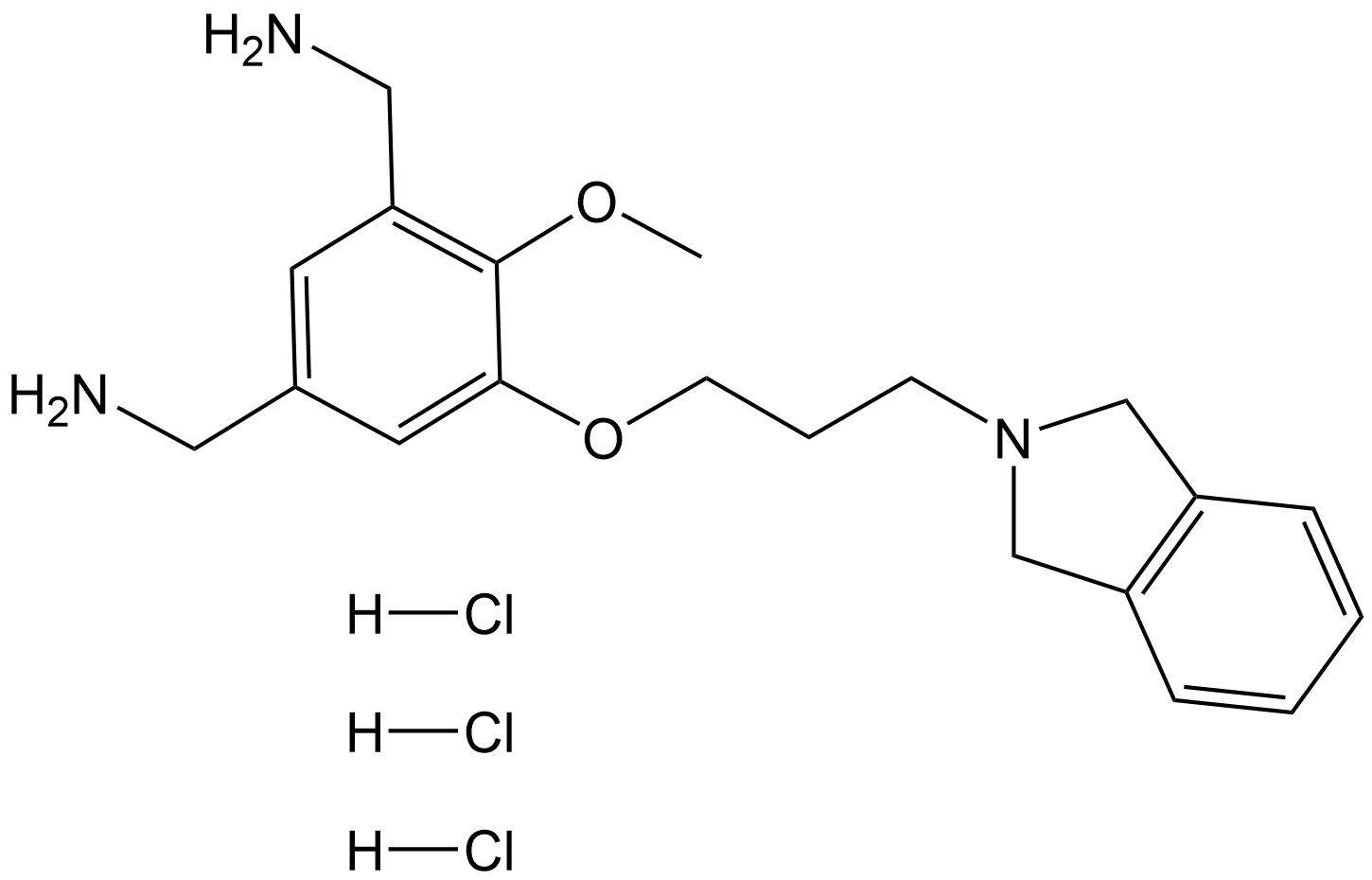
MS31 trihydrochloride (CAS No.: 2748239-18-9) is the trihydrochloride salt form of MS31 (CAS No.: 2366264-12-0). MS31 is an inhibitor of the epigenetic reader protein Spindlin-1 (SPIN1), acting by inhibiting the interaction between Spindlin-1 and the histone H3K4me3 methyl mark (inhibition of the Spindlin-1–H3K4me3 interaction, IC50 = 77 nM); Spindlin-1 participates in rRNA transcription (by recruiting RNA polymerase I via the Spindlin-1/C11orf84 complex), cell-cycle progression, and signaling pathways such as WNT/TCF-4, PI3K-Akt, and RET (via GDNF) by recognizing histone methylation marks (H3K4me3/K9me3, H4K20me3). It is highly expressed in multiple tumors and promotes tumor cell proliferation, migration, and invasion; therefore, MS31 is studied as an antitumor candidate compound.
In vitro experiments show that MS31 exhibits cell type-dependent cytotoxicity toward human primary immune cells, with IC50 values ranging approximately from 11–3122 µM (higher toxicity toward CD4⁺ T cells and B cells, with IC50 values of approximately 11–22 µM; IC50 values for M1/M2 macrophages are markedly higher than those for lymphocytes, and the IC50 for monocytes is similar to that of A366); regarding commonly used concentrations in functional experiments, 0–50 µM is used in macrophage polarization experiments (MS31 can shift M1 cells toward an M2 phenotype, significantly inhibit IL-8 release and upregulate IFNγ, CD163/TREM2, and weaken the phenotype of pre-differentiated M2 macrophages, reducing PGE2, IL-10, and CCL2 release and increasing CCL18), 0–10 µM is used in CD4⁺ T-cell activation experiments (with no obvious effect on proliferation, activation, or energy metabolism), and in B-cell experiments, concentrations as low as 2.5 µM can markedly inhibit B-cell activation (concentration-dependently reducing proliferation, plasmablast formation, and IgG/IgA release, one of the lowest effective functional concentrations reported in this paper, mainly inhibiting CpG-mediated innate B-cell responses).
Among the above IC50 values, 77 nM refers to the biochemical inhibition of the Spindlin-1–H3K4me3 interaction, whereas the µM-level values are cytotoxicity IC50 values from 48-hour viability assays in primary immune cells; the two should not be confused. The effective concentration of MS31 at the cellular level is much higher than its biochemical IC50, suggesting that higher concentrations may be required for it to exert effects inside cells.
References:
[1] Schiffmann S, Henke M, Weber F, Parnham MJ. Immune-modulatory effects of Spindlin-1 inhibitors. Clin Exp Immunol. 2025 Jan 21;219(1):uxaf013. doi: 10.1093/cei/uxaf013. PMID: 40512144; PMCID: PMC12164290.
| Storage | 4℃, sealed storage, away from moisture |
| M.Wt | 450.83 |
| Cas No. | 2748239-18-9 |
| Formula | C20H27N3O2·3HCl |
| Chemical Name | (5-(3-(isoindolin-2-yl)propoxy)-4-methoxy-1,3-phenylene)dimethanamine trihydrochloride |
| Canonical SMILES | NCC1=CC(CN)=C(OC)C(OCCCN2CC(C=CC=C3)=C3C2)=C1.[H]Cl.[H]Cl.[H]Cl |
| Shipping Condition | Small Molecules with Blue Ice, Modified Nucleotides with Dry Ice. |
| General tips | We do not recommend long-term storage for the solution, please use it up soon. |