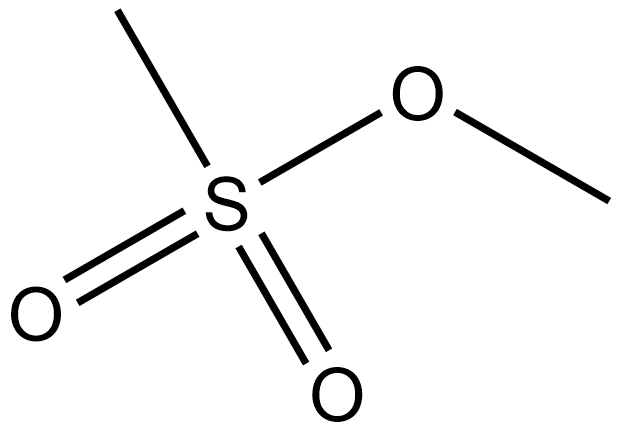
Methyl methanesulfonate
Methyl methanesulfonate (CAS No.: 66-27-3) is a synthetic small molecule alkylating biochemical reagent that is broadly categorized as a genotoxic stress inducer and DNA damaging research tool in life sciences and drug discovery workflows, with no known natural biological origin and primary utility in experimental systems that interrogate genome stability, DNA repair capacity, and cellular stress adaptation. Mechanistically, it functions as a direct methylating agent that transfers methyl groups to nucleobases, with well established formation of lesions such as 3 methyladenine and 7 methylguanine, which promote base pairing errors, replication fork impediment, and downstream activation of DNA damage response networks; these effects are commonly linked to base excision repair processes and associated signaling axes involving damage sensing, checkpoint control, and replication stress response pathways. In vitro, MMS is widely used as a positive control or challenge agent in cell based assays, where active concentrations are typically applied in the low micromolar to millimolar range depending on cell type, exposure duration, and assay endpoint, while potency metrics such as IC50 or EC50 are context dependent and often reported as broad ranges rather than fixed universal values. In biomedical research practice, this compound is routinely employed to model alkylation mediated DNA injury in cultured mammalian cells, microbial systems, and other laboratory models, and it is also used in mechanistic screening paradigms to evaluate candidate modulators of DNA repair, cell cycle regulation, and stress tolerance; in selected preclinical animal research settings it can serve as an experimental genotoxicant to study tissue level responses under controlled protocols, with the concentrations or doses used in experiments typically depending on specific experimental designs and research objectives.
| Storage | -20°C for 2 years |
| M.Wt | 110.13 |
| Cas No. | 66-27-3 |
| Formula | C2H6O3S |
| Solubility | ≥19.5 mg/mL in DMSO; ≥12.8 mg/mL in EtOH; ≥7 mg/mL in H2O |
| Chemical Name | methyl methanesulfonate |
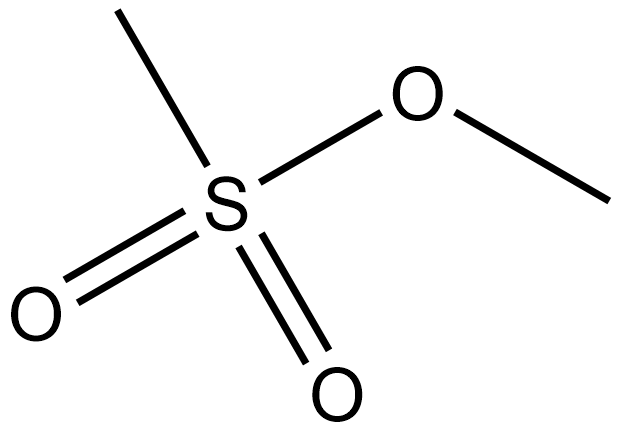
| Canonical SMILES | O=S(=O)(OC)C |
| Shipping Condition | Small Molecules with Blue Ice, Modified Nucleotides with Dry Ice. |
| General tips | We do not recommend long-term storage for the solution, please use it up soon. |
Quality Control & MSDS
- View current batch:
Chemical structure