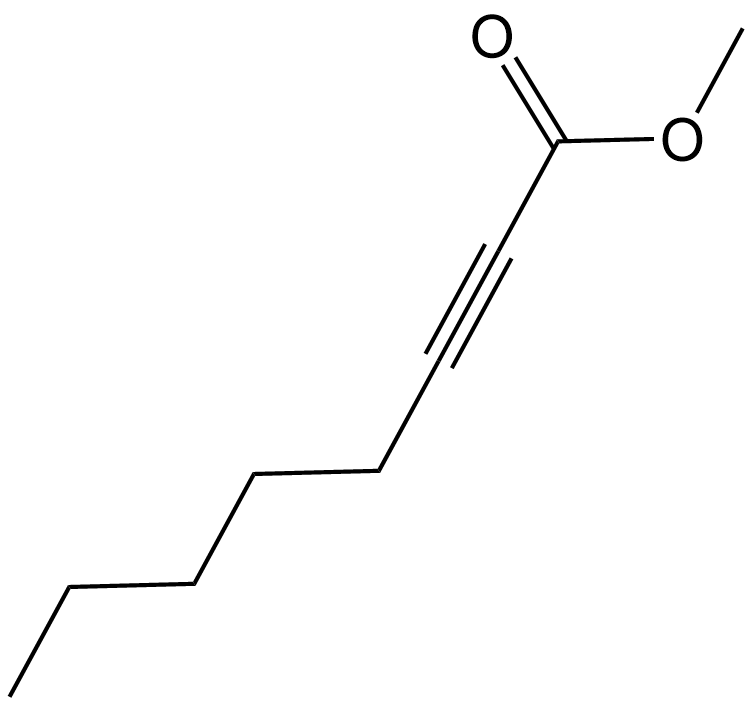
Methyl 2-Octynoate
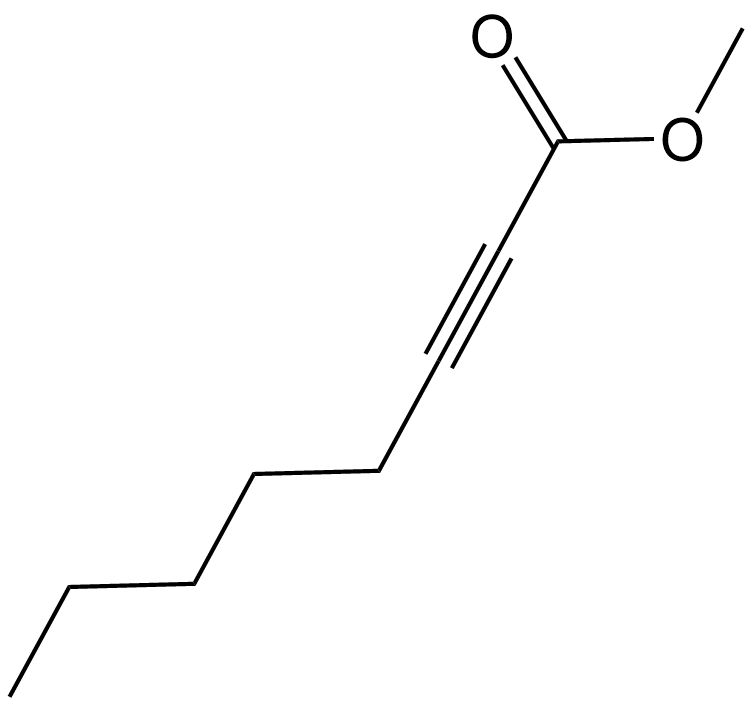





The core biological functions of Methyl 2-Octynoate (CAS No. 111-12-6) are as a synthetic fragrance ingredient (with a green leafy plant odor, used in cosmetics, perfumes, etc.) and a strong skin sensitizer; it also shows potential neuroprotective and anti-inflammatory activity in in vitro Alzheimer's disease (AD) models. Targets and mode of action: acts as a Michael acceptor reacting with cysteine residues, activates the Nrf2 signaling pathway (upregulating Hmox1 gene and HMOX1 protein expression), inhibits lipopolysaccharide (LPS)-induced iNOS protein expression (anti-inflammatory), and can also regulate mitochondrial calcium homeostasis and membrane potential via an Nrf2-independent pathway. EC50-related data: mouse local lymph node assay (LLNA) EC3 value 0.45% (112.5 μg/cm2, sensitization assessment), Daphnia magna 48 h immobilization EC50 0.62 mg/L, algae 72 h growth inhibition EyC50 0.32 mg/L/ErC50 0.33 mg/L. Animal studies can be used for LLNA evaluation of skin sensitization, and an in vivo micronucleus test in mice with intraperitoneal injection of 168–505 mg/kg (non-mutagenic). Common concentrations in cell culture: N2a (AD neuronal model) 100 μM, BV-2 (microglial cells) 200 μM (both are non-toxic experimental concentrations), Ames test up to 3.6 mg/plate. Clinical and application-related concentrations: maximum permitted concentration in cosmetics 0.01% (≤0.002% when used in combination with methyl octyn carbonate), patch testing commonly 1%–2% (but >1% may induce active sensitization; recommended safe concentration < 1%), no expected sensitization induction level (NESIL) 110 μg/cm2. Potential effective concentrations: in in vitro AD models, 100 μM (neurons) and 200 μM (microglia) can exert antioxidant, anti-inflammatory, and mitochondrial protective effects; there is no clinical therapeutic concentration, and it is mainly used in fragrance formulations and toxicology research.
References:
[1] Heisterberg MV, Vigan M, Johansen JD. Active sensitization and contact allergy to methyl 2-octynoate. Contact Dermatitis. 2010 Feb;62(2):97-101. doi: 10.1111/j.1600-0536.2009.01664.x. PMID: 20136892.
[2] Api AM, Belsito D, Biserta S, Botelho D, Bruze M, Burton GA Jr, Buschmann J, Cancellieri MA, Dagli ML, Date M, Dekant W, Deodhar C, Fryer AD, Gadhia S, Jones L, Joshi K, Lapczynski A, Lavelle M, Liebler DC, Na M, O'Brien D, Patel A, Penning TM, Ritacco G, Rodriguez-Ropero F, Romine J, Sadekar N, Salvito D, Schultz TW, Siddiqi F, Sipes IG, Sullivan G, Thakkar Y, Tokura Y, Tsang S. RIFM fragrance ingredient safety assessment, methyl 2-octynoate, CAS Registry Number 111-12-6. Food Chem Toxicol. 2019 Dec;134 Suppl 2:110825. doi: 10.1016/j.fct.2019.110825. Epub 2019 Sep 19. PMID: 31542434.
[3] Silva A, Pereira M, Carrascal MA, Brites G, Neves B, Moreira P, Resende R, Silva MM, Santos AE, Pereira C, Cruz MT. Calcium Modulation, Anti-Oxidant and Anti-Inflammatory Effect of Skin Allergens Targeting the Nrf2 Signaling Pathway in Alzheimer's Disease Cellular Models. Int J Mol Sci. 2020 Oct 21;21(20):7791. doi: 10.3390/ijms21207791. PMID: 33096789; PMCID: PMC7594024.
| Storage | Store at -20°C |
| M.Wt | 154.21 |
| Cas No. | 111-12-6 |
| Formula | C9H14O2 |
| Synonyms | Folione; Methyl pentylacetylenecarboxylate; NSC 72098 |
| Solubility | ≥14.6 mg/mL in DMSO; ≥27.2 mg/mL in EtOH; ≥29.2 mg/mL in H2O |
| Chemical Name | methyl oct-2-ynoate |
| Canonical SMILES | O=C(C#CCCCCC)OC |
| Shipping Condition | Small Molecules with Blue Ice, Modified Nucleotides with Dry Ice. |
| General tips | We do not recommend long-term storage for the solution, please use it up soon. |
Quality Control & MSDS
- View current batch:
Chemical structure