


Methenamine mandelate
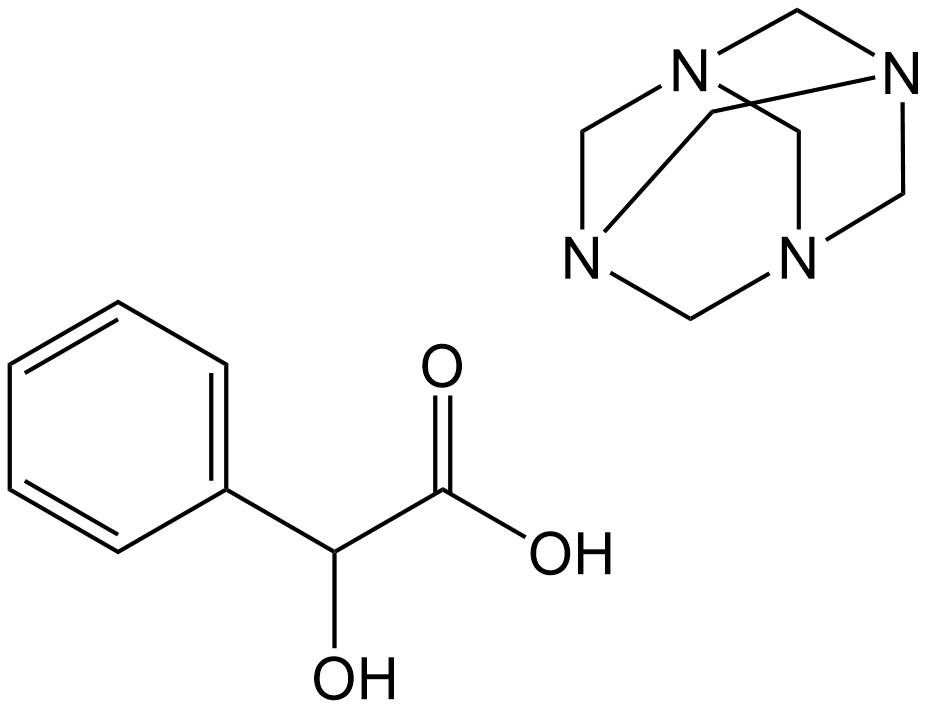
Methenamine mandelate (CAS No.: 587-23-5) is a double salt formed from methenamine (CAS No.: 100-97-0) and mandelic acid, with two core activities: urinary tract antibacterial activity and antitumor activity, both of which are highly dependent on an acidic environment.
Classical urinary tract antibacterial activity: Its antibacterial effect depends on an acidic urinary environment with an average pH of 5.5~6.8. After entering the urinary tract, the double salt decomposes to release methenamine and free mandelic acid; under acidic conditions, methenamine is hydrolyzed and converted into formaldehyde, exerting a bactericidal effect through nonspecific alkylation; free mandelic acid acts in the form of an undissociated organic acid through the Rosenheim mechanism to exert bacteriostatic / bactericidal activity. The two act synergistically to achieve urinary tract antibacterial effects and are not prone to inducing bacterial resistance, making it a classic clinical drug used for long-term bacteriostatic treatment of chronic and recurrent urinary tract infections.
Antitumor activity of pH-sensitive nan formulations: When co-loaded with sodium bicarbonate into PLGA nanoparticles, the nanoparticles can enter tumor cells via the endosomal / lysosomal pathway; in the acidic environment of lysosomes at pH≈5.0, sodium bicarbonate reacts with protons to generate CO₂ bubbles, rupturing the nanoparticles and enabling rapid burst release of the drug; the released drug is rapidly converted into sufficient formaldehyde in the acidic environment, inducing DNA damage in tumor cells and activating the DNA damage response pathway, ultimately causing tumor cell cycle arrest, growth inhibition, and apoptosis. In vivo, it can significantly inhibit the growth of MCF-7 breast cancer xenograft tumors, realizing an antitumor function through repurposing an old drug.
In addition, this drug can be secreted into breast milk in small amounts. At conventional doses, no obvious adverse effects on newborns have been observed during lactation, indicating a certain degree of safety for use during breastfeeding.
References:
[1] Drugs and Lactation Database (LactMed®) [Internet]. Bethesda (MD): National Institute of Child Health and Human Development; 2006–. Methenamine Mandelate. 2021 Jan 18. PMID: 30000080.
[2] Zhang L, Hao W, Xu L, Gao Y, Wang X, Zhu D, Chen Z, Zhang X, Chen H, Mei L. A pH-sensitive methenamine mandelate-loaded nanoparticle induces DNA damage and apoptosis of cancer cells. Acta Biomater. 2017 Oct 15;62:246-256. doi: 10.1016/j.actbio.2017.08.019. Epub 2017 Aug 16. PMID: 28822844.
| Storage | Store at -20°C |
| M.Wt | 292.33 |
| Cas No. | 587-23-5 |
| Formula | C6H12N4 · C8H8O3 |
| Chemical Name | 1,3,5,7-tetraazaadamantane 2-hydroxy-2-phenylacetate |
| Canonical SMILES | O=C(O)C(O)C=1C=CC=CC1.N12CN3CN(C1)CN(C2)C3 |
| Shipping Condition | Small Molecules with Blue Ice, Modified Nucleotides with Dry Ice. |
| General tips | We do not recommend long-term storage for the solution, please use it up soon. |