


Lucigenin
Lucigenin (CAS No.: 2315-97-1) is a synthetic chemiluminescent and fluorescent probe widely employed in biomedical research for the detection of reactive oxygen species, particularly superoxide anion radicals, in enzymatic systems and living cells. Functioning as a redox-active reporter, it undergoes electron transfer reactions that generate measurable luminescent signals, enabling the monitoring of oxidative stress and free radical production across diverse biological contexts, including NADPH oxidase activity in phagocytes, endothelial cells, fibroblasts, and vascular smooth muscle cells, as well as enzymatic sources such as xanthine oxidase and microsomal reductases. In addition to its role in superoxide detection, Lucigenin exhibits pronounced sensitivity to chloride ions, with its fluorescence being efficiently quenched upon chloride binding, making it a useful indicator for chloride flux and ion transport studies; its excitation and emission maxima at approximately 455 nm and 505 nm, respectively, facilitate integration into fluorescence-based assays. Although broadly applied, it is recognized that Lucigenin-derived signals may not be fully selective for specific ROS-generating pathways and can also respond to other oxidants such as hydrogen peroxide, which should be considered in experimental interpretation. Typically utilized in cell-based assays, isolated tissue preparations, and biochemical systems, Lucigenin supports studies of oxidative stress mechanisms, redox signaling, and ion homeostasis, with experimental concentrations generally falling within low micromolar to higher micromolar ranges depending on assay sensitivity and design.
| Physical Appearance | A crystalline solid |
| Storage | -20°C |
| M.Wt | 510.5 |
| Cas No. | 2315-97-1 |
| Formula | C28H22N4O6 |
| Synonyms | L- 6,868; NSC 151912 |
| Solubility | insoluble in EtOH; insoluble in H2O; ≥11.2 mg/mL in DMSO |
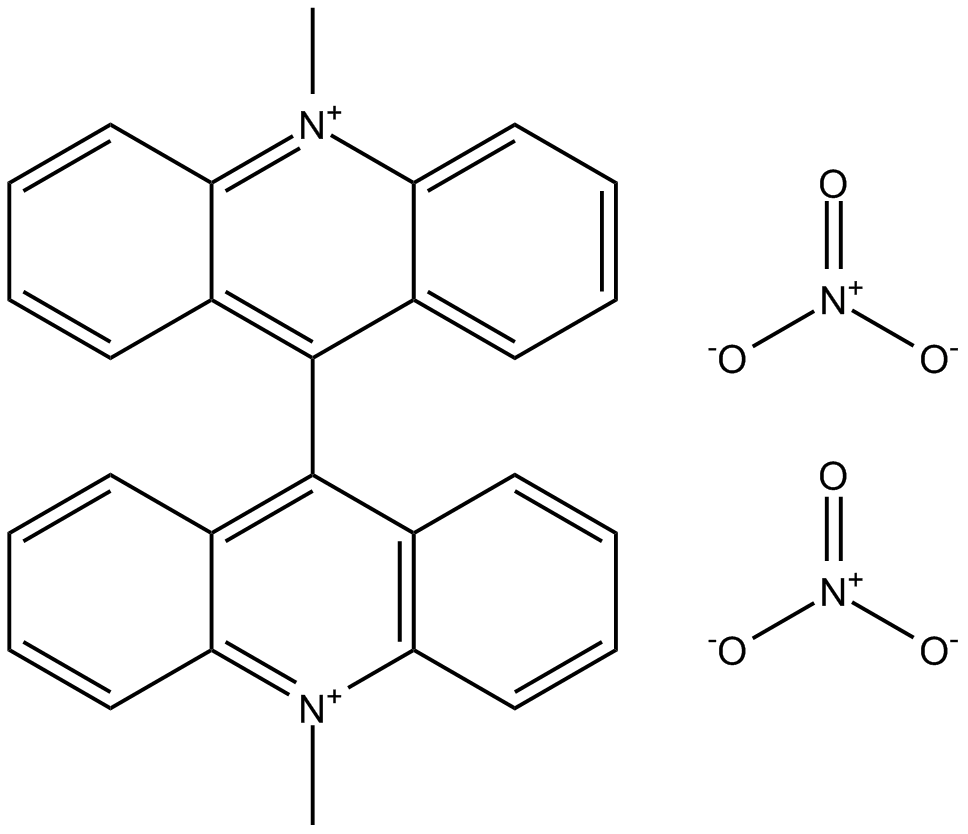
| Chemical Name | 10,10'-dimethyl-[9,9'-biacridine]-10,10'-diium nitrate |
| Canonical SMILES | C[N+]1=C2C(C=CC=C2)=C(C3=C4C(C=CC=C4)=[N+](C5=CC=CC=C53)C)C6=C1C=CC=C6.O=[N+]([O-])[O-].O=[N+]([O-])[O-] |
| Shipping Condition | Small Molecules with Blue Ice, Modified Nucleotides with Dry Ice. |
| General tips | We do not recommend long-term storage for the solution, please use it up soon. |