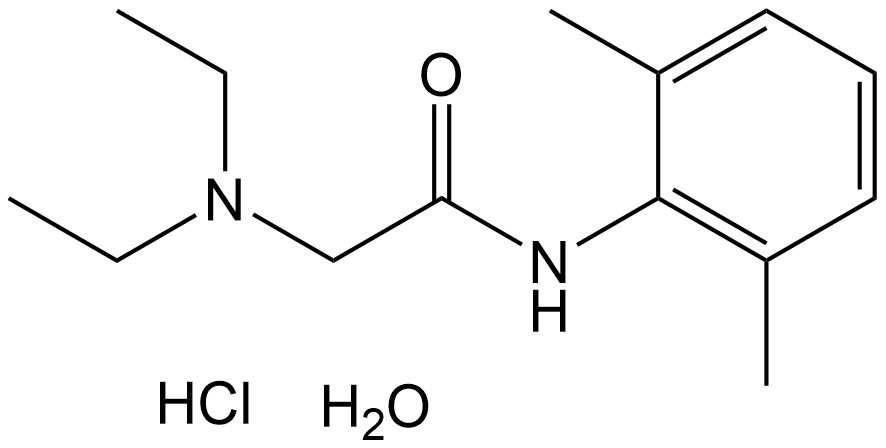
Lidocaine hydrochloride hydrate
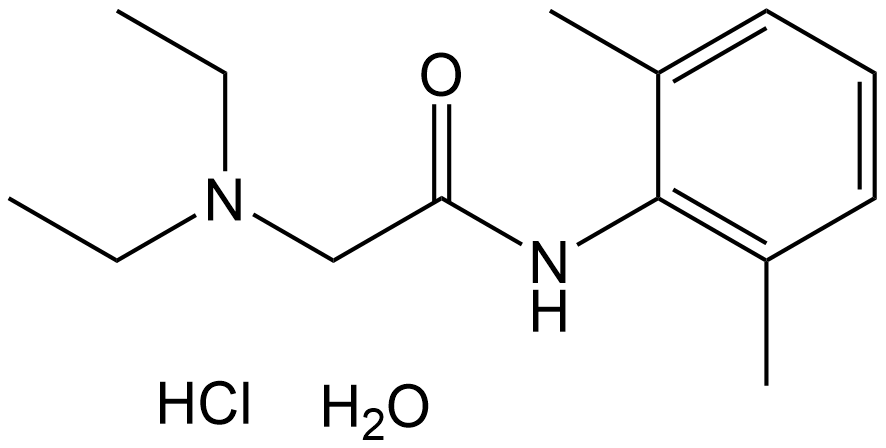
Lidocaine hydrochloride monohydrate (CAS 6108-05-0) is a dual-target small molecule that concurrently inhibits TRPM7 ion channels and voltage-gated sodium channels. It suppresses TRPM7 currents in a dose-dependent and use/frequency-dependent but voltage-independent manner (IC₅₀ ≈ 11 mM in primary cortical neurons and TRPM7-overexpressing HEK293 cells), and produces voltage- and use-dependent block of voltage-gated sodium channels by binding to the S4 segments in domains III and IV of the channel and cooperating with the fast inactivation gate (IC₅₀ for sodium current inhibition ≈ 204 μM). Consequently, it modulates TRPM7-mediated Zn²⁺ influx/accumulation, Mg²⁺ homeostasis, neurotransmitter release, and neuronal survival pathways under ischemic/hypoxic conditions, as well as action potential initiation and propagation mediated by voltage-gated sodium channels. In experimental use, typical concentrations in cell culture are 1–30 mM (10 mM markedly suppresses TRPM7-mediated intracellular zinc accumulation and alleviates neuronal zinc toxicity), while in animal studies 1% lidocaine administered by local infiltration around the rat tail nerve rapidly induces reversible blockade of thermal and mechanical nociception. Clinically, micromolar concentrations that inhibit voltage-gated sodium channels underlie its over 60 years of use as a classic local anesthetic and anti-ventricular arrhythmic agent, whereas the millimolar concentrations required for TRPM7 inhibition are far above the clinically safe plasma range; plasma levels >200 μM can induce central toxicity such as coma and respiratory depression, and it is therefore not yet suitable as a direct clinical intervention for stroke.
References:
[1] Cummins TR. Setting up for the block: the mechanism underlying lidocaine's use-dependent inhibition of sodium channels. J Physiol. 2007 Jul 1;582(Pt 1):11. doi: 10.1113/jphysiol.2007.136671. Epub 2007 May 24. PMID: 17525109; PMCID: PMC2075285.
[2] Leng TD, Lin J, Sun HW, Zeng Z, O'Bryant Z, Inoue K, Xiong ZG. Local anesthetic lidocaine inhibits TRPM7 current and TRPM7-mediated zinc toxicity. CNS Neurosci Ther. 2015 Jan;21(1):32-9. doi: 10.1111/cns.12318. Epub 2014 Aug 28. PMID: 25169754; PMCID: PMC6495118.
[3] Li Z, Chai Y, Gong C, Du G, Liu J, Yang J. Evaluation of the antinociceptive effects of lidocaine and bupivacaine on the tail nerves of healthy rats. Basic Clin Pharmacol Toxicol. 2013 Jul;113(1):31-6. doi: 10.1111/bcpt.12061. Epub 2013 Apr 6. PMID: 23506425.
| Storage | 4℃, sealed storage, away from moisture and light |
| M.Wt | 288.81 |
| Cas No. | 6108-05-0 |
| Formula | C14H22N2O.HCl.H2O |
| Synonyms | Lignocaine hydrochloride hydrate;Petercaine;Zingo |
| Solubility | ≥50.4 mg/mL in DMSO; ≥50.9 mg/mL in EtOH; ≥51.3 mg/mL in H2O |
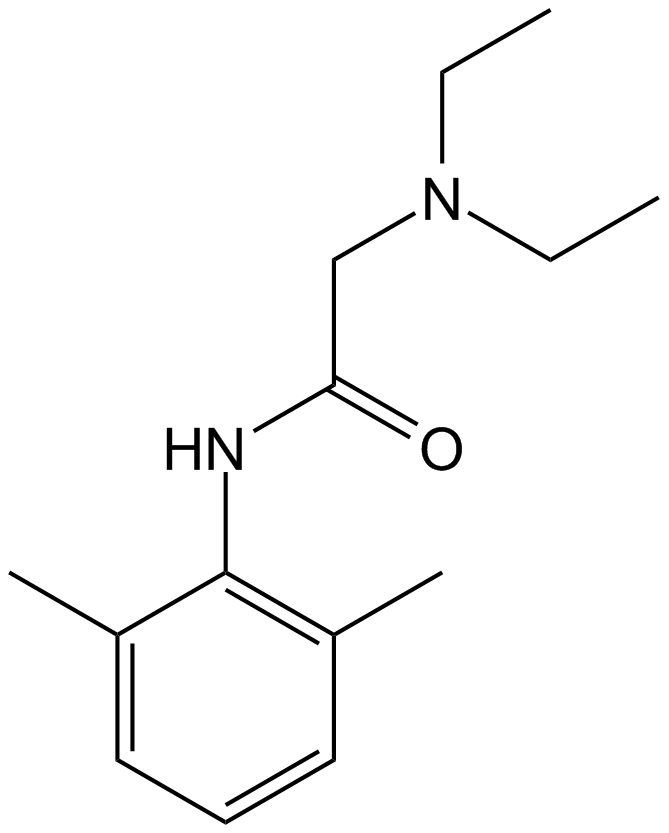
| Chemical Name | 2-(diethylamino)-N-(2,6-dimethylphenyl)acetamide hydrochloride hydrate |
| Canonical SMILES | Cl.O=C(NC=1C(=CC=CC1C)C)CN(CC)CC.O |
| Shipping Condition | Small Molecules with Blue Ice, Modified Nucleotides with Dry Ice. |
| General tips | We do not recommend long-term storage for the solution, please use it up soon. |
Quality Control & MSDS
- View current batch:
Chemical structure