


L-Selenocystine
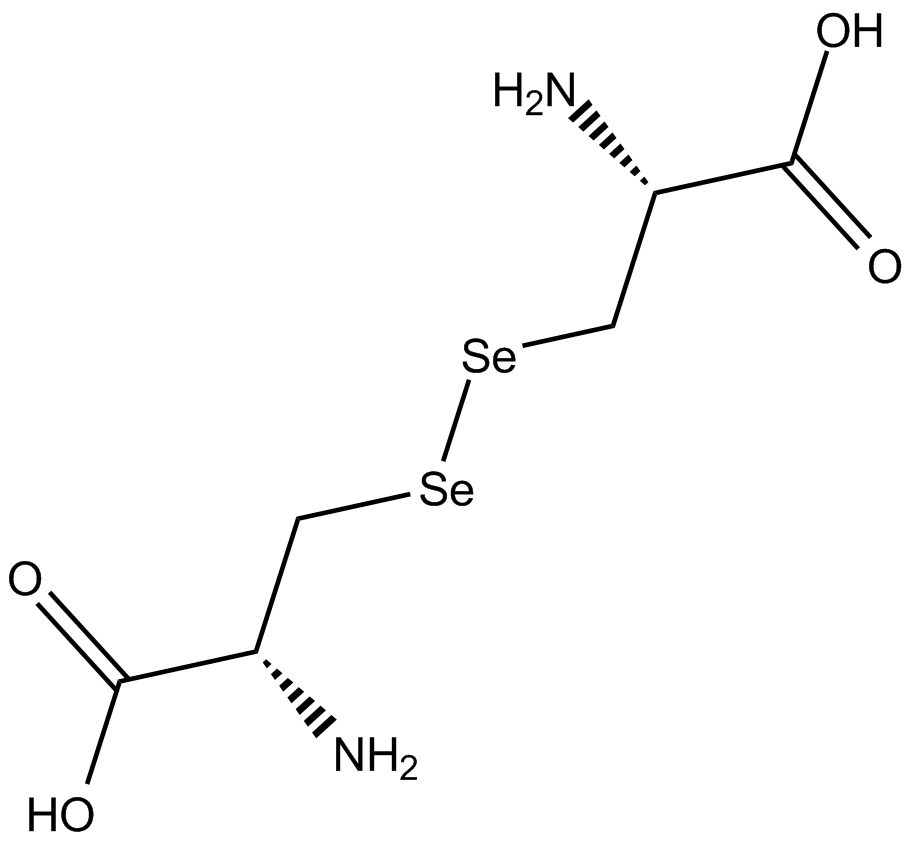
L-Selenocystine (CAS No.: 29621-88-3) is a redox-active, selenium-containing amino acid and diselenide-bridged small molecule widely utilized in biomedical research to investigate oxidative stress, protein folding homeostasis, and cancer biology. Functioning as both a pro-oxidant and antioxidant depending on cellular context, it modulates intracellular redox balance through interactions with thiol-dependent systems and can be reduced to selenocysteine by thioredoxin reductase, making it a useful probe for studying this enzyme and related redox pathways. L-Selenocystine has been shown to induce reactive oxygen species generation, trigger apoptosis, and exert cytotoxic and cytostatic effects across multiple tumor cell lines, typically at low micromolar concentrations, while also inhibiting proliferation. Mechanistically, it activates the unfolded protein response and endoplasmic reticulum stress, leading to pronounced cytoplasmic vacuolization in cells such as HeLa, and has been reported to interfere with Nrf2 signaling and autophagy pathways, thereby influencing cellular stress adaptation and survival mechanisms. Due to these properties, it is broadly applied in studies of redox regulation, ER stress signaling, and anticancer drug discovery, where experimental concentrations and treatment regimens are adjusted according to specific cell models and research objectives.
| Physical Appearance | A solid |
| Storage | -20°C |
| M.Wt | 334.09 |
| Cas No. | 29621-88-3 |
| Formula | C6H12N2O4Se2 |
| Synonyms | Seleno-L-cystine |
| Solubility | insoluble in DMSO; insoluble in EtOH; insoluble in H2O |
| Chemical Name | (2R,2'R)-3,3'-diselanediylbis(2-aminopropanoic acid) |
| Canonical SMILES | OC([C@@H](N)C[Se][Se]C[C@H](N)C(O)=O)=O |
| Shipping Condition | Small Molecules with Blue Ice, Modified Nucleotides with Dry Ice. |
| General tips | We do not recommend long-term storage for the solution, please use it up soon. |