


L-Rhamnose monohydrate
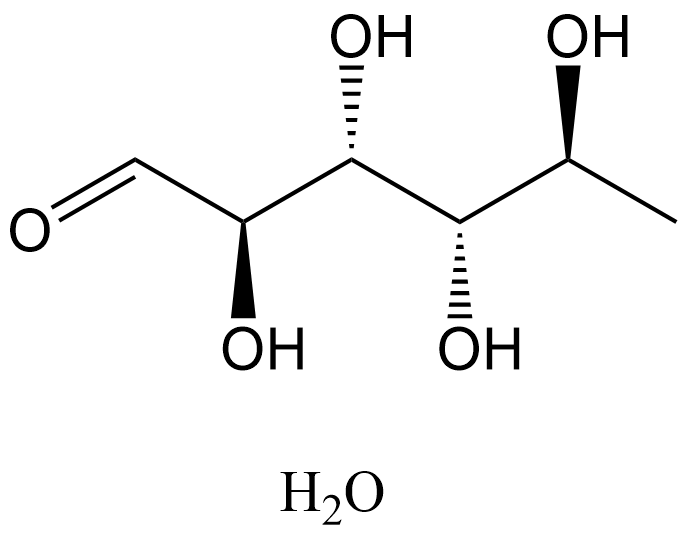
L-rhamnose monohydrate (L-rhamnose monohydrate, CAS No.: 10030-85-0) is a naturally occurring 6-deoxyhexose compound that can bind to the carbohydrate recognition domain of galectin-9 (LGALS9) as a ligand (molecular docking-predicted binding energy of −5.6 kcal/mol). It inhibits elastase, hyaluronidase, and collagenase, which are associated with skin aging, and can also act on α-L-rhamnose-recognizing lectin-like receptors on the surface of human dermal fibroblasts to mediate signal transduction. In addition, as a core sugar component of the O antigen of Gram-negative bacteria and the cell wall of Mycobacterium tuberculosis, it can be recognized by innate immune pattern recognition receptors and activate immune responses.
This compound is involved in multiple biological pathways: skin extracellular matrix remodeling and anti-aging pathways, where it reduces extracellular matrix degradation by inhibiting the expression of matrix metalloproteinases MMP-1 and MMP-2 and promoting type I collagen synthesis, while downregulating levels of pro-inflammatory factors such as IL-6 and IL-8, thereby exerting anti-glycation, anti-inflammatory, and skin anti-aging effects; immunomodulatory and antitumor pathways, where it can regulate LGALS9-mediated immune responses, and can also serve as a structural component of medicinal plant polysaccharides to mediate immune activation in the body, inhibit tumor cell proliferation, and exert direct antitumor effects by reducing the mitotic activity of tumor cells.
In terms of quantitative activity parameters: at the purified enzyme level, it can inhibit hyaluronidase activity by 60%~70% at concentrations of 0.25~100 mM, inhibit elastase activity by 23% at 1 mM, and show a weak inhibition rate of approximately 15% against collagenase at 25~100 mM; in animal antitumor experiments, in an Ehrlich solid carcinoma mouse model administered by intraperitoneal injection for 10 days, the tumor growth inhibition rate reached 62% at a dose of 3 g/kg/day, and continuous administration for 14 days prolonged the survival of tumor-bearing mice, with the optimal antitumor dose estimated at 3.64 g/kg/day.
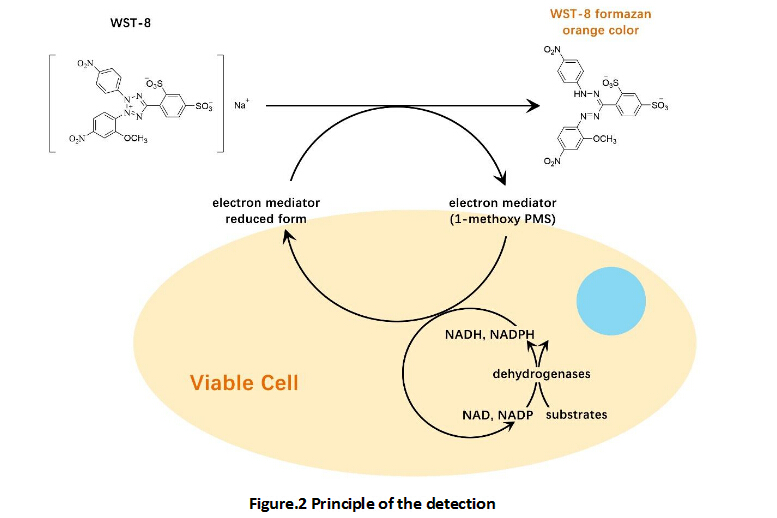
Cell-level applications: in normal human dermal fibroblast experiments, subcytotoxic concentrations of 1 mM and 10 mM are commonly used (corresponding cell viabilities of 88% and 78%, respectively) to evaluate skin anti-aging activity. It can reduce MMP-1 and MMP-2 levels, promote type I collagen production, and downregulate inflammatory factor levels in young and physiologically aged fibroblasts; meanwhile, as a constituent monosaccharide of various medicinal plant polysaccharides such as Dendrobium officinale polysaccharides and Ajuga polysaccharides, it participates in mediating the hypoglycemic, immunomodulatory, antitumor, and other activities of these polysaccharides. At the animal experiment level, in addition to the Ehrlich carcinoma tumor model used for antitumor efficacy evaluation, it can also be conjugated with tumor-associated carbohydrate antigens as a vaccine adjuvant to enhance antitumor immune responses in mouse models.
References:
[1] Ge FH, Ma XP, Ma JF, Bi CQ, Chen TL, Zhang XD, Xiao X. Qualitative and Quantitative Characterization of Monosaccharide Components of Salvia miltiorrhiza, Liguspyragine Hydrochloride, and Glucose Injection. J Anal Methods Chem. 2017;2017:9245620. doi: 10.1155/2017/9245620. Epub 2017 Apr 11. PMID: 28487814; PMCID: PMC5405384.
[2] Feng H, Tian L. Study on Extraction Process of Root of Henry Wood Betony Polysaccharides and Their Antitumor Activity against S180. Molecules. 2021 Apr 19;26(8):2359. doi: 10.3390/molecules26082359. PMID: 33921554; PMCID: PMC8073743.
[3] Yu Y, Yang G, Sun L, Song X, Bao Y, Luo T, Wang J. Comprehensive Evaluation of 24 Red Raspberry Varieties in Northeast China Based on Nutrition and Taste. Foods. 2022 Oct 16;11(20):3232. doi: 10.3390/foods11203232. PMID: 37430981; PMCID: PMC9601403.
[4] Novotná R, Škařupová D, Hanyk J, Ulrichová J, Křen V, Bojarová P, Brodsky K, Vostálová J, Franková J. Hesperidin, Hesperetin, Rutinose, and Rhamnose Act as Skin Anti-Aging Agents. Molecules. 2023 Feb 11;28(4):1728. doi: 10.3390/molecules28041728. PMID: 36838716; PMCID: PMC9963045.
[5] Yan B, Hou Z, Zhao Y, Su B, Zhang C, Li K. Mechanistic Study of L-Rhamnose Monohydrate Dehydration Using Terahertz Spectroscopy and Density Functional Theory. Molecules. 2025 Mar 6;30(5):1189. doi: 10.3390/molecules30051189. PMID: 40076411; PMCID: PMC11902057.
[6] Tomsik, P., Soukup, T., Cermakova, E. et al. L-rhamnose and L-fucose suppress cancer growth in mice. cent.eur.j.biol. 6, 1–9 (2011). https://doi.org/10.2478/s11535-010-0087-0
| Storage | Store at -20°C |
| M.Wt | 182.17 |
| Cas No. | 10030-85-0 |
| Formula | C6H14O6 |
| Synonyms | Rhamnose monohydrate |
| Chemical Name | (2R,3R,4S,5S)-2,3,4,5-tetrahydroxyhexanal hydrate |
| Canonical SMILES | O=C[C@H](O)[C@H](O)[C@@H](O)[C@@H](O)C.O |
| Shipping Condition | Small Molecules with Blue Ice, Modified Nucleotides with Dry Ice. |
| General tips | We do not recommend long-term storage for the solution, please use it up soon. |