


L(+)-Ornithine hydrochloride
L(+)-Ornithine hydrochloride (CAS No.: 3184-13-2) is a non-proteinogenic amino acid and a key intermediate of the urea cycle, derived from L-arginine via arginase-mediated hydrolysis, where it facilitates the detoxification of excess nitrogen through enzymatic regulation of ammonia metabolism. As an endogenous metabolite, it also serves as a precursor for the biosynthesis of L-glutamate and proline, linking it to broader metabolic and redox homeostasis pathways. Functionally, L(+)-Ornithine hydrochloride is widely utilized in biomedical research for its role in modulating nitrogen balance, reducing ammonia-associated toxicity, and exerting nephroprotective effects, making it particularly relevant in studies of metabolic disorders, hepatic and renal dysfunction, and amino acid metabolism. Mechanistically, its biological activity is primarily associated with its participation in the urea cycle and its influence on enzyme systems governing nitrogen clearance rather than direct receptor binding, with observed effects typically occurring in the low micromolar to millimolar concentration range depending on the model system. In experimental settings, L(+)-Ornithine hydrochloride has been applied in both in vitro and in vivo models to investigate metabolic regulation, organ protection, and neurobehavioral responses, including modulation of ethanol-induced effects in animal studies, with dosing and concentration parameters varying according to specific research objectives and study designs.
| Physical Appearance | A solid |
| Storage | -20°C |
| M.Wt | 168.62 |
| Cas No. | 3184-13-2 |
| Formula | C5H13ClN2O2 |
| Solubility | insoluble in EtOH; insoluble in DMSO; ≥98.4 mg/mL in H2O |
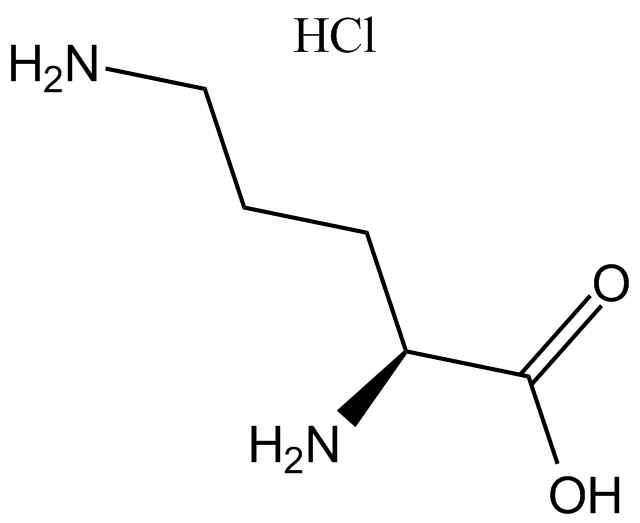
| Chemical Name | (S)-2,5-diaminopentanoic acid hydrochloride |
| Canonical SMILES | NCCC[C@H](N)C(O)=O.Cl |
| Shipping Condition | Small Molecules with Blue Ice, Modified Nucleotides with Dry Ice. |
| General tips | We do not recommend long-term storage for the solution, please use it up soon. |