


L-Lactate Assay Kit (Colorimetric/Fluorometric)
L-Lactate is the predominant form of lactic acid in mammals. It is produced by the brain, skeletal muscle, and erythrocytes, and is primarily metabolized by the liver and kidneys. Blood L-lactate concentration serves as a critical biomarker for evaluating tissue hypoxia, perfusion status, and patient prognosis in critical care settings. Elevated L-lactate levels are commonly observed in life-threatening conditions such as cardiac arrest, sepsis, and mesenteric ischemia. In addition, L-Lactate plays a central role in cellular energy metabolism and tumor metabolic reprogramming, and is widely used in the food industry as an indicator of fermentation quality, freshness, and storage stability.
This kit provides a simple, sensitive assay for L-lactate quantification. L-Lactate is oxidized by lactate oxidase to pyruvate and hydrogen peroxide (H2O2), which drives the Amplex Red reaction in the presence of horseradish peroxidase to form highly fluorescent resorufin. Fluorescence intensity and absorbance correlate linearly with L-lactate concentration. The kit is compatible with serum, plasma, cells, tissues, and other sample types, and specifically detects L-lactate without cross-reactivity to D-lactate.
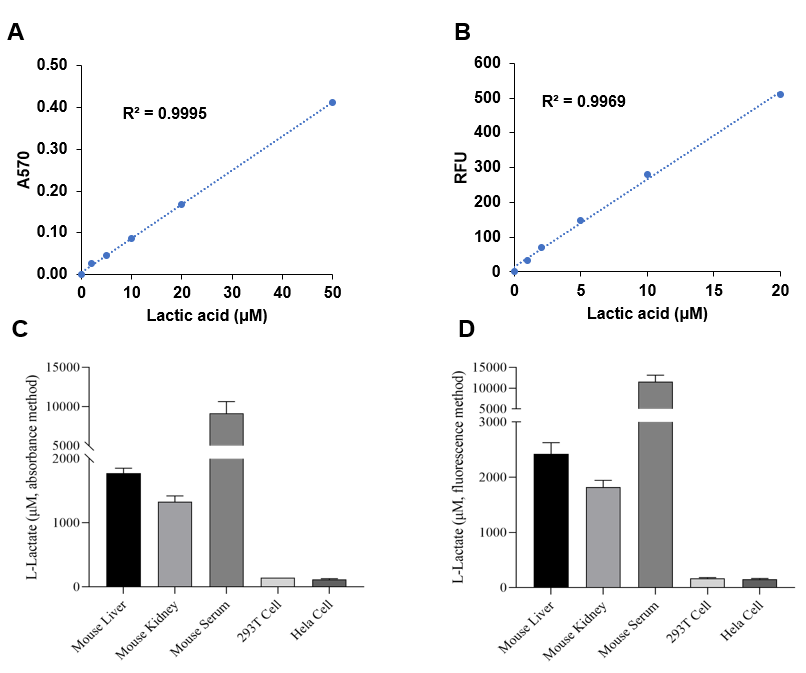
Figure 1. Typical standard curves and assay data. (A, B) Standard curves generated by colorimetric (A) and fluorometric (B) detection; (C, D) Quantification of L-lactate levels in various samples using colorimetric (C) and fluorometric (D) assays.
|
Components |
100 Assays |
Storage |
|
Lactate Lysis Buffer |
20 mL |
-20°C |
|
Lactate Assay Buffer |
20 mL |
-20°C |
|
Amplex Red |
200 μL |
-20°C away from light |
|
Enzyme Solution A |
200 μL |
-20°C |
|
Enzyme Solution B |
200 μL |
-20°C |
|
L-Lactate Standard (5 mM) |
200 μL |
-20°C |
|
Shipping: Blue ice Shelf life: 1 year |
||