


L-Hydroxyproline
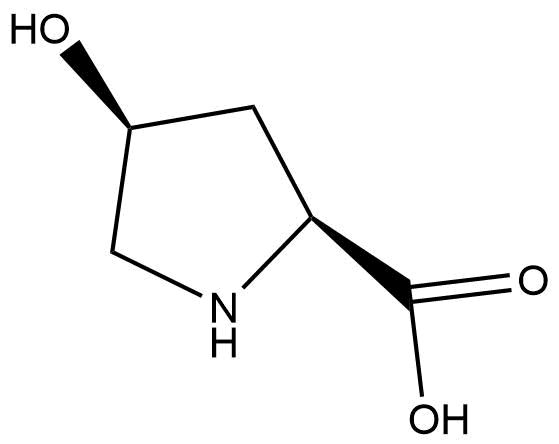
L-Hydroxyproline (CAS No.: 51-35-4) is a naturally occurring, non-essential amino acid and a hydroxylated derivative of proline that is predominantly found in collagen and elastin, where it plays a critical role in stabilizing the triple-helical structure of these extracellular matrix proteins. As a neutral heterocyclic amino acid, it is widely recognized as a biochemical marker of collagen turnover and is commonly used in studies of bone metabolism, tissue remodeling, and fibrotic diseases, including liver fibrosis. In biomedical research, L-hydroxyproline serves as a valuable analytical indicator for assessing extracellular matrix deposition and degradation, and it is frequently employed in both in vitro and in vivo models investigating connective tissue disorders and wound healing processes. Although it does not function as a direct pharmacological modulator of a specific receptor or signaling pathway, its biological relevance is closely associated with collagen biosynthesis pathways and post-translational modification processes involving prolyl hydroxylases. In addition to its physiological roles, L-hydroxyproline is extensively utilized as a chiral building block in organic synthesis and drug discovery, particularly in the development of structurally complex pharmaceuticals and bioactive molecules, including certain antimicrobial natural products. Experimental applications typically involve its use as a metabolic readout or structural precursor, with concentrations adjusted according to specific assay requirements, generally spanning micromolar to millimolar ranges in cell-based systems.
| Physical Appearance | A solid |
| Storage | -20°C |
| M.Wt | 131.13 |
| Cas No. | 51-35-4 |
| Formula | C5H9NO3 |
| Synonyms | (S)-(-)- trans -4-Hydroxyproline; 4(R)-Hydroxy-2(S)-pyrrolidinecarboxylic acid; NSC 46704 |
| Solubility | insoluble in EtOH; insoluble in DMSO; ≥30.1 mg/mL in H2O |
| Chemical Name | (2S,4S)-4-hydroxypyrrolidine-2-carboxylic acid |
| Canonical SMILES | O[C@@H]1CN[C@H](C(O)=O)C1 |
| Shipping Condition | Small Molecules with Blue Ice, Modified Nucleotides with Dry Ice. |
| General tips | We do not recommend long-term storage for the solution, please use it up soon. |