


Iptacopan
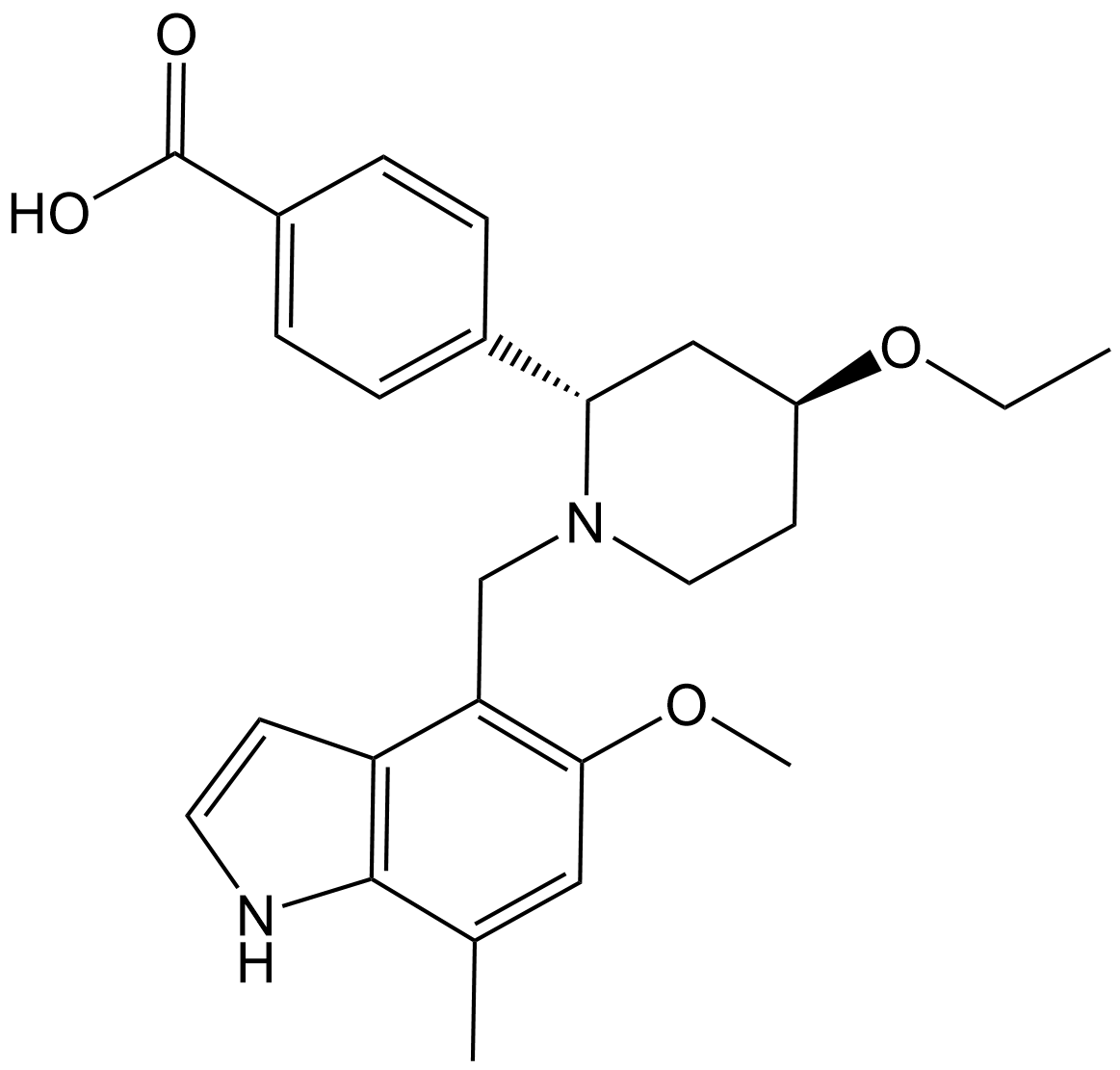
Iptacopan (LNP023, CAS No. 1644670-37-0) is an orally available, highly selective, reversible small-molecule complement factor B (Factor B, CFB) inhibitor. As a core targeted agent of the alternative complement pathway, it competitively inhibits the serine protease activity of factor B, blocking the formation and activation of the alternative pathway C3 convertase C3bBb. It also inhibits C5 activation in the classical and lectin complement pathways mediated via the alternative pathway amplification loop, while not affecting complement activation in these two pathways that is independent of the amplification loop, thereby comprehensively blocking inflammation, cell lysis, and tissue damage driven by dysregulation of the alternative complement pathway. This compound inhibits the enzymatic activity of human complement factor B with an IC50 of 0.01 μM; in a 50% human serum system, it inhibits alternative pathway-induced membrane attack complex C5b-9 formation with a C50 of 0.13 μM; it inhibits C3 deposition and complement-mediated hemolysis in red blood cells from patients with paroxysmal nocturnal hemoglobinuria (PNH) with an IC50 of 0.4 μM. It shows no significant inhibitory activity against factor D, the classical/lectin complement pathways, or other kinases, receptors, ion channels, and proteases, demonstrating high target selectivity.
In animal studies, because complement factor B is highly conserved across species, Iptacopan exhibits pharmacological activity across rodents, dogs, non-human primates, and other species. Its animal use has been therapeutic intervention in disease models. Common models include an LPS-induced mouse alternative complement pathway activation model, the KxB/N mouse arthritis model, a passive Heymann nephritis (membranous nephropathy) rat model, and a complement factor H (CFH) deficiency-induced C3 glomerulopathy mouse model. In these models, it has shown significant therapeutic effects against complement-mediated pathological injury. In cellular applications, its core effective concentration range is 0.01 μM~0.4 μM, enabling efficient inhibition of target enzymatic activity, pathway activation, and pathological hemolysis, respectively.
In clinical use, Iptacopan is administered orally twice daily (bid). Phase II clinical studies explored dosing regimens of 25 mg bid escalated to 100 mg bid and 50 mg bid escalated to 200 mg bid, with 200 mg bid as its core clinical therapeutic dose. At this dose, the mean steady-state peak plasma concentration (Cmax) is 4520 ng/mL and the area under the curve (AUC) is 19900 h・ng/mL, maintaining trough concentrations ≥900 ng/mL in all patients and achieving near-maximal inhibition of the alternative complement pathway. In PNH patients, this dose achieved the primary endpoint in 100% of patients at 12 weeks, with serum lactate dehydrogenase (LDH) decreased by ≥60% from baseline; all patients maintained LDH<1.5×ULN through 12 weeks, along with a significant increase in hemoglobin levels and a substantial reduction in transfusion requirements. In other indications, the 200 mg bid dose has also shown clear efficacy: 12 weeks of treatment reduced the urine protein-to-creatinine ratio by 45% in patients with C3 glomerulopathy, and 6 months of treatment reduced the urine protein-to-creatinine ratio by up to 40% in patients with IgA nephropathy. This dose is currently being used in Phase III clinical trials for multiple indications including PNH, atypical hemolytic uremic syndrome (aHUS), C3 glomerulopathy, and IgA nephropathy, and Phase II clinical exploration is underway in indications such as lupus nephritis, age-related macular degeneration, and immune thrombocytopenia.
References:
[1] Jang JH, Wong L, Ko BS, Yoon SS, Li K, Baltcheva I, Nidamarthy PK, Chawla R, Junge G, Yap ES. Iptacopan monotherapy in patients with paroxysmal nocturnal hemoglobinuria: a 2-cohort open-label proof-of-concept study. Blood Adv. 2022 Aug 9;6(15):4450-4460. doi: 10.1182/bloodadvances.2022006960. PMID: 35561315; PMCID: PMC9636331.
[2] Wells PS, Tritschler T, Khan F, Anderson DR, Kahn SR, Lazo-Langner A, Carrier M, Le Gal G, Castellucci LA, Shah V, Kaatz S, Kearon C, Solymoss S, Zide R, Schulman S, Chagnon I, Mallick R, Rodger MA, Kovacs MJ. Predicting major bleeding during extended anticoagulation for unprovoked or weakly provoked venous thromboembolism. Blood Adv. 2022 Aug 9;6(15):4605-4616. doi: 10.1182/bloodadvances.2022007027. PMID: 35679460; PMCID: PMC9636329.
[3] Schubart A, Flohr S, Junt T, Eder J. Low-molecular weight inhibitors of the alternative complement pathway. Immunol Rev. 2023 Jan;313(1):339-357. doi: 10.1111/imr.13143. Epub 2022 Oct 11. PMID: 36217774; PMCID: PMC10092480.
| Storage | Store at -20°C |
| M.Wt | 422.52 |
| Cas No. | 1644670-37-0 |
| Formula | C25H30N2O4 |
| Synonyms | LNP023 |
| Chemical Name | 4-((2S,4S)-4-ethoxy-1-((5-methoxy-7-methyl-1H-indol-4-yl)methyl)piperidin-2-yl)benzoic acid |
| Canonical SMILES | CCO[C@H]1CCN(CC2=C3C=CNC3=C(C)C=C2OC)[C@@H](C1)C1=CC=C(C=C1)C(O)=O |
| Shipping Condition | Small Molecules with Blue Ice, Modified Nucleotides with Dry Ice. |
| General tips | We do not recommend long-term storage for the solution, please use it up soon. |