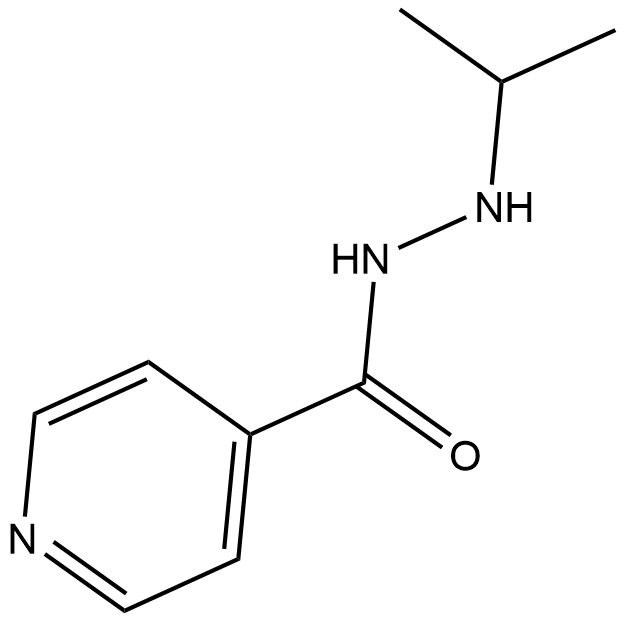
Iproniazid
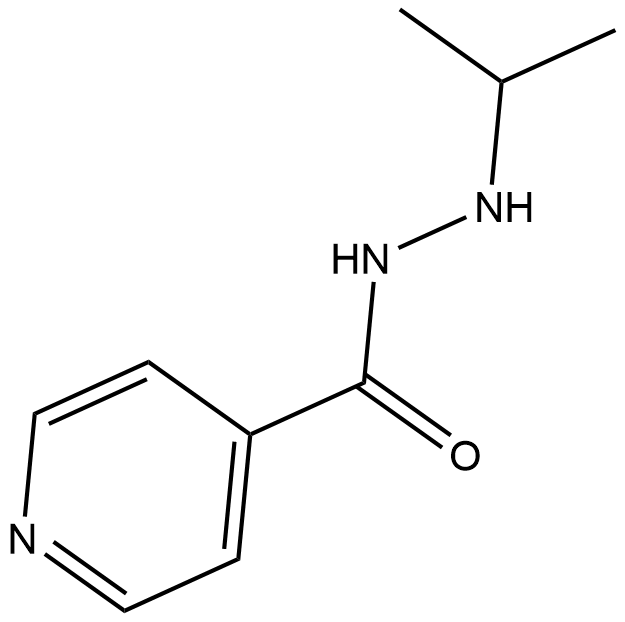
Iproniazid (CAS No.: 54-92-2) is an orally active irreversible monoamine oxidase (MAO) inhibitor that can inhibit both MAO-A and MAO-B isoenzymes, with inhibitory concentrations (IC50) of 6.56 and 7.54 micromolar, respectively. As a nonselective MAO inhibitor, Iproniazid can modulate neurotransmitter levels, affect neuronal function, and provide important insights for the study of various neuropsychiatric diseases such as depression and Parkinson's disease. In addition, this compound acts as an amplifier in studies of rotenone-induced apoptosis and is prominently used in the scientific investigation of apoptotic pathways. Notably, Iproniazid can cause hepatic necrosis and therefore plays a key role in hepatotoxicity research. Although Iproniazid was once used clinically for the management of depression, its primary use is now focused on preclinical trials. In in vitro and in vivo studies, Iproniazid is frequently used to investigate the regulatory effects on neurotransmitters, with rat models commonly used to observe its behavioral and physiological responses. Researchers adjust its dosage according to specific experimental designs and research objectives to explore the biological mechanisms of MAO in neuronal and hepatic functions, and to use it as a model compound for studying drug-induced hepatotoxicity and the regulation of apoptotic pathways.
| Physical Appearance | Solid |
| Storage | -20°C |
| M.Wt | 179.22 |
| Cas No. | 54-92-2 |
| Formula | C9H13N3O |
| Solubility | ≥18 mg/mL in DMSO; ≥17.1 mg/mL in EtOH; ≥16.5 mg/mL in H2O |
| Chemical Name | N'-isopropylisonicotinohydrazide |
| Canonical SMILES | O=C(NNC(C)C)C=1C=CN=CC1 |
| Shipping Condition | Small Molecules with Blue Ice, Modified Nucleotides with Dry Ice. |
| General tips | We do not recommend long-term storage for the solution, please use it up soon. |
Quality Control & MSDS
- View current batch:
Chemical structure