


Indole-3-pyruvic acid
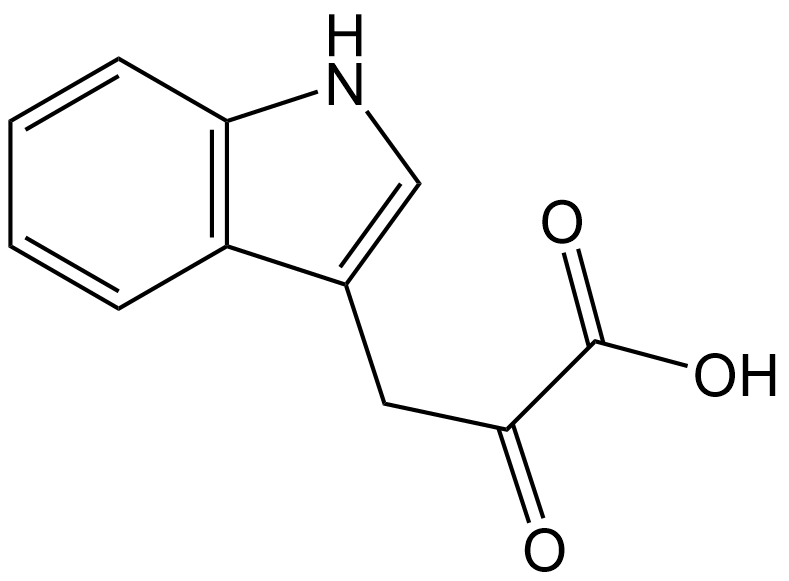





Indole-3-pyruvic acid (IPA, CAS No. 392-12-1) is a key metabolic product of tryptophan. In plants and fungi, it mainly serves as an endogenous metabolic intermediate involved in biosynthetic regulation, and it also exerts diverse biological functions in other biological systems.
In plants, as a core intermediate in auxin (IAA) biosynthesis, it inhibits tryptophan aminotransferase TAA1 via negative feedback in the two-step auxin biosynthetic pathway (TAA1 catalyzes the conversion of tryptophan to IPA, and YUCCA catalyzes the conversion of IPA to IAA), and maintains IPA homeostasis through a reversible reaction. Its Km for TAA1 is 0.7μM, while the Km of tryptophan for TAA1 is 43.6μM.
In fungi (Neurospora crassa), as a key intermediate in the IPA pathway for indole-3-acetic acid (IAA) biosynthesis, it is catalytically converted to indole-3-acetaldehyde by indole-3-pyruvate decarboxylase, ultimately producing IAA.
In cell experiments, the commonly used concentration for in vitro treatment of human peripheral blood mononuclear cells (PBMC) is 500μM.
In mammals, it can activate the aryl hydrocarbon receptor (AhR) and regulate the Th17/Treg cell balance via the AhR pathway to alleviate rheumatoid arthritis; it can also directly inhibit UHRF1 transcription and activate the AMPK pathway to exert an endogenous anti-tumor effect. In a collagen-induced arthritis (CIA) rat model, oral gavage at 20mg/kg/d can improve arthritis symptoms; in a breast cancer mouse model, oral administration at 120mg/kg can inhibit tumor growth.
References:
[1] Sardar P, Kempken F. Characterization of indole-3-pyruvic acid pathway-mediated biosynthesis of auxin in Neurospora crassa. PLoS One. 2018 Feb 8;13(2):e0192293. doi: 10.1371/journal.pone.0192293. PMID: 29420579; PMCID: PMC5805262.
[2] Sato A, Soeno K, Kikuchi R, Narukawa-Nara M, Yamazaki C, Kakei Y, Nakamura A, Shimada Y. Indole-3-pyruvic acid regulates TAA1 activity, which plays a key role in coordinating the two steps of auxin biosynthesis. Proc Natl Acad Sci U S A. 2022 Jun 21;119(25):e2203633119. doi: 10.1073/pnas.2203633119. Epub 2022 Jun 13. PMID: 35696560; PMCID: PMC9231625.
[3] Huang T, Cheng L, Jiang Y, Zhang L, Qian L. Indole-3-pyruvic acid alleviates rheumatoid arthritis via the aryl hydrocarbon receptor pathway. Ann Transl Med. 2023 Mar 15;11(5):213. doi: 10.21037/atm-23-1074. PMID: 37007545; PMCID: PMC10061485.
[4] Su J, Lin X, Li D, Yang C, Lv S, Chen X, Yang X, Pan B, Xu R, Ren L, Zhang Y, Xie Y, Chen Q, Xia C. Prevotella copri exhausts intrinsic indole-3-pyruvic acid in the host to promote breast cancer progression: inactivation of AMPK via UHRF1-mediated negative regulation. Gut Microbes. 2024 Jan-Dec;16(1):2347757. doi: 10.1080/19490976.2024.2347757. Epub 2024 May 21. PMID: 38773738; PMCID: PMC11123460.
| Storage | Store at -20°C |
| M.Wt | 203.19 |
| Cas No. | 392-12-1 |
| Formula | C11H9NO3 |
| Synonyms | Indolepyruvic acid |
| Chemical Name | 3-(1H-indol-3-yl)-2-oxopropanoic acid |
| Canonical SMILES | O=C(O)C(=O)CC1=CNC=2C=CC=CC21 |
| Shipping Condition | Small Molecules with Blue Ice, Modified Nucleotides with Dry Ice. |
| General tips | We do not recommend long-term storage for the solution, please use it up soon. |