

Haloperidol
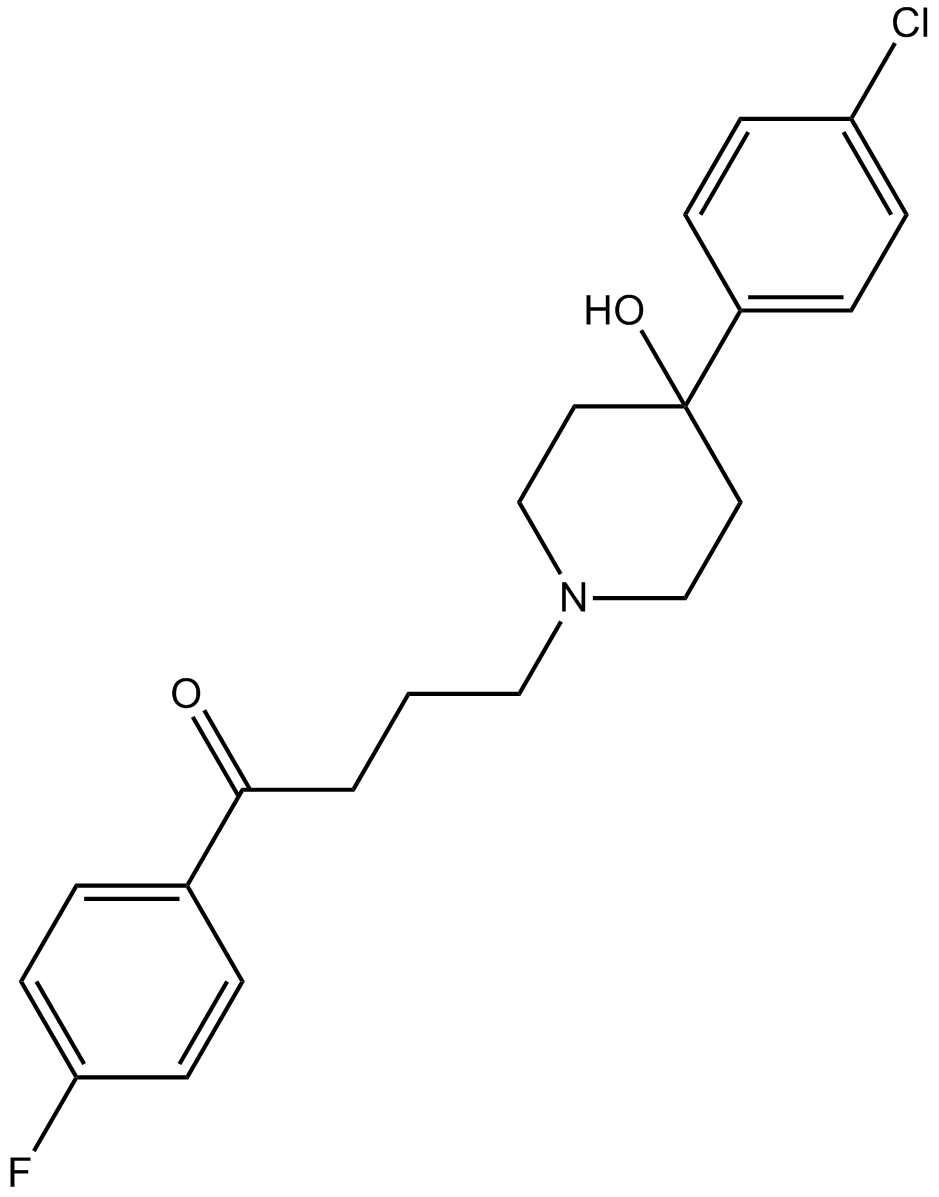
Haloperidol (CAS 52-86-8) is an antipsychotic drug with functions similar to those of phenothiazine antipsychotics[1].
Haloperidol is a dopamine inverse agonist. Haloperidol also inhibits neurological function, thereby relieving tension, and is a highly potent antipsychotic with a potency about 50 times that of chlorpromazine, equally effective against delusional and hallucinatory symptoms. These effects are mainly achieved by blocking dopamine receptors in the cerebral cortex and limbic system; blockade of dopamine receptors in the nigrostriatal pathway accounts for related side effects such as akathisia and dystonia[1].
Long-term administration of haloperidol induces movement disorders such as oral dyskinesia in rodents and is commonly used to establish tardive dyskinesia animal models.
References: [1] Dr Ananya Mandal, MD. Haloperidol Pharmacology.
| Physical Appearance | A solid |
| Storage | Store at -20°C |
| M.Wt | 375.86 |
| Cas No. | 52-86-8 |
| Formula | C21H23ClFNO2 |
| Solubility | insoluble in H2O; ≥18.79 mg/mL in DMSO; ≥2.52 mg/mL in EtOH with gentle warming and ultrasonic |
| Chemical Name | 4-[4-(4-chlorophenyl)-4-hydroxypiperidin-1-yl]-1-(4-fluorophenyl)butan-1-one |
| Canonical SMILES | OC1(CCN(CCCC(c(cc2)ccc2F)=O)CC1)c(cc1)ccc1Cl |
| Shipping Condition | Small Molecules with Blue Ice, Modified Nucleotides with Dry Ice. |
| General tips | We do not recommend long-term storage for the solution, please use it up soon. |
| Animal experiment:[1] | |
|
Animal models |
Male Sprague-Dawley rats, 225 ~ 250 g |
|
Dosage form |
0, 0.01, 0.05, 0.1 or 0.5 mg/kg Administered subcutaneously |
|
Applications |
In rats, the dopamine agonist apomorphine (APO) caused a significant decrease in prepulse inhibition (PPI) of the acoustic startle response, which could be reversed in a dose-dependent manner by haloperidol. PPI of the acoustic startle response is a measure of sensorimotor gating that is impaired in both schizophrenic patients and in rats treated with dopamine agonists. The ability of antipsychotics such as haloperidol to restore PPI in APO-treated rats correlates significantly with their clinical potency. |
|
Note |
The technical data provided above is for reference only. |
|
References: 1. Swerdlow NR, Geyer MA. Clozapine and haloperidol in an animal model of sensorimotor gating deficits in schizophrenia. Pharmacol Biochem Behav. 1993 Mar;44(3):741-4. |
|
Quality Control & MSDS
- View current batch:
Chemical structure