


glycerate
glycerate (CAS No.: 473-81-4) is an endogenous metabolic intermediate present in both plant and mammalian systems, occurring as D- and L-enantiomers and participating in central carbon metabolism and related biochemical networks. It is closely associated with pathways involved in oxalate biosynthesis, where metabolic imbalance can lead to its abnormal accumulation, making it a useful indicator for investigating dysregulated oxalate metabolism and its underlying enzymatic control mechanisms. In microbial systems, glycerate functions as a substrate for enzymes such as 3-hydroxyisobutyrate dehydrogenase from Pseudomonas aeruginosa, with reported catalytic activity in the millimolar affinity range, supporting its role in intermediary metabolism and enzymology studies. As a small-molecule metabolite, glycerate is widely applied in biochemical and metabolomic research to construct metabolic models, evaluate pathway flux, and analyze gene expression or enzyme activity associated with metabolic regulation. It is also utilized in cell-based and in vitro systems to probe metabolic pathway perturbations, with experimental concentrations typically selected according to specific assay requirements and study objectives.
| Physical Appearance | A colorless oil |
| Storage | -20°C |
| M.Wt | 106.08 |
| Cas No. | 473-81-4 |
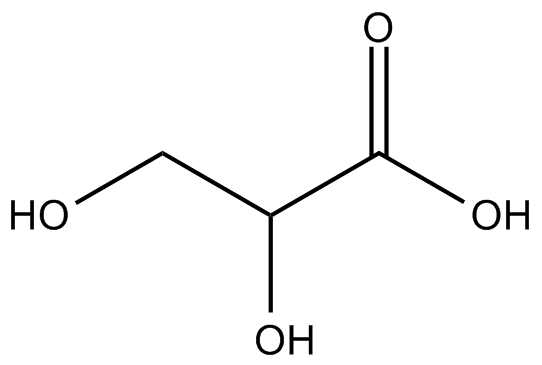
| Formula | C3H6O4 |
| Solubility | Soluble in DMSO |
| Chemical Name | 2,3-dihydroxypropanoic acid |
| Canonical SMILES | OCC(O)C(O)=O |
| Shipping Condition | Small Molecules with Blue Ice, Modified Nucleotides with Dry Ice. |
| General tips | We do not recommend long-term storage for the solution, please use it up soon. |