


Flunisolide
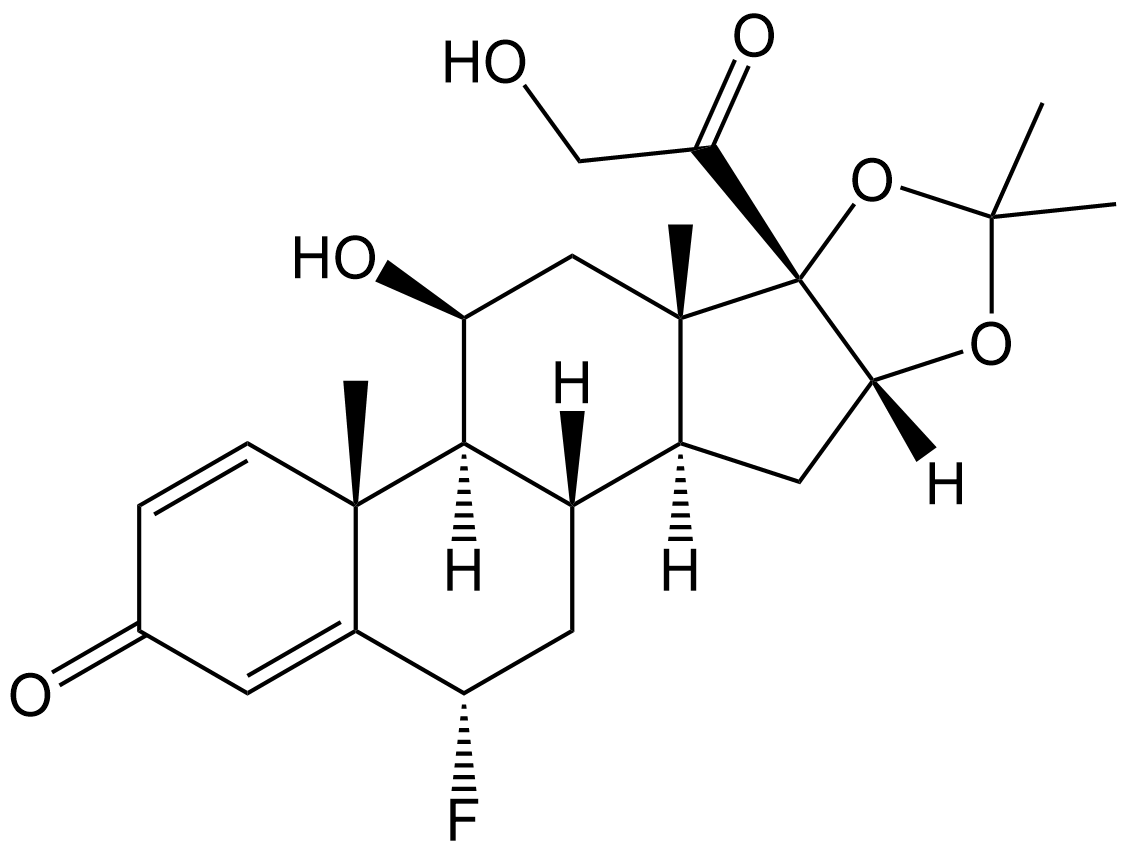





Flunisolide (CAS No. 3385-03-3) is a fluorinated glucocorticoid that acts as a glucocorticoid receptor (GR) agonist. It is effective when administered orally or by inhalation and exhibits prominent anti-inflammatory activity; its marketed formulations are clinically used mainly for the treatment of asthma, allergic rhinitis, and various airway inflammatory diseases. This compound is a classic tool drug for glucocorticoid safety evaluation. In CD‑1 mouse models, a daily oral dose of 200 μg/kg can induce reversible hyaline lesions in the pyloric stomach, and it is often used to evaluate glucocorticoid-induced gastric toxicity.
Cellular and ex vivo in vitro experiments show that the core action of flunisolide is to inhibit inflammatory cell activation and reduce the release of multiple pro-inflammatory factors: treatment at 0.1–10 μM for 1 h can inhibit lung fibroblast activation; incubation at 10 μM for 24 h can downregulate the secretion of MMP‑9, TIMP‑1, TGF‑β, and fibronectin in sputum cells from patients with mild to moderate asthma, while promoting apoptosis of sputum eosinophils; exposure at 0.1–10 μM for 24 h can block TNF‑α-induced ICAM‑1 expression in BEAS‑2B cells and reduce the release of GM‑CSF and IL‑5. In addition, 115 μM flunisolide can complete ATP-dependent, apical-to-basolateral polarized transport in Calu‑3 cells within 0–3 h, serving as an in vitro model tool for studying transmembrane drug transport processes in airway epithelium.
In animal disease model studies, flunisolide administered via the airway can exert anti-inflammatory and anti-pulmonary fibrosis effects: daily oral administration of 200 μg/kg in CD‑1 mice can induce reversible hyaline lesions in the pyloric stomach, and this model is used to evaluate oral glucocorticoid-related gastric injury; in mice with silica dust exposure-induced lung injury, intranasal administration of 0.3–10 μg/mouse flunisolide daily from day 21 to day 27 after modeling can significantly alleviate pulmonary inflammation and fibrosis, improve airway hyperresponsiveness, accelerate the clearance of silica particles from the lungs, and reduce the accumulation of macrophages and myofibroblasts in lung tissue. Taken together, based on its in vitro and in vivo characteristics, flunisolide is a representative GR agonist tool compound for studying airway inflammation, airway remodeling, glucocorticoid signaling pathways, and organ toxicity.
References:
[1] McKevitt TP, Giffen P, Woodfine JA, McCawley SJ, Papworth SA, McGill P, Osborne J, Beard P, Williams TC, Klapwijk J, Lewis DJ. Hyalinization of the pyloric stomach in CD-1 mice following oral (dietary) administration of the corticosteroid agonists mometasone furoate, budesonide, and flunisolide. Toxicol Pathol. 2011 Oct;39(6):958-68. doi: 10.1177/0192623311418681. Epub 2011 Sep 1. PMID: 21885873.
[2] O'Callaghan C, White JA, Kantar A. Nebulization of corticosteroids to asthmatic children: large variation in dose inhaled. Respirology. 2014 Feb;19(2):276-279. doi: 10.1111/resp.12208. Epub 2013 Nov 24. PMID: 24267983.
[3] Florea BI, van der Sandt IC, Schrier SM, Kooiman K, Deryckere K, de Boer AG, Junginger HE, Borchard G. Evidence of P-glycoprotein mediated apical to basolateral transport of flunisolide in human broncho-tracheal epithelial cells (Calu-3). Br J Pharmacol. 2001 Dec;134(7):1555-63. doi: 10.1038/sj.bjp.0704390. PMID: 11724763; PMCID: PMC1573081.
[4] Profita M, Gagliardo R, Di Giorgi R, Bruno A, Riccobono L, Bonanno A, Bousquet J, Vignola AM. In vitro effects of flunisolide on MMP-9, TIMP-1, fibronectin, TGF-beta1 release and apoptosis in sputum cells freshly isolated from mild to moderate asthmatics. Allergy. 2004 Sep;59(9):927-32. doi: 10.1111/j.1398-9995.2004.00516.x. PMID: 15291899.
[5] Boero S, Silvestri M, Ullmann N, Rossi GA. Modulation by flunisolide of tumor necrosis factor-alpha-induced stimulation of airway epithelial cell activities related to eosinophil inflammation. J Asthma. 2010 May;47(4):381-7. doi: 10.3109/02770901003759410. PMID: 20528590.
[6] Ferreira TPT, Lima JGME, Farias-Filho FA, Jannini de Sá YAP, de Arantes ACS, Guimarães FV, Carvalho VF, Hogaboam C, Wallace J, Martins MA, Silva PMRE. Intranasal Flunisolide Suppresses Pathological Alterations Caused by Silica Particles in the Lungs of Mice. Front Endocrinol (Lausanne). 2020 Jun 17;11:388. doi: 10.3389/fendo.2020.00388. PMID: 32625168; PMCID: PMC7311565.
| Storage | Store at -20°C |
| M.Wt | 434.5 |
| Cas No. | 3385-03-3 |
| Formula | C24H31FO6 |
| Synonyms | Nisolid, Nasalide, RS 3999 |
| Chemical Name | (2S,6aR,6bS,7S,8aS,8bS,11aR,12aS,12bS)-2-fluoro-7-hydroxy-8b-(2-hydroxyacetyl)-6a,8a,10,10-tetramethyl-1,2,6a,6b,7,8,8a,8b,11a,12,12a,12b-dodecahydro-4H-naphtho[2',1':4,5]indeno[1,2-d][1,3]dioxol-4-one |
| Canonical SMILES | C(CO)(=O)[C@]12[C@]3(C)[C@@](C[C@]1(OC(C)(C)O2)[H])([C@]4([C@]([C@@H](O)C3)([C@]5(C)C([C@@H](F)C4)=CC(=O)C=C5)[H])[H])[H] |
| Shipping Condition | Small Molecules with Blue Ice, Modified Nucleotides with Dry Ice. |
| General tips | We do not recommend long-term storage for the solution, please use it up soon. |