


Farnesol
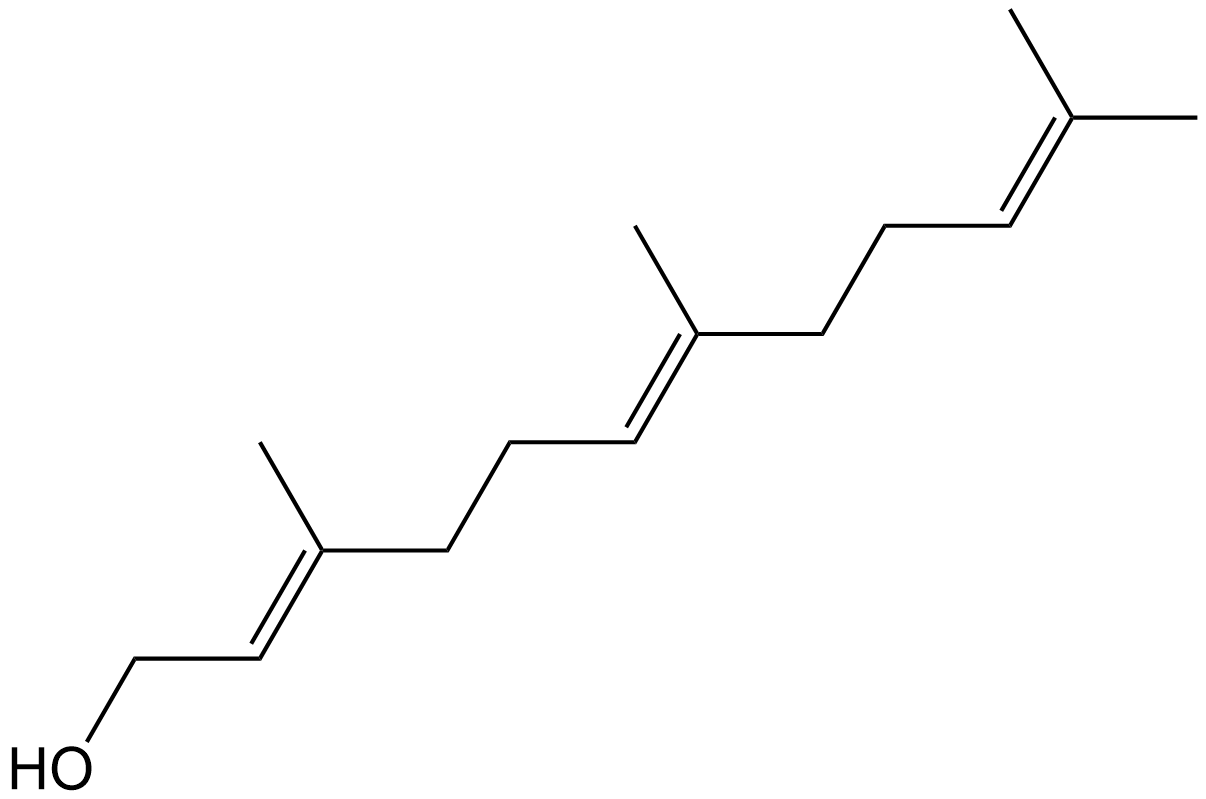
Farnesol (FOH) is a 15-carbon acyclic sesquiterpene primary alcohol and an intermediate produced by dephosphorylation of FPP in the mevalonate/cholesterol biosynthesis pathway. It is present in various plant essential oils and mammalian tissues. Its actions are characterized by multiple targets: it can promote HMG‑CoA reductase degradation, inhibit the phosphatidylcholine synthesis-related enzyme CCTα, antagonize L-/N-type voltage-gated Ca²⁺ channels, weakly activate FXR and the PPAR family, and regulate THRβ function. Downstream effects involve multiple pathways, including ER stress and UPR (the PERK, IRE1α, and ATF6 pathways), NF‑κB signaling and inflammatory factor expression, mitochondria-dependent apoptosis, and ROS generation, and it also shows regulatory effects on microbiota structure in the gut microbiota-brain axis.
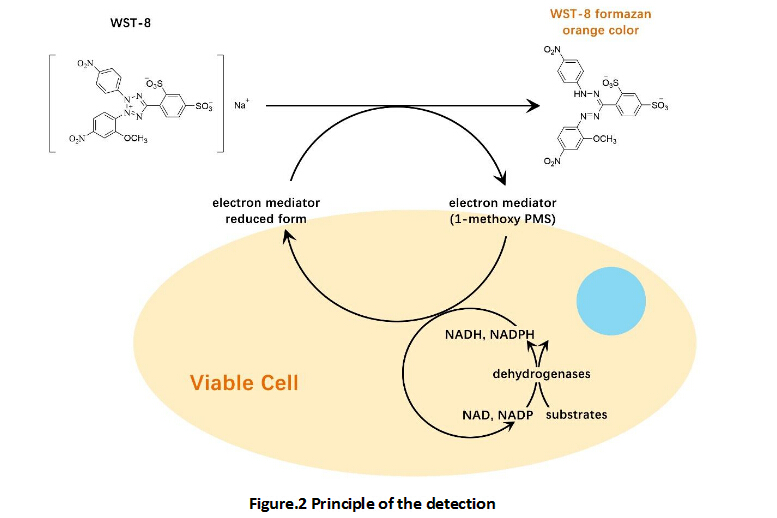
At the cellular level, Farnesol has concentration-dependent anti-proliferative effects on various tumor cells (such as H460, A549, MOLT4, pancreatic cancer cells, B16 melanoma, etc.). Common working concentrations are 25–250 μM (most experiments use 50–100 μM for 24–72 h, and the proliferation IC₅₀ range given in literature reviews is also 25–250 μM, with leukemia cells being the most sensitive). In Leishmania amazonensis promastigotes, the IC₅₀ of Farnesol is approximately 33–46 μM in nutrient-rich medium, and decreases to around 4–7 μM under nutrient-limited conditions. In other cell models, micromolar levels are often used in NHEK keratinocytes to promote differentiation, while 50–100 μM is commonly used in ARPE‑19, H460, and other cells for ER stress studies.
In animal experiments, Farnesol is mainly used in antitumor/chemoprevention and anti-inflammatory/neuroprotection studies. In a hamster PC‑1 pancreatic cancer subcutaneous xenograft model, supplementation of the diet with 20 g/kg Farnesol can almost completely inhibit tumor growth, and in a chemical carcinogenesis (N‑nitrosobis(2‑oxopropyl)amine) model it reduces the incidence of pancreatic cancer and regulates BAK/BCL‑XL expression; in multiple chemically induced carcinogenesis models of liver cancer, kidney cancer, and colon cancer in rats, Farnesol, as a preventive treatment, can reduce the number and size of preneoplastic lesions and lower the proliferation index. In immune diseases, in a MOG₃₅₋₅₅-induced EAE model in female C57BL/6 mice, oral administration of 100 mg/kg/day Farnesol (dissolved in corn oil) from the day of induction to day 26 can delay disease onset by approximately 2 days and reduce disease severity by about 80%, accompanied by reduced inflammatory cell infiltration in the spinal cord, increased Treg proportion, and decreased gut microbiota F/B ratio; previous literature has also reported that i.p. 100 mg/kg also has neuroprotective effects in LPS-induced neurodegeneration and acrylamide neurotoxicity models.
References:
[1] Joo JH, Jetten AM. Molecular mechanisms involved in farnesol-induced apoptosis. Cancer Lett. 2010 Jan 28;287(2):123-35. doi: 10.1016/j.canlet.2009.05.015. Epub 2009 Jun 10. PMID: 19520495; PMCID:
[2] PMC2815016.Sell LB, Ramelow CC, Kohl HM, Hoffman K, Bains JK, Doyle WJ, Strawn KD, Hevrin T, Kirby TO, Gibson KM, Roullet JB, Ochoa-Repáraz J. Farnesol induces protection against murine CNS inflammatory demyelination and modifies gut microbiome. Clin Immunol. 2022 Feb;235:108766. doi: 10.1016/j.clim.2021.108766. Epub 2021 Jun 10. PMID: 34091018; PMCID: PMC8660955.
[3] Pinheiro LS, Andrade-Neto VV, Mantuano-Barradas M, Pereira EC, Barbosa RCF, de Oliveira MCC, Menna-Barreto RFS, Cunha-Júnior EF, Torres-Santos EC. Biological effects of trans, trans-farnesol in Leishmania amazonensis. Front Cell Infect Microbiol. 2023 Nov 16;13:1221246. doi: 10.3389/fcimb.2023.1221246. PMID: 38035328; PMCID: PMC10687452.
| Physical Appearance | Liquid |
| Storage | Store at -20°C |
| M.Wt | 222.37 |
| Cas No. | 4602-84-0 |
| Formula | C15H26O |
| Synonyms | Farnesyl Alcohol; FOH; FCI 119a; NSC 60597 |
| Chemical Name | (2E,6E)-3,7,11-trimethyldodeca-2,6,10-trien-1-ol |
| Canonical SMILES | OCC=C(C)CCC=C(C)CCC=C(C)C |
| Shipping Condition | Small Molecules with Blue Ice, Modified Nucleotides with Dry Ice. |
| General tips | We do not recommend long-term storage for the solution, please use it up soon. |