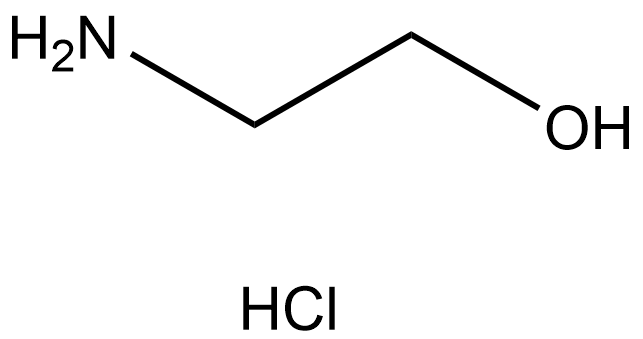
Ethanolamine hydrochloride
Ethanolamine hydrochloride (CAS No.: 2002-24-6) is a protonated amino alcohol salt broadly classified as a small molecule biochemical intermediate and cell culture relevant reagent, representing the hydrochloride form of ethanolamine, a naturally occurring metabolite distributed in biological tissues and a biosynthetic constituent of phospholipid metabolism including phosphatidylethanolamine related membrane pathways, and it is therefore commonly positioned in life sciences catalogs under metabolism, membrane biology, and biochemical process research categories; functionally, it serves as a bioavailable ethanolamine source in experimental systems and is used to modulate nitrogen containing headgroup availability, membrane lipid remodeling, and associated cellular processes such as membrane dynamics, vesicular trafficking, autophagy linked phosphatidylethanolamine conjugation events, and broader metabolic network studies, while no single high affinity protein target is universally established for this compound in the manner of selective receptor ligands, its biological effects are generally interpreted through pathway level mechanisms involving ethanolamine utilization routes, phospholipid biosynthesis flux, and context dependent changes in intracellular pH and ionic environment; consistent with this mechanism profile, standardized potency metrics such as discrete IC50, EC50, or MIC values are not broadly defined across the literature for a primary target driven pharmacology model, and reported in vitro effects are typically concentration and model dependent, often characterized within millimolar to lower concentration experimental windows depending on cell type and assay design rather than fixed universal activity constants; in biomedical research and early drug discovery workflows, this reagent is typically applied in cell based metabolic perturbation studies, membrane composition analyses, stress response assays, and screening paradigms that investigate pathway sensitivity to nutrient or precursor availability, and it may also be incorporated into method development for biochemical assays requiring controlled buffering behavior, with concentrations or doses used in experiments typically depending on specific experimental designs and research objectives, and all usage is limited to laboratory research contexts such as in vitro systems or nonclinical experimental models.
| Storage | -20°C for 3 years |
| M.Wt | 97.54 |
| Cas No. | 2002-24-6 |
| Formula | C2H8ClNO |
| Synonyms | 2-Aminoethanol hydrochloride |
| Solubility | ≥9.5 mg/mL in DMSO; ≥4.85 mg/mL in EtOH; ≥10 mg/mL in H2O |
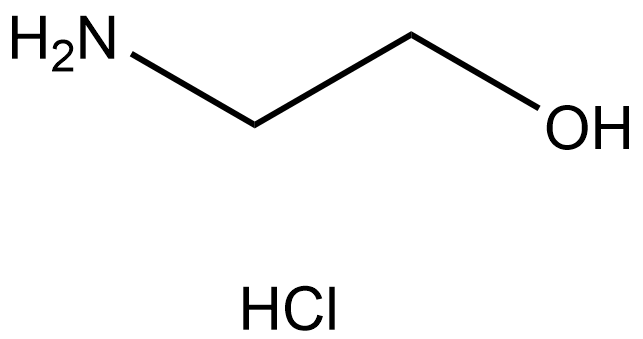
| Chemical Name | 2-aminoethan-1-ol hydrochloride |
| Canonical SMILES | Cl.OCCN |
| Shipping Condition | Small Molecules with Blue Ice, Modified Nucleotides with Dry Ice. |
| General tips | We do not recommend long-term storage for the solution, please use it up soon. |
Quality Control & MSDS
- View current batch:
Chemical structure