DPPH
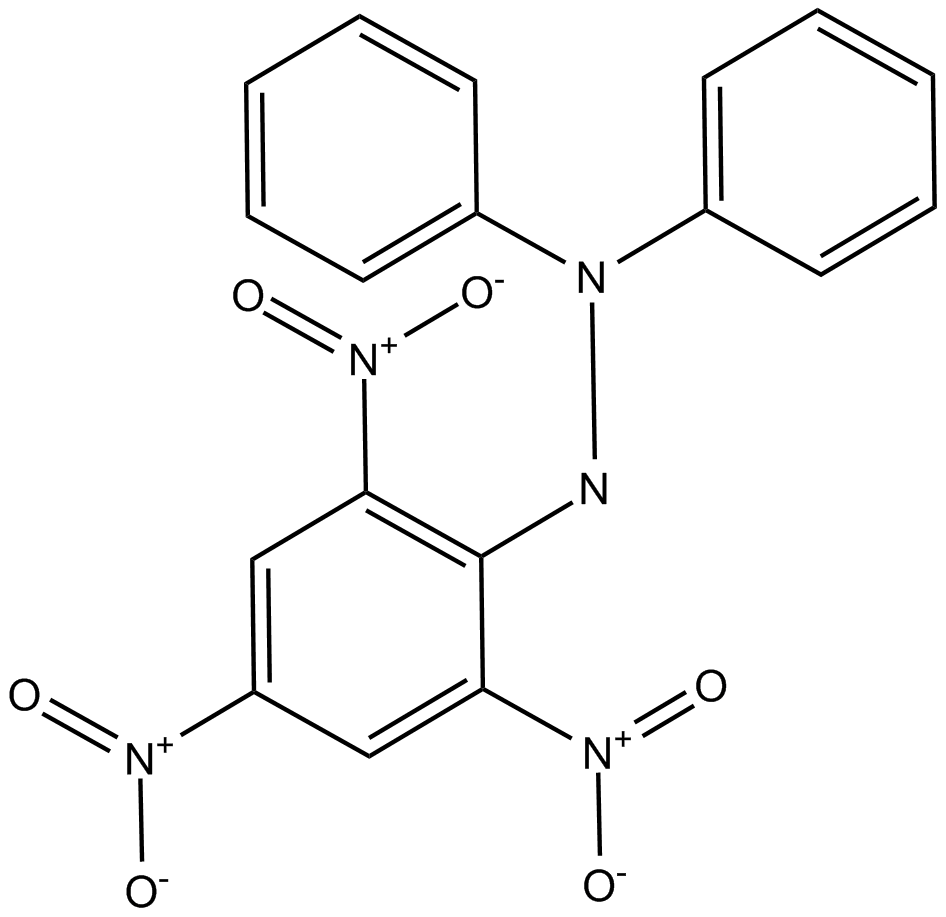
DPPH (CAS No.: 1898-66-4) is a synthetic, nitrogen-centered stable free radical widely employed as a colorimetric probe in antioxidant research and drug discovery for evaluating radical scavenging capacity and hydrogen-donating activity of candidate compounds. Functioning as a redox-active molecule, DPPH accepts an electron or hydrogen atom from antioxidants, leading to its reduction and a characteristic color transition from deep violet to pale yellow, which can be quantitatively monitored by absorbance decrease in the 515–528 nm range. This well-defined spectrophotometric response underlies its extensive use in assessing the antioxidant potential of small molecules, natural products, biological extracts, and complex formulations in both aqueous and organic solvent systems, enabling evaluation of hydrophilic and lipophilic antioxidant activities. Mechanistically, DPPH serves as a surrogate radical species rather than engaging specific cellular targets or signaling pathways, providing a rapid and reproducible in vitro readout of redox reactivity that correlates with general free radical quenching properties. It is frequently applied in high-throughput screening workflows, biochemical assays, and cell-based extract analyses to prioritize compounds with potential cytoprotective or anti-oxidative effects, with observed activity typically spanning from low micromolar to higher concentration ranges depending on compound potency and assay conditions. Experimental concentrations and assay formats vary according to study design, making DPPH a versatile and foundational tool in early-stage antioxidant profiling and functional characterization within biomedical and pharmaceutical research contexts.
| Physical Appearance | A solid |
| Storage | -20°C |
| M.Wt | 394.32 |
| Cas No. | 1898-66-4 |
| Formula | C18H12N5O6· |
| Synonyms | 2,2- Diphenyl- 1- Picrylhydrazyl; DPPH radical |
| Solubility | insoluble in H2O; insoluble in DMSO; ≥13.13 mg/mL in EtOH with ultrasonic |
| Chemical Name | 1,1-diphenyl-2-picrylhydrazil Radical |
| Canonical SMILES | O=[N+]([O-])C1=C([N.]N(C2=CC=CC=C2)C3=CC=CC=C3)C([N+]([O-])=O)=CC([N+]([O-])=O)=C1 |
| Shipping Condition | Small Molecules with Blue Ice, Modified Nucleotides with Dry Ice. |
| General tips | We do not recommend long-term storage for the solution, please use it up soon. |