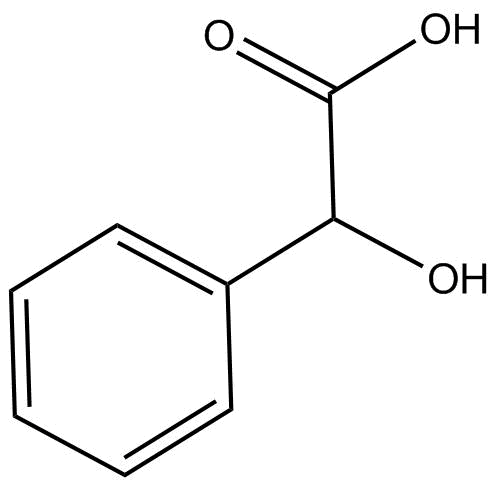
DL-Mandelic acid
DL-Mandelic acid (racemic mandelic acid, DL-mandelic acid, CAS 90-64-2) is a racemic mixture of D-(−)/(R)-mandelic acid (CAS No.: 611-71-2, Cat. No.: B8606) and L-(+)/S-mandelic acid (CAS No.: 17199-29-0, Cat. No.: C6138). Its core biological function is the nonspecific, pH-dependent antibacterial (bacteriostatic/bactericidal) action of a weak organic acid—the bactericidal efficacy comes from the free, undissociated acid form (Rosenheim mechanism), must occur in an acidic environment (such as urine pH ≤5.5), is effective against both Gram-positive and Gram-negative bacteria, and its nonspecific mechanism makes resistance difficult to develop, while activity is lost after salt formation (sodium salt); its two enantiomeric components have only recorded millimolar-level weak inhibition of PTP1B at the enzymatic level ((R)-form IC50 5500 µM, (S)-form 4900 µM, recorded in the NCATS database, with no druggability significance); as an α-hydroxy acid, it also has keratolytic activity and is the major urinary metabolite of styrene/ethylbenzene metabolism in humans (both enantiomers can be detected).
At the clinical level, its classic application is antibacterial treatment of the urinary tract: methenamine mandelate (CAS No.: 587-23-5) is administered orally in adults at 1 g 4 times daily, requiring urine pH ≤5.5 to ensure the antibacterial activity of free mandelic acid and synergize with methenamine to release formaldehyde, for long-term bacteriostasis in chronic/recurrent urinary tract infections; it is contraindicated in renal insufficiency and in those with gout/uric acid stone tendency, and should not be used together with sulfonamides. In dermatologic topical chemical peeling (industry practice uses the DL racemate), 45% or 40% mandelic acid peeling (once every 2 weeks × 6 sessions) treats mild to moderate acne with efficacy comparable to 30% salicylic acid and fewer adverse events such as erythema.
| Physical Appearance | Solid |
| Storage | -20°C |
| M.Wt | 152.15 |
| Cas No. | 90-64-2 |
| Formula | C8H8O3 |
| Synonyms | Mandelic acid |
| Solubility | ≥24.68 mg/mL in H2O; ≥4.13 mg/mL in EtOH with ultrasonic; ≥56.8 mg/mL in DMSO |
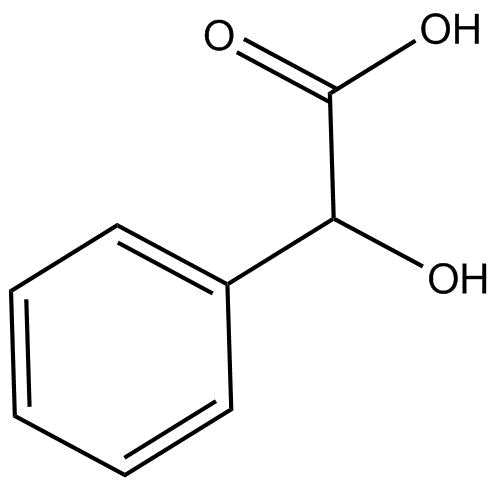
| Chemical Name | 2-hydroxy-2-phenylacetic acid |
| Canonical SMILES | OC(C(O)=O)C1=CC=CC=C1 |
| Shipping Condition | Small Molecules with Blue Ice, Modified Nucleotides with Dry Ice. |
| General tips | We do not recommend long-term storage for the solution, please use it up soon. |
Quality Control & MSDS
- View current batch:
Chemical structure