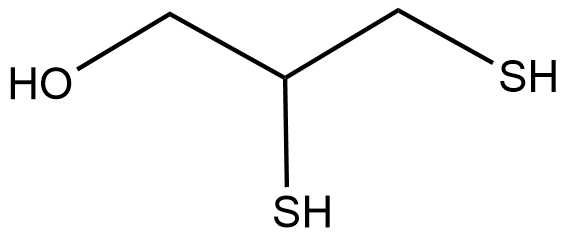
Dimercaprol
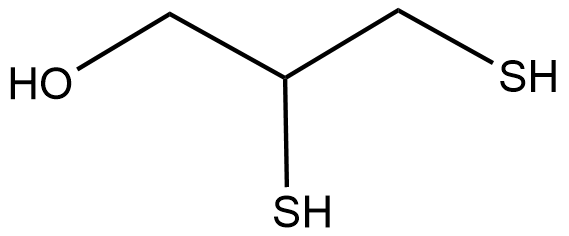
Dimercaprol (CAS No.: 59-52-9) is a well-known chelating agent widely used in research on heavy metal poisoning, particularly playing an important role in studies of toxic metals such as arsenic, mercury, gold, lead, and antimony. It was originally developed as a protective agent against the chemical warfare agent Lewisite, and is therefore also known as British Anti-Lewisite (BAL). This compound binds to metal ions, thereby neutralizing their toxicity, and has demonstrated broad biological effects in biomedical research. Dimercaprol is recognized as having anti-HIV activity, especially for exploring the regulation of the HIV-1 tat protein. Its mechanism of action involves preventing cytotoxicity and damage by disrupting metal-mediated biological pathways. Experimental studies typically use Dimercaprol in the nanomolar to micromolar range, with specific concentrations depending on the study design and objectives. These studies often employ various in vitro and in vivo models to elucidate its efficacy and potential applications. Although detailed IC50 or EC50 data are not available, the role of Dimercaprol in chelation therapy research makes it an important tool for studying the mitigation of heavy metal toxicity and understanding the related molecular mechanisms.
| Physical Appearance | Liquid |
| Storage | 4°C |
| M.Wt | 124.23 |
| Cas No. | 59-52-9 |
| Formula | C3H8OS2 |
| Synonyms | 2,3-Dimercapto-1-propanol; Dithioglycerol |
| Solubility | ≥23 mg/mL in DMSO; ≥22.1 mg/mL in EtOH; ≥25.9 mg/mL in H2O |
| Chemical Name | 2,3-dimercaptopropan-1-ol |
| Canonical SMILES | OCC(S)CS |
| Shipping Condition | Small Molecules with Blue Ice, Modified Nucleotides with Dry Ice. |
| General tips | We do not recommend long-term storage for the solution, please use it up soon. |
Quality Control & MSDS
- View current batch:
Chemical structure