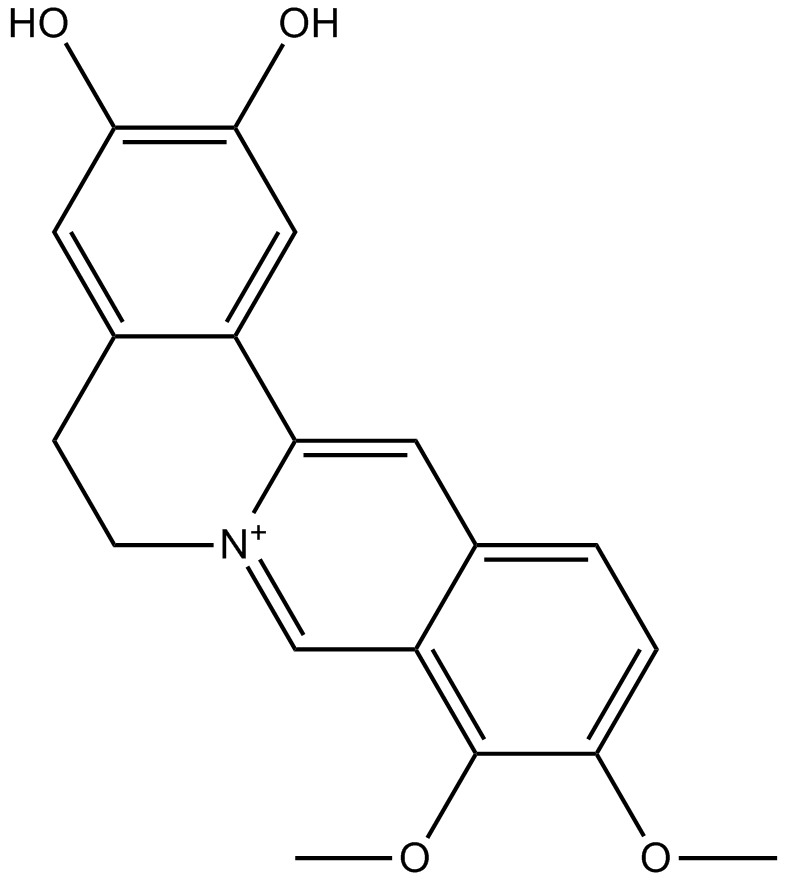
Demethyleneberberine
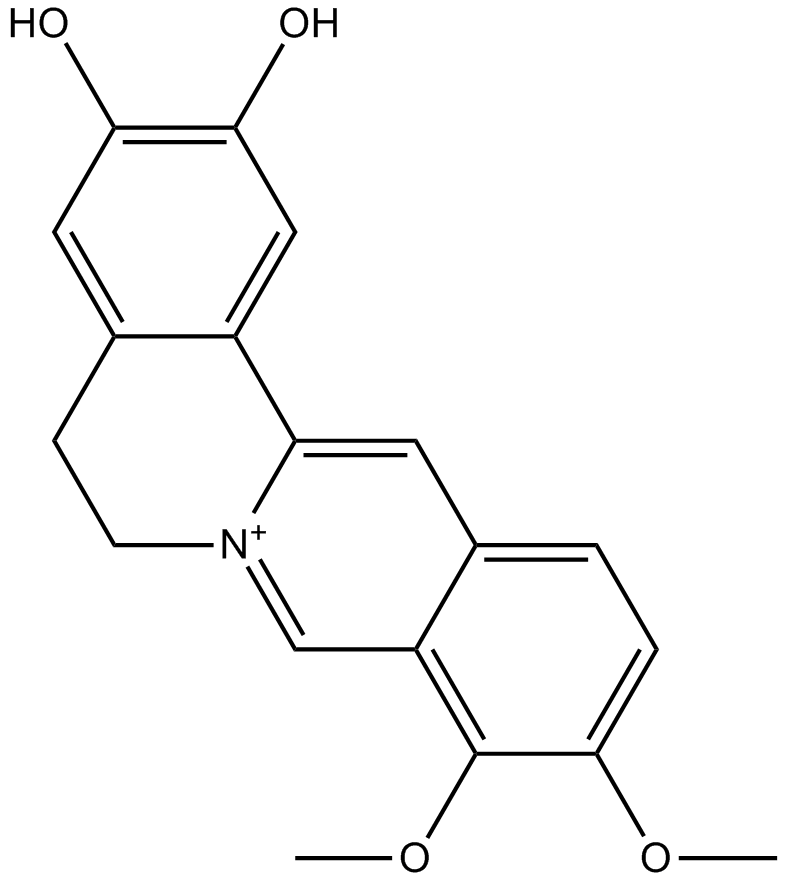
Demethyleneberberine (DMB, CAS No. 25459-91-0) is a natural isoquinoline alkaloid derived from traditional Chinese medicines such as Phellodendron bark (also a major metabolite of berberine). Its core biological functions include antioxidant, anti-inflammatory, anti-fibrotic, neuroprotective effects, anti-autoimmune hepatitis activity, alleviation of ulcerative colitis (UC), and inhibition of non-small cell lung cancer (NSCLC) proliferation and metastasis. These effects are mainly achieved by inhibiting the NF-κB and MAPK signaling pathways and the c-Myc/HIF-1α pathway, and activating the AMPK signaling pathway; it also inhibits TLR4-mitochondria signaling and NLRP3 inflammasome-mediated IL-1β maturation, and can reversibly inhibit monoamine oxidase B (MAO-B) activity. Common therapeutic models include the DSS-induced UC mouse model, concanavalin A (Con A)-induced autoimmune hepatitis mouse model, thioacetamide (TAA)-induced liver fibrosis mouse model, 3-nitropropionic acid (3-NP)-induced Huntington’s disease (HD)-related model, and the NSCLC tumor xenograft mouse model.
Common applications and concentrations: In cell culture, commonly used concentrations are 10-80 μM in RAW264.7 macrophages and A549/NCI-H1299 NSCLC cells (for inflammation inhibition, cell cycle arrest, and senescence induction), and 2 mM in HcoEpiC colonic epithelial cells (for distribution studies). In animal experiments, oral administration of 100-200 mg/kg/d in the UC model, intraperitoneal injection of 7.5-30 mg/kg/d in the autoimmune hepatitis model, the relevant dose in the liver fibrosis model is not clearly defined, and intratumoral injection of 50 mg/kg/d in the NSCLC xenograft model. Effective therapeutic concentrations: At the cellular level, 80 μM can induce G1-phase arrest and senescence in A549 cells, and 10-20 μM can inhibit LPS-induced inflammatory cytokine release. At the animal level, 100-200 mg/kg/d can improve colonic injury in UC mice; 30 mg/kg/d shows a therapeutic effect on autoimmune hepatitis close to sulfasalazine 100 mg/kg; 50 mg/kg/d can significantly inhibit NSCLC tumor growth, and oral administration of 50 mg/kg/d for 98 consecutive days shows no obvious toxicity.
References:
[1] Zhang M, Li Q, Zhou C, Zhao Y, Li R, Zhang Y. Demethyleneberberine attenuates concanavalin A-induced autoimmune hepatitis in mice through inhibition of NF-κB and MAPK signaling. Int Immunopharmacol. 2020 Mar;80:106137. doi: 10.1016/j.intimp.2019.106137. Epub 2020 Jan 10. PMID: 31931366.
[2] Gupta S, Khan A, Vishwas S, Gulati M, Gurjeet Singh T, Dua K, Kumar Singh S, Najda A, Sayed AA, Almeer R, Abdel-Daim MM. Demethyleneberberine: A possible treatment for Huntington's disease. Med Hypotheses. 2021 Aug;153:110639. doi: 10.1016/j.mehy.2021.110639. Epub 2021 Jun 29. PMID: 34229236.
[3] Liu J, Huang X, Liu D, Ji K, Tao C, Zhang R, Chen J. Demethyleneberberine induces cell cycle arrest and cellular senescence of NSCLC cells via c-Myc/HIF-1α pathway. Phytomedicine. 2021 Oct;91:153678. doi: 10.1016/j.phymed.2021.153678. Epub 2021 Jul 18. PMID: 34385092.
[4] Saklani P, Khan H, Singh TG, Gupta S, Grewal AK. Demethyleneberberine, a potential therapeutic agent in neurodegenerative disorders: a proposed mechanistic insight. Mol Biol Rep. 2022 Oct;49(10):10101-10113. doi: 10.1007/s11033-022-07594-9. Epub 2022 Jun 3. PMID: 35657450.
[5] Zhao Y, Liu P, Zhang Y, Jiang H, Luan H, Xu Y, Zhang Y, Li R. Demethyleneberberine blocked the maturation of IL-1β in inflammation by inhibiting TLR4-mitochondria signaling. Int Immunopharmacol. 2022 Dec;113(Pt A):109319. doi: 10.1016/j.intimp.2022.109319. Epub 2022 Oct 17. PMID: 36252484.
| Storage | Store at -20°C |
| M.Wt | 324.35 |
| Cas No. | 25459-91-0 |
| Formula | C19H18NO4 |
| Synonyms | DMB |
| Solubility | ≥50.1 mg/mL in DMSO; ≥2.57 mg/mL in EtOH with gentle warming and ultrasonic; insoluble in H2O |
| Chemical Name | 9,10-dimethoxy-5,6-dihydroisoquinolino[2,1-b]isoquinolin-7-ium-2,3-diol |
| Canonical SMILES | COc(ccc1c2c[n+](CCc(cc3O)c4cc3O)c-4c1)c2OC |
| Shipping Condition | Small Molecules with Blue Ice, Modified Nucleotides with Dry Ice. |
| General tips | We do not recommend long-term storage for the solution, please use it up soon. |
Quality Control & MSDS
- View current batch:
Chemical structure