


D-Tyrosine
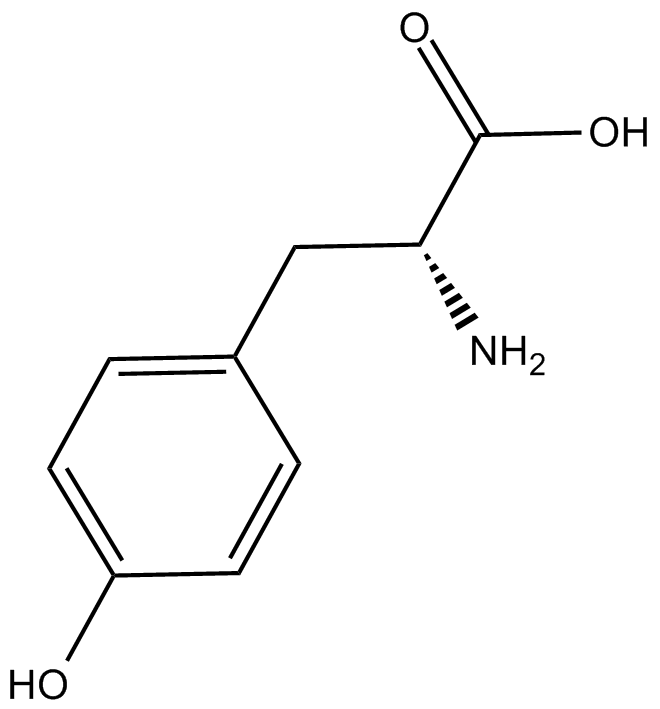





D-Tyrosine (CAS No.: 556-02-5) is the D-enantiomer of the non-essential amino acid tyrosine, a metabolite derived from phenylalanine in biological systems and broadly associated with pathways involved in catecholamine, thyroid hormone, and melanin biosynthesis. In contrast to the L-isomer, D-tyrosine exhibits distinct biochemical properties and has been characterized as a modulator of enzymatic and microbial processes relevant to biomedical research. Notably, it functions as a negative regulator of melanogenesis through inhibition of tyrosinase activity, making it a useful tool for investigating pigmentation pathways and enzyme regulation in cellular models. In addition, D-tyrosine has been shown to interfere with bacterial biofilm dynamics by inhibiting biofilm formation and promoting biofilm dispersal without directly suppressing bacterial proliferation, highlighting its utility in studies of microbial community behavior and surface-associated growth. These effects are typically observed in vitro at concentrations ranging from low micromolar to millimolar levels, depending on the experimental system and organism studied. As such, D-tyrosine is widely applied in biochemical, microbiological, and cell-based assays to elucidate mechanisms of enzyme inhibition, intercellular signaling, and biofilm regulation, with experimental concentrations and conditions tailored to specific research objectives.
| Physical Appearance | Solid |
| Storage | -20°C |
| M.Wt | 181.19 |
| Cas No. | 556-02-5 |
| Formula | C9H11NO3 |
| Solubility | Insoluble in DMSO; insoluble in EtOH; insoluble in H2O |
| Chemical Name | (R)-2-amino-3-(4-hydroxyphenyl)propanoic acid |
| Canonical SMILES | N[C@@H](C(O)=O)CC1=CC=C(O)C=C1 |
| Shipping Condition | Small Molecules with Blue Ice, Modified Nucleotides with Dry Ice. |
| General tips | We do not recommend long-term storage for the solution, please use it up soon. |