


D-(-)-Mandelic acid
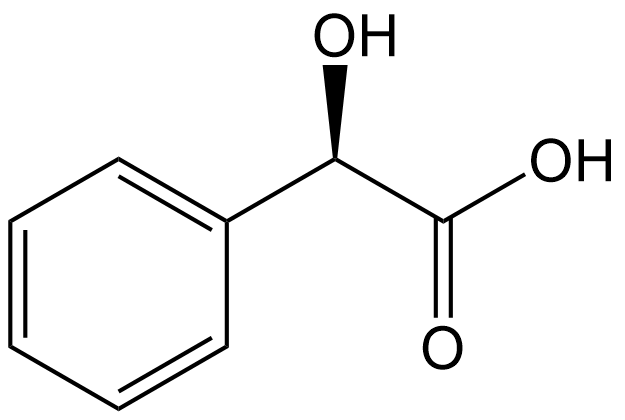
D-(-)-Mandelic acid(D-(−)-mandelic acid, (R)-(−)-configuration, CAS No. 611-71-2)belongs to α-hydroxy aromatic carboxylic acids and is an important chiral synthetic building block in the pharmaceutical and chemical fields. It can be used as a key chiral intermediate in the production of various drugs, including semisynthetic penicillins, cephalosporins, anti-obesity agents, and antitumor drugs, and can also be used as a chiral resolving reagent for chemical resolution. Its core biological effects are mainly nonspecific, pH-dependent physicochemical actions: its antibacterial activity follows the Rosenheim mechanism, relying on the undissociated free organic acid form to exert bacteriostatic / bactericidal effects, and it is effective only in an acidic environment(such as urine pH ≤5.5). After salt formation(such as the sodium salt), the activity is lost. It is effective against both Gram-positive and Gram-negative bacteria and is not prone to inducing resistance. As an α-hydroxy acid, it also has keratolytic activity, and it is the main urinary metabolite of styrene and ethylbenzene in humans, serving as a biomarker of occupational exposure.
Currently available public antibacterial MIC data mostly come from racemic mandelic acid preparations with unspecified configuration and cannot be directly equated with the D-form. Specifically, the MIC for Escherichia coli ATCC 25922 is 2.00 mg/mL, for Staphylococcus aureus ATCC 25923 is 1.75 mg/mL, for Listeria monocytogenes is 1.50 mg/mL, for Bacillus subtilis is 1.50 mg/mL, and for Salmonella typhimurium is 2.25 mg/mL, with a corresponding MBC range of 2.00–2.50 mg/mL, and MIC values against foodborne pathogens of 1.25–2.5 mg/mL. In an acidic urine model, under conditions of 5 mg/mL and pH 5.48, sensitive Escherichia coli can be killed, whereas methicillin-resistant Staphylococcus aureus clinical isolates require concentrations approximately one order of magnitude higher, with MIC₅₀/MIC₉₀ of 20/40 mg/mL and MBC₅₀/MBC₉₀ of 20/80 mg/mL. In terms of enzyme inhibitory activity, its IC₅₀ against PTP1B is 5500 μM, differing by only about 12% from the 4900 μM of the S-enantiomer, with no significance in terms of enantioselectivity.
Clinical applications mainly include three aspects: first, urinary tract antibacterial use. Methenamine mandelate(CAS No.: 587-23-5)is a commonly used clinical preparation, with an adult dosage of 1 g orally, 4 times daily. Urine pH≤5.5 must be maintained to ensure the antibacterial activity of free mandelic acid, which acts synergistically with formaldehyde released from methenamine, and is used for long-term bacteriostasis in chronic / recurrent urinary tract infections. It is contraindicated in individuals with renal insufficiency, gout, or a tendency to form uric acid stones, and concomitant use with sulfonamide drugs is prohibited. Second, topical dermatological use. Common clinical topical preparations are mostly racemic mandelic acid, with no clear configuration-specific evidence-based distinction. 45% or 40% mandelic acid peeling(once every 2 weeks, for a total of 6 sessions)has efficacy comparable to 30% salicylic acid in treating mild to moderate acne, with a lower incidence of adverse events such as erythema, supported by RCT evidence. A peeling regimen combining 20% salicylic acid with 10% mandelic acid for acne and hyperpigmentation is also supported by multiple RCTs. Market claims about enantiomeric differences such as “the D-form penetrates faster, while the L-form is gentler” are found only in manufacturer promotions and are not supported by peer-reviewed studies. Third, occupational exposure monitoring. Urinary mandelic acid levels can serve as a biomarker of occupational exposure to styrene and ethylbenzene.
| Storage | Store at RT |
| M.Wt | 152.15 |
| Cas No. | 611-71-2 |
| Formula | C8H8O3 |
| Synonyms | R-(−)-Mandelic Acid |
| Chemical Name | (R)-2-hydroxy-2-phenylacetic acid |
| Canonical SMILES | OC([C@H](O)C1=CC=CC=C1)=O |
| Shipping Condition | Small Molecules with Blue Ice, Modified Nucleotides with Dry Ice. |
| General tips | We do not recommend long-term storage for the solution, please use it up soon. |