


Chloranil
Chloranil (CAS No.: 118-75-2) is a quinone-based small molecule widely utilized in biomedical research as a fungicidal metabolite and oxidative stress–inducing agent, derived from environmental compounds such as pentachlorophenol and hexachlorobenzene. It is extensively applied in studies of redox biology and inflammatory signaling due to its ability to robustly promote reactive oxygen species generation and activate the ROS–JNK–NOX2 signaling cascade, leading to the formation of neutrophil extracellular traps and modulation of innate immune responses. Chloranil has also been shown to engage Toll-like receptor 4–dependent pathways, contributing to inflammation and neurological dysfunction, and is therefore employed in experimental models to investigate neuroinflammation and immune-mediated tissue injury. In neuronal systems, it serves as a tool compound to induce ferroptosis and associated oxidative damage, while in stem cell models it can trigger apoptosis, supporting its use in dissecting mechanisms of regulated cell death and stress signaling. Its biological activity is typically observed in the nanomolar to micromolar concentration range depending on the cellular context and assay conditions. Chloranil is broadly applicable in in vitro and in vivo models for probing oxidative stress, inflammation, and cell death pathways, as well as for screening modulators of these processes, with experimental concentrations or dosing regimens determined by specific study designs and objectives.
| Physical Appearance | A solid |
| Storage | -20°C |
| M.Wt | 245.88 |
| Cas No. | 118-75-2 |
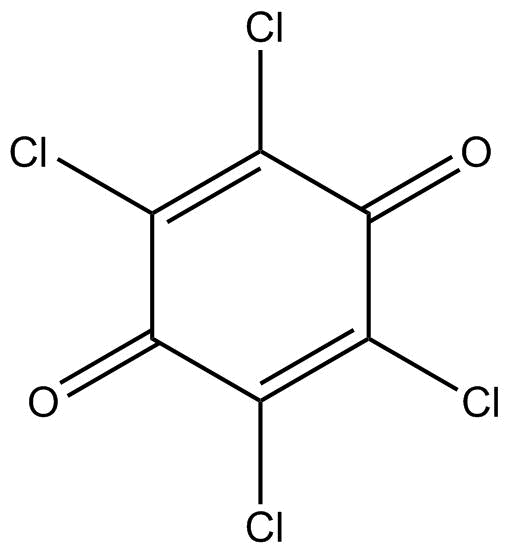
| Formula | C6Cl4O2 |
| Solubility | insoluble in EtOH; insoluble in H2O; ≥27.3 mg/mL in DMSO |
| Chemical Name | 2,3,5,6-tetrachlorocyclohexa-2,5-diene-1,4-dione |
| Canonical SMILES | ClC1=C(Cl)C(C(Cl)=C(Cl)C1=O)=O |
| Shipping Condition | Small Molecules with Blue Ice, Modified Nucleotides with Dry Ice. |
| General tips | We do not recommend long-term storage for the solution, please use it up soon. |