


Ceftolozane sulfate
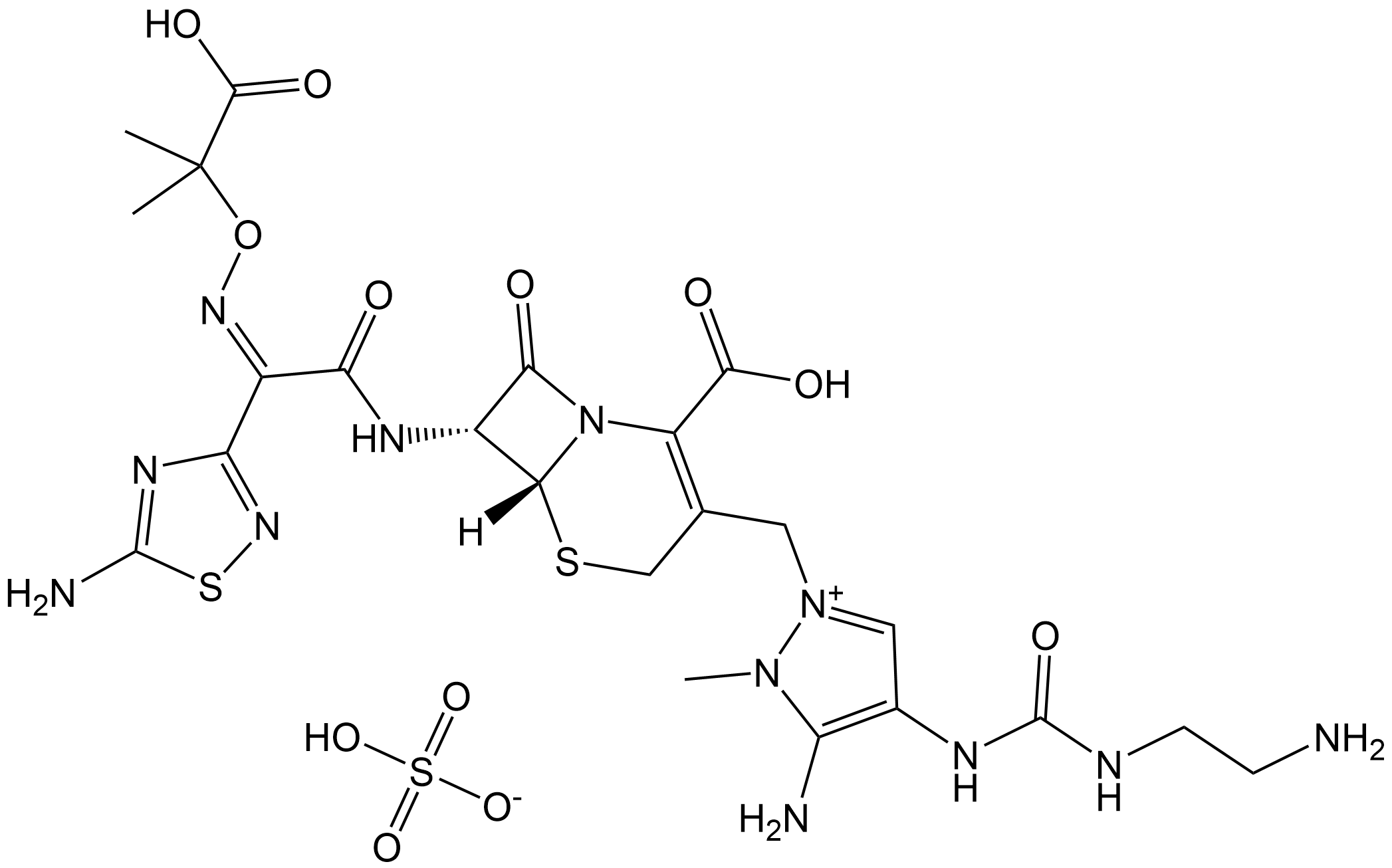
Ceftolozane sulfate (CAS No. 936111-69-2) is the sulfate form of Ceftolozane. Ceftolozane is a time-dependent oxyimino cephalosporin antibacterial agent; its core biological function is to inhibit bacterial penicillin-binding proteins (PBP3 as the primary target), and it also binds Pseudomonas aeruginosa PBP1b and PBP1c with high affinity to block cell wall synthesis and exert bactericidal activity. It is highly stable against chromosomal AmpC β-lactamases.
Key activity data: for Pseudomonas aeruginosa, MIC₅₀/MIC₉₀ is 0.5/2 mg/L; for multidrug-resistant / extensively drug-resistant Pseudomonas aeruginosa, MIC₉₀ is 8/16 mg/L; for non-carbapenemase-producing Enterobacterales, MIC₅₀/MIC₉₀ is 0.25/0.5-4 mg/L; for ESBL-producing Klebsiella pneumoniae, MIC₉₀ increases to 16-32 mg/L; it has no antibacterial activity against carbapenemase-producing strains (MIC>64 mg/L).
Animal studies are commonly used for disease model treatment; common application models include neutropenic mouse thigh Pseudomonas aeruginosa / Enterobacterales infection models, used to evaluate bactericidal efficacy and PK/PD targets.
Common applications and concentrations: in cell culture, for in vitro susceptibility testing (cation-adjusted MH broth), the test concentration range is 0.03-32 mg/L; in animal studies, dosing is based on human-equivalent doses, with the bactericidal target being the percentage of the dosing interval during which free drug concentrations exceed the MIC at 30%-50%; clinically, for complicated intra-abdominal / urinary tract infections, 1 g every 8 hours by intravenous infusion is used; for hospital-acquired / ventilator-associated pneumonia and Pseudomonas aeruginosa bacteremia (patients with high renal clearance), 2 g every 8 hours by extended infusion is used, with an effective treatment concentration requirement of free drug concentrations exceeding the MIC for more than 40%-50% of the dosing interval.
References:
[1] Cho JC, Fiorenza MA, Estrada SJ. Ceftolozane/Tazobactam: A Novel Cephalosporin/β-Lactamase Inhibitor Combination. Pharmacotherapy. 2015 Jul;35(7):701-15. doi: 10.1002/phar.1609. Epub 2015 Jul 1. PMID: 26133315.
[2] Ruiz J, Ferrada A, Salavert M, Gordon M, Villarreal E, Castellanos-Ortega Á, Ramirez P. Ceftolozane/Tazobactam Dosing Requirements Against Pseudomonas aeruginosa Bacteremia. Dose Response. 2020 Jan 29;18(1):1559325819885790. doi: 10.1177/1559325819885790. PMID: 32063809; PMCID: PMC6990616.
[3] Candel FJ, González Del Castillo J, Julián Jiménez A, Matesanz M. Ceftolozane-tazobactam in nosocomial pneumonia. Rev Esp Quimioter. 2022 Apr;35 Suppl 1(Suppl 1):35-039. doi: 10.37201/req/s01.08.2022. Epub 2022 Apr 22. Erratum in: Rev Esp Quimioter. 2022 Sep 27;35(5):508. doi: 10.37201/req/erratum01.2022. PMID: 35488823; PMCID: PMC9106209.
[4] Deroche L, Aranzana-Climent V, Rozenholc A, Prouvensier L, Darnaud L, Grégoire N, Marchand S, Ploy M-C, François B, Couet W, Barraud O, Buyck JM. Characterization of Pseudomonas aeruginosa resistance to ceftolozane-tazobactam due to ampC and/or ampD mutations observed during treatment using semi-mechanistic PKPD modeling. Antimicrob Agents Chemother. 2023 Oct 18;67(10):e0048023. doi: 10.1128/aac.00480-23. Epub 2023 Sep 11. PMID: 37695298; PMCID: PMC10583683.
[5] Santerre Henriksen A, Jeannot K, Oliver A, Perry JD, Pletz MW, Stefani S, Morrissey I, Longshaw C; ARTEMIS Study Investigators. In vitro activity of cefiderocol against European Pseudomonas aeruginosa and Acinetobacter spp., including isolates resistant to meropenem and recent β-lactam/β-lactamase inhibitor combinations. Microbiol Spectr. 2024 Apr 2;12(4):e0383623. doi: 10.1128/spectrum.03836-23. Epub 2024 Mar 14. PMID: 38483164; PMCID: PMC10986614.
[6] Santerre Henriksen A, Arena F, Attwood M, Canton R, Gatermann S, Naas T, Morrissey I, Longshaw C; ARTEMIS Study Investigators. In vitro activity of cefiderocol against European Enterobacterales, including isolates resistant to meropenem and recentβ-lactam/β-lactamase inhibitor combinations. Microbiol Spectr. 2024 Jun 21;12(8):e0418123. doi: 10.1128/spectrum.04181-23. Epub ahead of print. PMID: 38904361; PMCID: PMC11302063.
| Storage | 4℃, sealed storage, away from moisture |
| M.Wt | 764.77 |
| Cas No. | 936111-69-2 |
| Formula | C23H32N12O12S3 |
| Synonyms | CXA-101; FR264205 |
| Chemical Name | 5-amino-2-(((6R,7R)-7-((Z)-2-(5-amino-1,2,4-thiadiazol-3-yl)-2-(((2-carboxypropan-2-yl)oxy)imino)acetamido)-2-carboxy-8-oxo-5-thia-1-azabicyclo[4.2.0]oct-2-en-3-yl)methyl)-4-(3-(2-aminoethyl)ureido)-1-methyl-1H-pyrazol-2-ium hydrogen sulfate |
| Canonical SMILES | OS([O-])(=O)=O.[H][C@]12SCC(C[N+]3=CC(NC(=O)NCCN)=C(N)N3C)=C(N1C(=O)[C@H]2NC(=O)C(=N/OC(C)(C)C(O)=O)\C1=NSC(N)=N1)C(O)=O |
| Shipping Condition | Small Molecules with Blue Ice, Modified Nucleotides with Dry Ice. |
| General tips | We do not recommend long-term storage for the solution, please use it up soon. |