


Cefozopran hydrochloride
Cefozopran hydrochloride (CAS No.: 113981-44-5) is a semisynthetic small molecule beta lactam antibacterial research compound in the fourth generation cephalosporin class, widely categorized in anti infective discovery and microbiology focused pharmacology as a broad spectrum inhibitor of bacterial cell wall biogenesis with activity against Gram positive and Gram negative organisms, and it is commonly used as a reference scaffold for studying structure activity relationships and resistance relevant phenotypes in preclinical laboratory systems. Mechanistically, cefozopran derived molecules primarily engage penicillin binding proteins involved in the terminal stages of peptidoglycan assembly, thereby disrupting transpeptidation and cell wall maturation, which leads to morphological abnormalities such as elongation, filamentation, and aberrant septation followed by bactericidal and lytic outcomes in susceptible strains; this mechanism is associated with canonical peptidoglycan synthesis networks rather than host signaling cascades, making the compound particularly suitable for target based antibacterial profiling, susceptibility testing, and pathway level interrogation of cell envelope stress responses. Across published microbiological evaluations of this class, potency is generally described in the low to moderate micromolar equivalent activity space when translated from susceptibility endpoints, and minimum inhibitory concentrations are typically reported in low concentration ranges that vary by species, strain background, inoculum, and resistance determinants, so experimental interpretation should rely on standardized assay conditions rather than fixed universal values. In biomedical research workflows, cefozopran hydrochloride is frequently applied in in vitro bacterial growth inhibition assays, time kill and post antibiotic effect characterization, resistance selection studies, and combination screening paradigms, and it is also used in animal infection research models including respiratory, urinary tract, and soft tissue burden reduction paradigms to benchmark antibacterial response under controlled experimental settings; the concentrations or doses used in experiments typically depend on specific experimental designs and research objectives, including organism susceptibility, exposure duration, and the pharmacodynamic hypotheses being tested.
| Storage | -20°C for 3 years |
| M.Wt | 551.99 |
| Cas No. | 113981-44-5 |
| Formula | C19H18ClN9O5S2 |
| Synonyms | SCE-2787 hydrochloride |
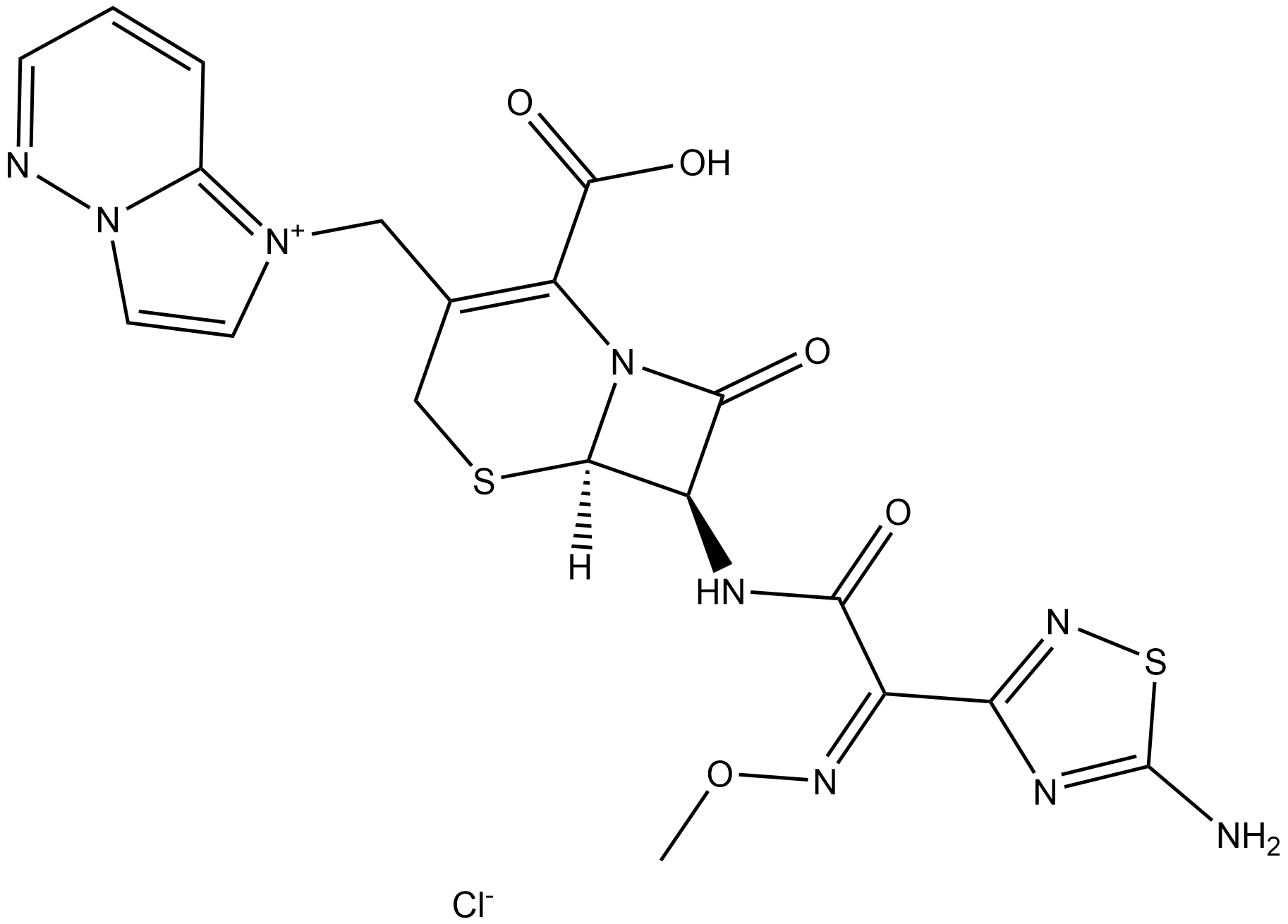
| Chemical Name | 1-(((6R,7R)-7-((Z)-2-(5-amino-1,2,4-thiadiazol-3-yl)-2-(methoxyimino)acetamido)-2-carboxy-8-oxo-5-thia-1-azabicyclo[4.2.0]oct-2-en-3-yl)methyl)imidazo[1,2-b]pyridazin-1-ium chloride |
| Canonical SMILES | C(O)(=O)C=1N2[C@@]([C@H](NC(/C(=N\OC)/C3=NSC(N)=N3)=O)C2=O)(SCC1C[N+]4=C5N(C=C4)N=CC=C5)[H].[Cl-] |
| Shipping Condition | Small Molecules with Blue Ice, Modified Nucleotides with Dry Ice. |
| General tips | We do not recommend long-term storage for the solution, please use it up soon. |