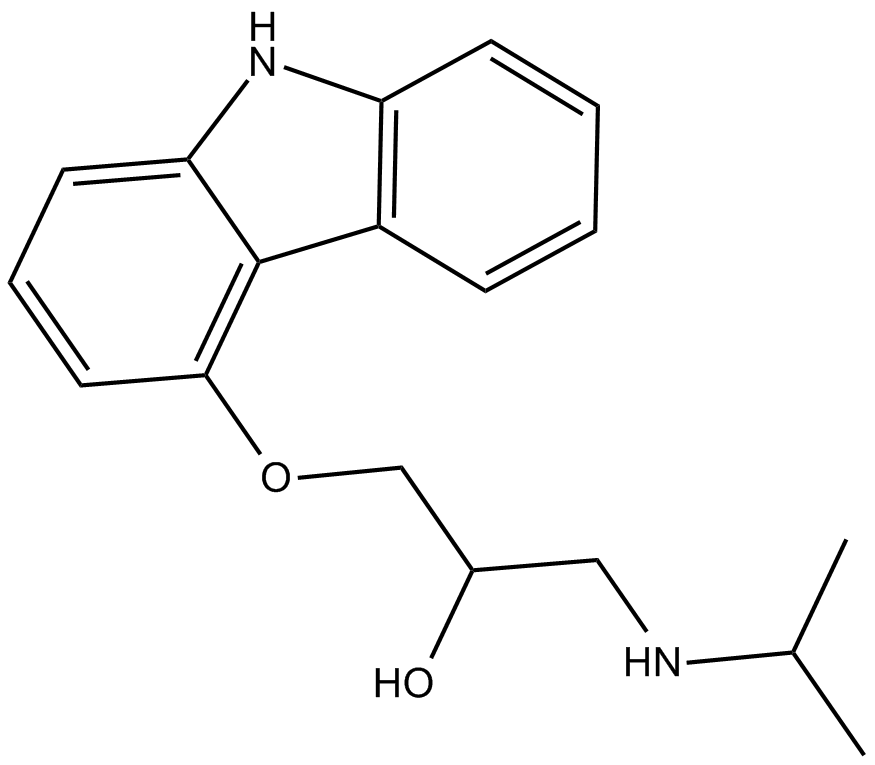
Carvedilol
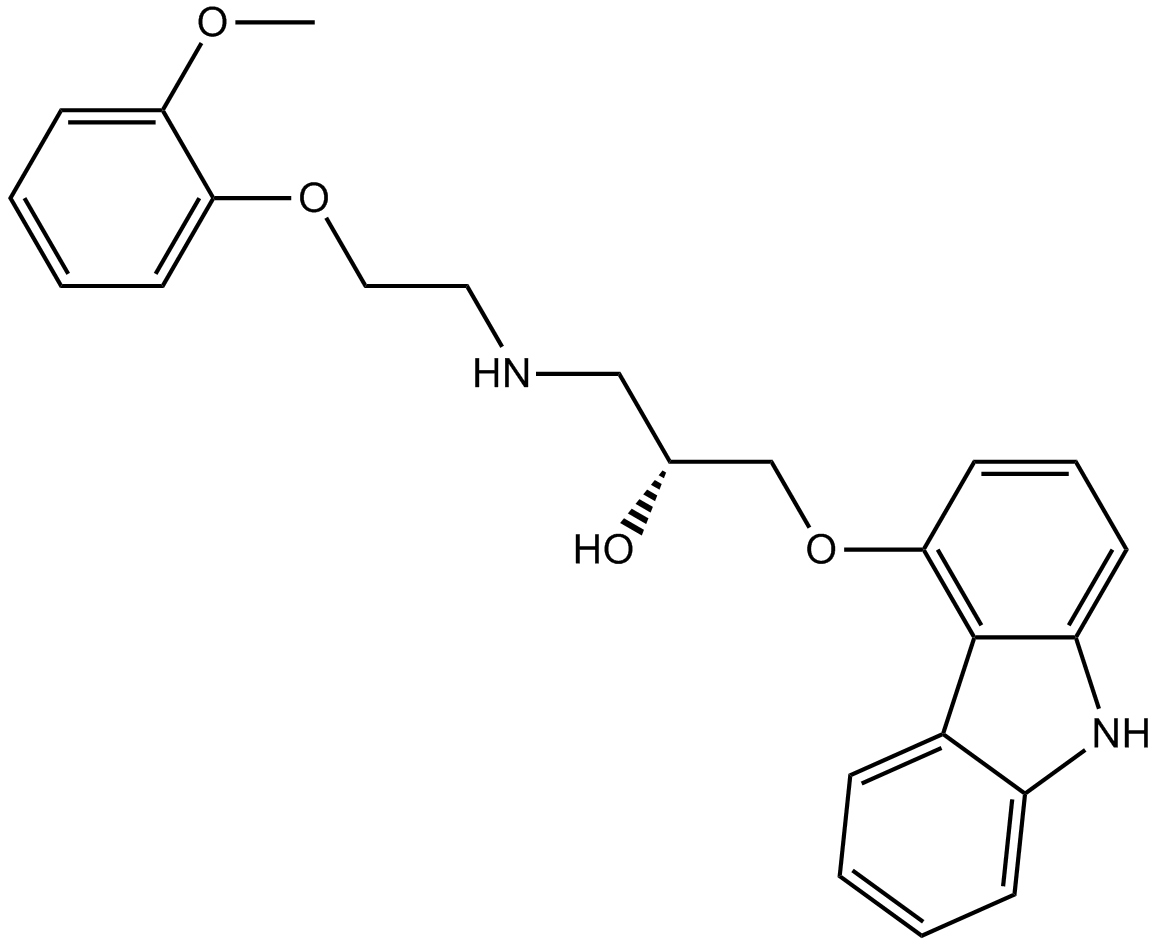
Carvedilol (BM14190) is an antagonist of α1- and β-adrenergic receptors (AR) and is used to treat congestive heart failure (CHF) and hypertension [1].
Adrenergic receptors are a class of G protein-coupled receptors, targets of norepinephrine and epinephrine, and are involved in the sympathetic nervous system [2].
In vitro: Carvedilol rapidly inhibited Fe2+-initiated lipid peroxidation in rat brain homogenates, with an IC50 of 8.1 μM. In rat brain homogenates, Carvedilol protected the homogenate from Fe2+-induced α-tocopherol depletion, with an IC50 of 17.6 μM. Carvedilol reduced the intensity of the DMPO-OH signal in a dose-dependent manner, with an IC50 of 25 μM [1]. Carvedilol prevents vascular smooth muscle cell proliferation, migration, and neointimal formation after vascular injury. In cultured human pulmonary artery vascular smooth muscle cells, Carvedilol (0.1-10 μM) inhibited mitogenesis stimulated by platelet-derived growth factor, epidermal growth factor, thrombin, and serum in a concentration-dependent manner, with IC50 values of 0.3-2.0 μM. Carvedilol inhibited platelet-derived growth factor-induced vascular smooth muscle cell migration in a concentration-dependent manner, with an IC50 of 3 μM [3].
References:
[1].? Yue T L, Cheng H Y, Lysko P G, et al. Carvedilol, a new vasodilator and beta adrenoceptor antagonist, is an antioxidant and free radical scavenger[J]. Journal of Pharmacology and Experimental Therapeutics, 1992, 263(1): 92-98.
[2].?Furchgott R F. The receptors for epinephrine and norepinephrine (adrenergic receptors)[J]. Pharmacological reviews, 1959, 11(2): 429-441.
[3].?Ohlstein E H, Douglas S A, Sung C P, et al. Carvedilol, a cardiovascular drug, prevents vascular smooth muscle cell proliferation, migration, and neointimal formation following vascular injury[J]. Proceedings of the National Academy of Sciences, 1993, 90(13): 6189-6193.
- 1. Jinsuke Nishino, Wenhuo Hu, et al. "Nonselective β-Adrenergic Receptor Inhibitors Impair Hematopoietic Regeneration in Mice and Humans after Hematopoietic Cell Transplants." Cancer Discov. 2025 Apr 2;15(4):748-766. PMID: 39786370
- 2. Chen SJ, Tsui PF, et al. "Carvedilol Ameliorates Experimental Atherosclerosis by Regulating Cholesterol Efflux and Exosome Functions." Int J Mol Sci. 2019 Oct 20;20(20). pii: E5202. PMID: 31635197
| Physical Appearance | A solid |
| Storage | -20°C |
| M.Wt | 406.47 |
| Cas No. | 72956-09-3 |
| Formula | C24H26N2O4 |
| Solubility | ≥40.6 mg/mL in DMSO; insoluble in H2O; ≥2.415 mg/mL in EtOH with gentle warming and ultrasonic |
| Chemical Name | 1-(9H-carbazol-4-yloxy)-3-[2-(2-methoxyphenoxy)ethylamino]propan-2-ol |
| Canonical SMILES | COc(cccc1)c1OCCNCC(COc1c(c(cccc2)c2[nH]2)c2ccc1)O |
| Shipping Condition | Small Molecules with Blue Ice, Modified Nucleotides with Dry Ice. |
| General tips | We do not recommend long-term storage for the solution, please use it up soon. |
| Cell experiment [1]: | |
|
Cell lines |
human neutrophils |
|
Preparation method |
The solubility of this compound in DMSO is >20.3mg/mL. General tips for obtaining a higher concentration: Please warm the tube at 37℃ for 10 minutes and/or shake it in the ultrasonic bath for a while. Stock solution can be stored below -20℃ for several months. |
|
Reacting condition |
10~100μM |
|
Applications |
Carvedilol inhibited PMA-induced O2- production in human neutrophils in a dose-dependent manner with an IC50 value of 28μM. |
| Animal experiment [2]: | |
|
Animal models |
Lewis rats induced with acute experimental autoimmune myocarditis |
|
Dosage form |
20 mg/kg/day for 3 wk |
|
Application |
Carvedilol suppressed left ventricular fractional shortening and decreased heart rates, markedly reduced the severity of myocarditis and suppressed thickening of the left ventricular posterior wall in rats with experimental autoimmune myocarditis. |
|
Other notes |
Please test the solubility of all compounds indoor, and the actual solubility may slightly differ with the theoretical value. This is caused by an experimental system error and it is normal. |
|
References: [1] Wu TC, Chen YH, Leu HB, Chen YL, Lin FY, Lin SJ, Chen JW. Carvedilol, a pharmacological antioxidant, inhibits neointimal matrix metalloproteinase-2 and -9 in experimental atherosclerosis. Free Radic Biol Med. 2007 Dec 1;43(11):1508-22. [2] Yuan Z, Shioji K, Kihara Y, Takenaka H, Onozawa Y, Kishimoto C. Cardioprotective effects of carvedilol on acute autoimmune myocarditis: anti-inflammatory effects associated with antioxidant property. Am J Physiol Heart Circ Physiol. 2004 Jan;286(1):H83-90. |
|
Quality Control & MSDS
- View current batch:
Chemical structure