


Cagrilintide acetate
Cagrilintide acetate is the acetate salt form of cagrilintide (CAS No.: 1415456-99-3). Cagrilintide is a long-acting human amylin analog developed through sequence engineering and fatty acylation. It is a nonselective full agonist of amylin receptors and the calcitonin receptor (CTR) and can activate AMY₁R and AMY₃R, formed by CTR with RAMP1 and RAMP3, respectively, as well as CTR alone. By activating c-Fos neuronal pathways upstream of AMY₁R/AMY₃R in brain regions including the area postrema, nucleus of the solitary tract, and lateral parabrachial nucleus, it suppresses food intake and delays gastric emptying via the vagus nerve. It also acts on hypothalamic energy metabolism pathways to promote fat mobilization, relatively preserving lean body mass while reducing body fat, and participates in glucose homeostasis by peripherally inhibiting glucagon secretion. In in vitro receptor functional assays, its EC₅₀ for human AMY₃R is approximately 49 pM (pEC₅₀=10.31), and its EC₅₀ for human CTR(a) is approximately 62 pM (pEC₅₀=10.21). In receptor binding assays, its IC₅₀ values for human AMY₃R and CTR(a) are approximately 170 pM and 223 pM, respectively, demonstrating high affinity and full agonist properties.
At the cellular level, Cagrilintide is mainly used in BHK, HeLa, and other cell lines stably expressing CTR and AMY₃R. Receptor activation, signal transduction, and structure–activity relationships are evaluated using cAMP reporter gene assays or fluorescence resonance energy transfer (FRET) assays. Treatment concentrations are generally in the picomolar to low-nanomolar range to characterize its potent agonist activity and fine selectivity toward AMY₁R/AMY₃R and CTR.
In animal experiments, Cagrilintide is mainly used for therapeutic intervention in rodent models of obesity fed a standard or high-fat diet. Continuous subcutaneous administration to mice at 3 nmol/kg/day for 3 weeks reduced body weight by approximately 3.4 g in high-fat-diet-fed wild-type mice, decreasing fat mass while largely preserving lean body mass. This weight-loss effect depends on AMY₁R and AMY₃R and disappears in RAMP1/3 double-knockout mice. Acute subcutaneous administration of 3–300 nmol/kg dose-dependently reduced 24 h food intake, with approximately 57% suppression of food intake at 300 nmol/kg. In rats, a single subcutaneous dose of 3 nmol/kg suppressed food intake for approximately 48–60 h. The elimination half-life following intravenous administration of 10 nmol/kg was approximately 20 h; the half-life following subcutaneous administration was approximately 27 h, and subcutaneous bioavailability was approximately 30%, reflecting its long-acting pharmacokinetic profile suitable for once-weekly dosing.
Clinically, Cagrilintide is in development for obesity and type 2 diabetes and can be used as monotherapy or in combination with the GLP-1 receptor agonist semaglutide (Semaglutide, CAS No.: 910463-68-2, catalog No.: C8705). Once-weekly subcutaneous administration of 4.5 mg as monotherapy reduced body weight by approximately 10.8% in subjects with obesity over 26 weeks, with greater weight loss than daily 3.0 mg liraglutide (Liraglutide, CAS No.: 204656-20-2, catalog No.: B7949). When combined with 2.4 mg of once-weekly semaglutide for 20 weeks, body weight reduction reached approximately 17.1%. Clinical adverse reactions are mainly mild-to-moderate gastrointestinal reactions and dose-dependent injection-site reactions, with generally good tolerability.
References:
[1] Kruse T, Hansen JL, Dahl K, Schäffer L, Sensfuss U, Poulsen C, Schlein M, Hansen AMK, Jeppesen CB, Dornonville de la Cour C, Clausen TR, Johansson E, Fulle S, Skyggebjerg RB, Raun K. Development of Cagrilintide, a Long-Acting Amylin Analogue. J Med Chem. 2021 Aug 12;64(15):11183-11194. doi: 10.1021/acs.jmedchem.1c00565. Epub 2021 Jul 21. PMID: 34288673.
[2] Yao H, Zhang A, Li D, Wu Y, Wang CZ, Wan JY, Yuan CS. Comparative effectiveness of GLP-1 receptor agonists on glycaemic control, body weight, and lipid profile for type 2 diabetes: systematic review and network meta-analysis. BMJ. 2024 Jan 29;384:e076410. doi: 10.1136/bmj-2023-076410. PMID: 38286487; PMCID: PMC10823535.
[3] D'Ascanio AM, Mullally JA, Frishman WH. Cagrilintide: A Long-Acting Amylin Analog for the Treatment of Obesity. Cardiol Rev. 2024 Jan-Feb 01;32(1):83-90. doi: 10.1097/CRD.0000000000000513. Epub 2023 Oct 20. PMID: 36883831.
[4] Carvas AO, Leuthardt A, Kulka P, Lommi G, Hassan S, Coester B, Lundh S, Pers T, Secher A, Raun K, Lutz TA, Le Foll C. Cagrilintide lowers bodyweight through brain amylin receptors 1 and 3. EBioMedicine. 2025 Aug;118:105836. doi: 10.1016/j.ebiom.2025.105836. Epub 2025 Jul 3. PMID: 40609154; PMCID: PMC12270663.
| Storage | -20℃, stored under nitrogen, away from moisture and light |
| M.Wt | 4409.01 (free base) |
| Cas No. | 1415456-99-3 (free base) |
| Formula | C194H312N54O59S2.xC2H4O2 |
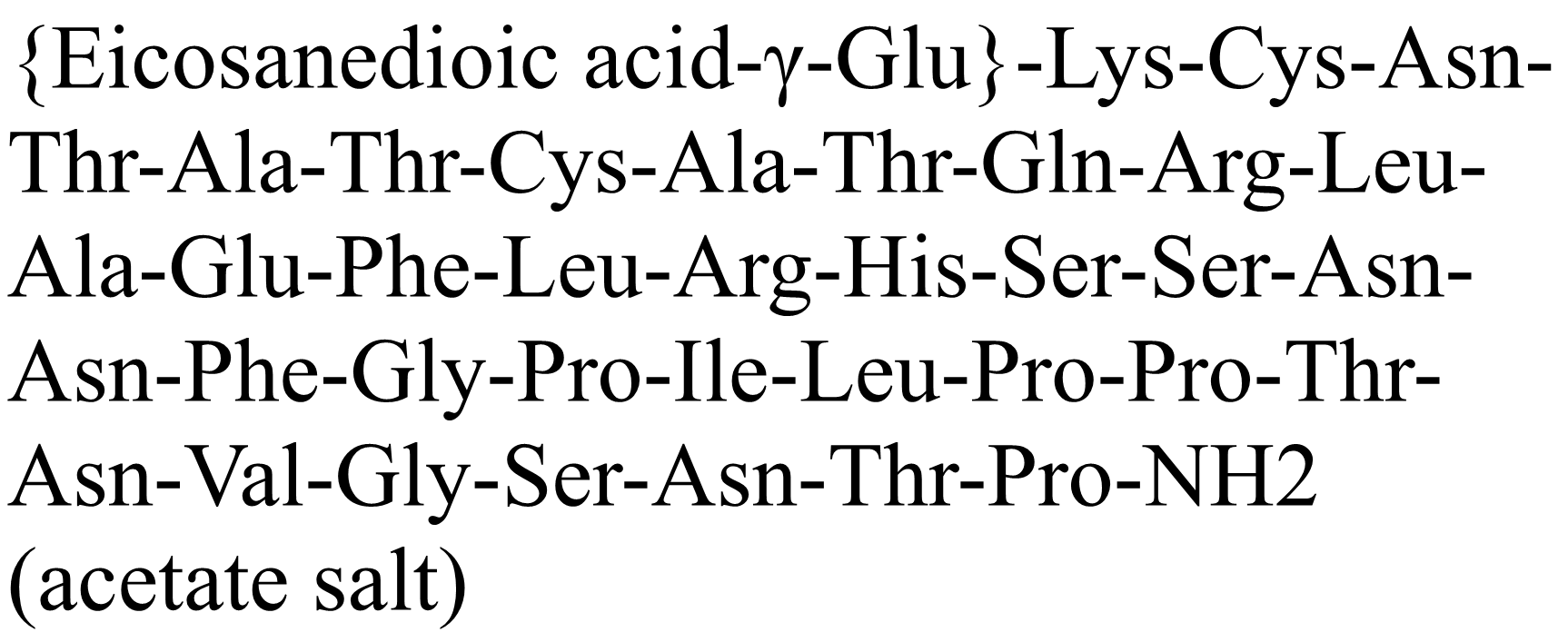
| Canonical SMILES | {Eicosanedioic acid-γ-Glu}-Lys-Cys-Asn-Thr-Ala-Thr-Cys-Ala-Thr-Gln-Arg-Leu-Ala-Glu-Phe-Leu-Arg-His-Ser-Ser-Asn-Asn-Phe-Gly-Pro-Ile-Leu-Pro-Pro-Thr-Asn-Val-Gly-Ser-Asn-Thr-Pro-NH2 (Disulfide bridge:Cys3-Cys8) |
| Shipping Condition | Small Molecules with Blue Ice, Modified Nucleotides with Dry Ice. |
| General tips | We do not recommend long-term storage for the solution, please use it up soon. |