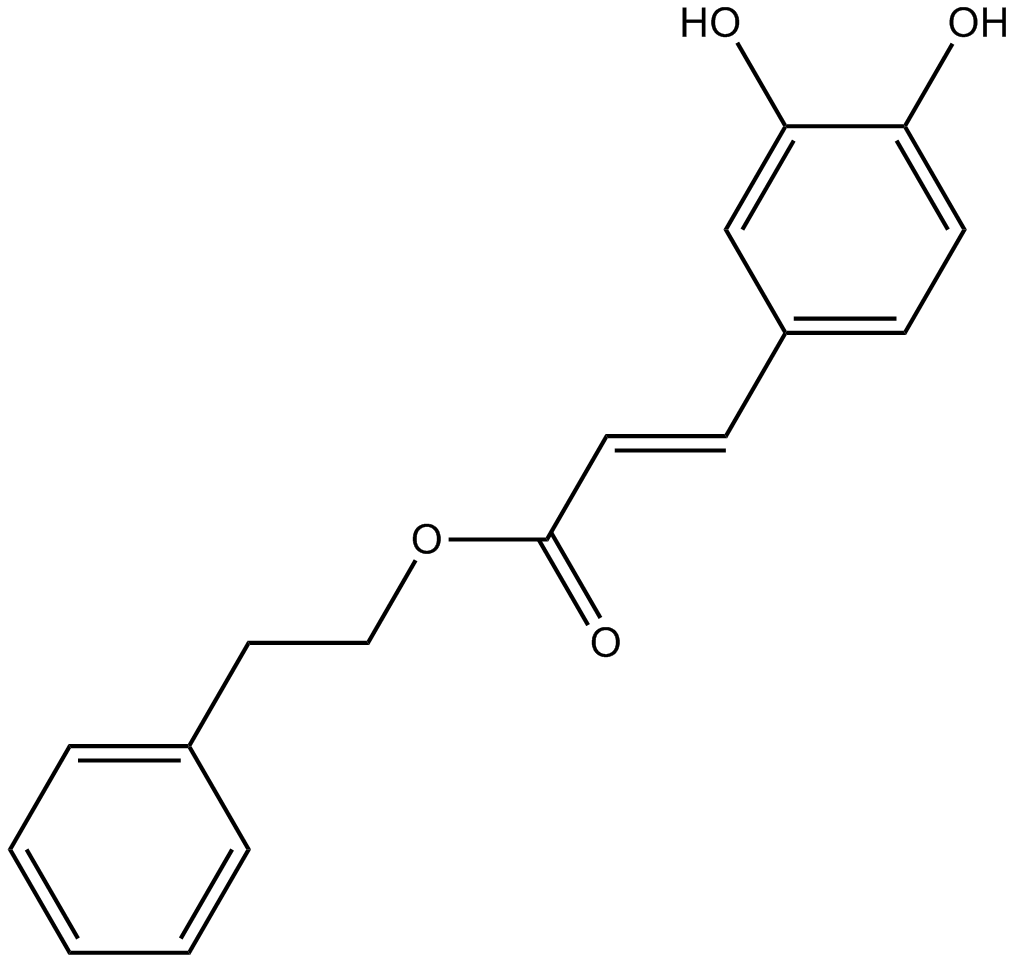
Caffeic Acid Phenethyl Ester
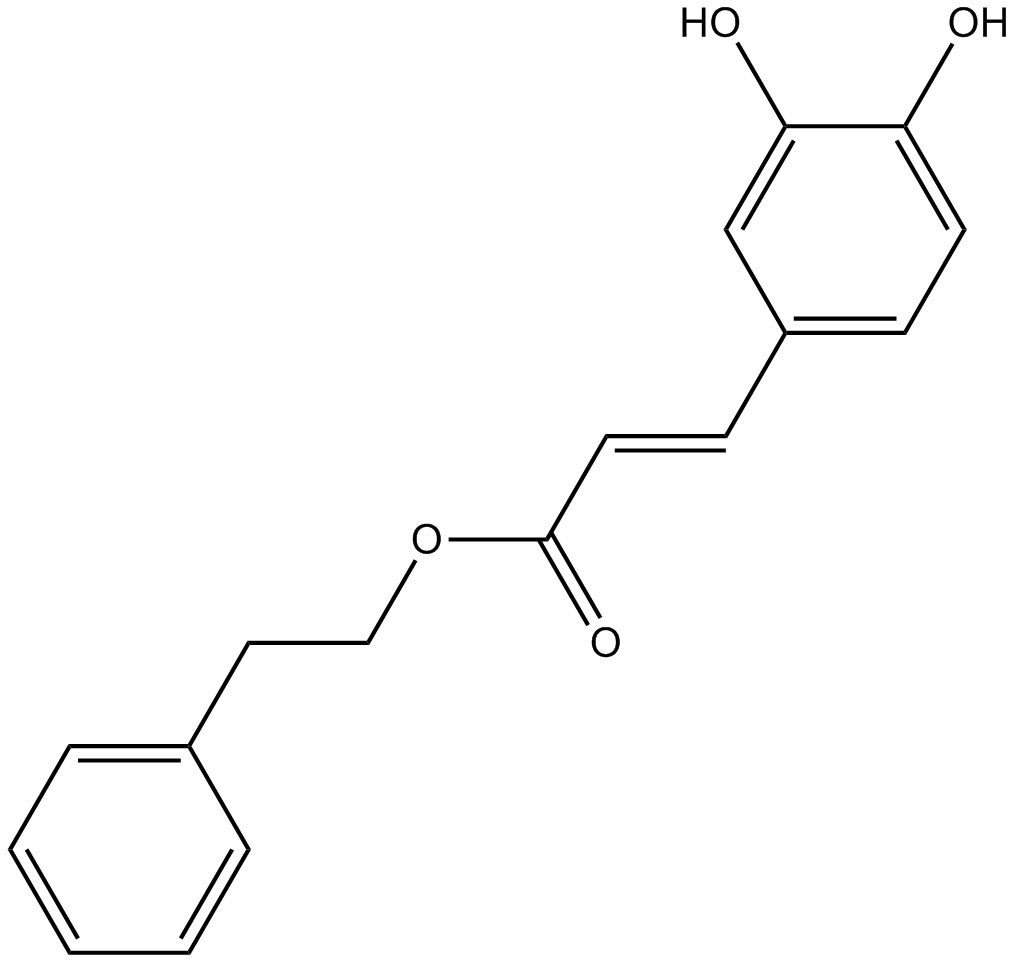
Caffeic acid phenethyl ester (Caffeic acid phenethyl ester, CAPE) is an inhibitor of NF-κB activation [1].
CAPE is derived from propolis and has multiple biological activities. This compound is an inhibitor of NF-κB. In U937 cells, CAPE dose-dependently inhibits TNF-dependent NF-κB activation, with the maximal effect at 25 μg/ml. CAPE also inhibits NF-κB activation induced by phorbol ester\ceramide\okadaic acid and hydrogen peroxide. CAPE blocks NF-κB binding to DNA without affecting other transcription factors. CAPE also has angiogenesis-related effects. This compound inhibits the formation of capillary-like vessels. In addition, it can induce VEGF production in CT26 cell culture and animal models. CAPE can also effectively block CT26 cells from secreting MMP-2 and MMP-9 [1,2].
References:
[1] Natarajan K, Singh S, Burke TR Jr, Grunberger D, Aggarwal BB.? Caffeic acid phenethyl ester is a potent and specific inhibitor of activation of nuclear transcription factor NF-kappa B. Proc Natl Acad Sci U S A. 1996 Aug 20;93(17):9090-5.
[2] Liao HF, Chen YY, Liu JJ, Hsu ML, Shieh HJ, Liao HJ, Shieh CJ, Shiao MS, Chen YJ.? Inhibitory effect of caffeic acid phenethyl ester on angiogenesis, tumor invasion, and metastasis. J Agric Food Chem. 2003 Dec 31;51(27):7907-12.
| Physical Appearance | A solid |
| Storage | -20°C |
| M.Wt | 284.31 |
| Cas No. | 104594-70-9 |
| Formula | C17H16O4 |
| Synonyms | CAPE; 2- Phenylethyl Caffeate; β- Phenylethyl Caffeate |
| Solubility | ≥28.4 mg/mL in DMSO; insoluble in H2O; ≥108.6 mg/mL in EtOH |
| Chemical Name | 2-phenylethyl (E)-3-(3,4-dihydroxyphenyl)prop-2-enoate |
| Canonical SMILES | C1=CC=C(C=C1)CCOC(=O)C=CC2=CC(=C(C=C2)O)O |
| Shipping Condition | Small Molecules with Blue Ice, Modified Nucleotides with Dry Ice. |
| General tips | We do not recommend long-term storage for the solution, please use it up soon. |
| Cell experiment [1]: | |
|
Cell lines |
The human histiocytic cell line U937 cells |
|
Preparation method |
The solubility of this compound in DMSO is >10 mM. General tips for obtaining a higher concentration: Please warm the tube at 37℃ for 10 minutes and/or shake it in the ultrasonic bath for a while. Stock solution can be stored below -20℃ for several months. |
|
Reacting condition |
0, 5, 10, 15, 25 and 30 μg/ml; 2 h |
|
Applications |
In U937 cells, Caffeic Acid Phenethyl Ester (CAPE) inhibited the TNF-dependent activation of NF-KB in a dose-dependent manner, with maximum effect occurring at 25 ug/ml. CAPE (25 ug/ml) also blocked NF-KB activation induced by Phorbol Ester, Ceramide, Okadaic Acid, and Hydrogen Peroxide. |
| Animal experiment [2]: | |
|
Animal models |
CT26-bearing BALB/c male mice with pulmonary metastases |
|
Dosage form |
10 mg/kg/day, intraperitoneal injection |
|
Application |
In CT26-bearing BALB/c male mice with pulmonary metastases, CAPE decreased tumor colonization in the lung. Mice treated with CAPE survived longer than untreated controls. CAPE reduced plasma VEGF levels by 53.2%. |
|
Other notes |
Please test the solubility of all compounds indoor, and the actual solubility may slightly differ with the theoretical value. This is caused by an experimental system error and it is normal. |
|
References: [1] Natarajan K, Singh S, Burke TR Jr, Grunberger D, Aggarwal BB. Caffeic acid phenethyl ester is a potent and specific inhibitor of activation of nuclear transcription factor NF-kappa B. Proc Natl Acad Sci U S A. 1996 Aug 2;93(17):9090-5. [2] Liao HF, Chen YY, Liu JJ, Hsu ML, Shieh HJ, Liao HJ, Shieh CJ, Shiao MS, Chen YJ. Inhibitory effect of caffeic acid phenethyl ester on angiogenesis, tumor invasion, and metastasis. J Agric Food Chem. 2003 Dec 31;51(27):7907-12. | |
Quality Control & MSDS
- View current batch:
Chemical structure