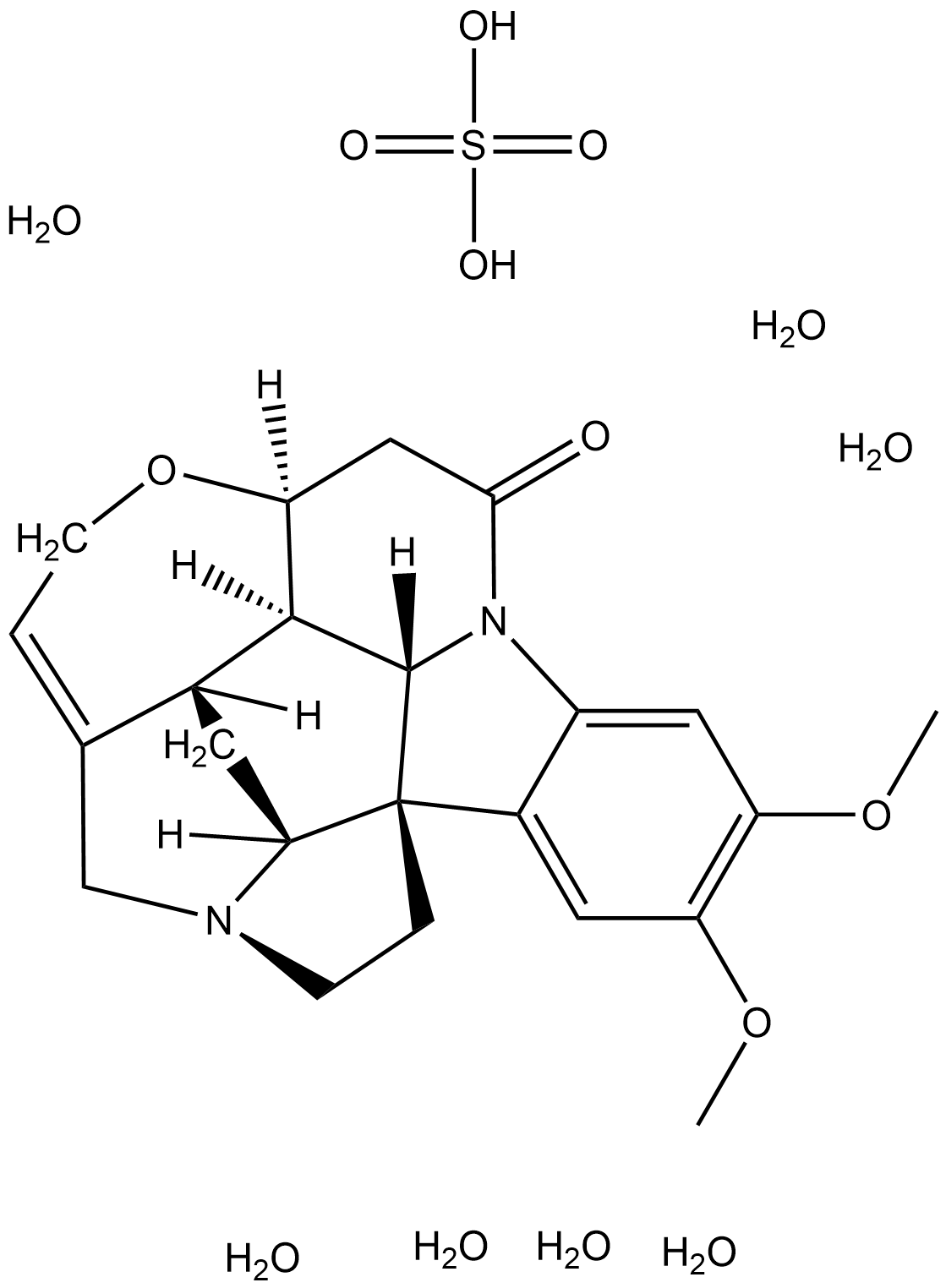
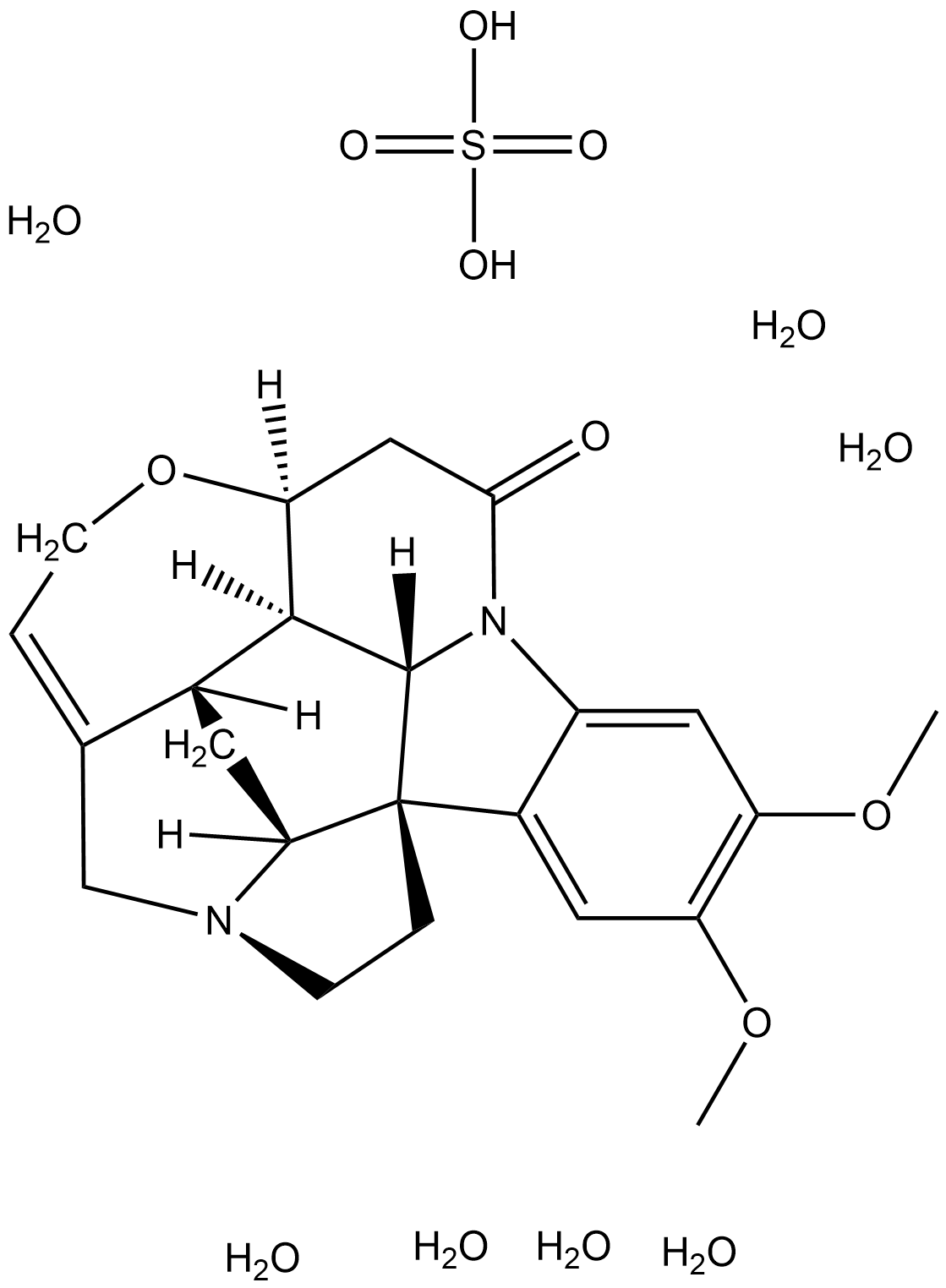
Brucine sulfate heptahydrate
Brucine sulfate heptahydrate (CAS No.: 60583-39-3) is a salt form of the indole alkaloid brucine, a natural product classically associated with Strychnos species and broadly categorized as a neuropharmacological research reagent for mechanistic studies in receptor biology, synaptic signaling, and small molecule probe development in life science discovery workflows. Within experimental systems, brucine is primarily characterized as an antagonist of glycine receptors, thereby reducing glycinergic inhibitory neurotransmission and functionally disinhibiting neuronal circuits, and it is commonly used to interrogate inhibitory synapse regulation, excitability dependent signaling, and network level responses in cellular and ex vivo neurobiology models. Consistent with alkaloid antagonist behavior in this target space, reported in vitro pharmacology for brucine and closely related preparations is generally discussed in the micromolar domain, with activity often described from low micromolar to broader micromolar ranges depending on receptor subtype context, assay platform, and readout methodology. In biomedical research pipelines, this compound is typically applied as a tool molecule in receptor validation assays, pathway perturbation experiments, and phenotypic screening designs that examine inhibitory tone, electrophysiological endpoints, and downstream transcriptional or calcium linked responses, while in vivo use is generally limited to controlled preclinical neuroscience paradigms under strict ethical and safety oversight. The concentrations or doses used in experiments typically depend on specific experimental designs and research objectives, including model system sensitivity, exposure duration, and intended depth of pathway modulation, and all handling is conducted exclusively for laboratory research purposes rather than any clinical, nutritional, or consumer use.
| Storage | -20°C for 3 years |
| Cas No. | 60583-39-3 |
| Formula | C23H26N2O4.1/2H2O4S.7/2H2O |
| Chemical Name | (4aR,4a1R,5aS,8aR,8a1S,15aS)-10,11-dimethoxy-2,4a,4a1,5,5a,7,8,8a1,15,15a-decahydro-14H-4,6-methanoindolo[3,2,1-ij]oxepino[2,3,4-de]pyrrolo[2,3-h]quinolin-14-one sulfate heptahydrate |
| Canonical SMILES | S(=O)(=O)(O)O.O=C1N2[C@@]3([C@]4(C=5C2=CC(OC)=C(OC)C5)[C@]6([N@@](CC4)CC=7[C@@]([C@]3([C@](C1)(OCC7)[H])[H])(C6)[H])[H])[H].O |
| Shipping Condition | Small Molecules with Blue Ice, Modified Nucleotides with Dry Ice. |
| General tips | We do not recommend long-term storage for the solution, please use it up soon. |
Quality Control & MSDS
- View current batch:
Chemical structure