


Anti-infection
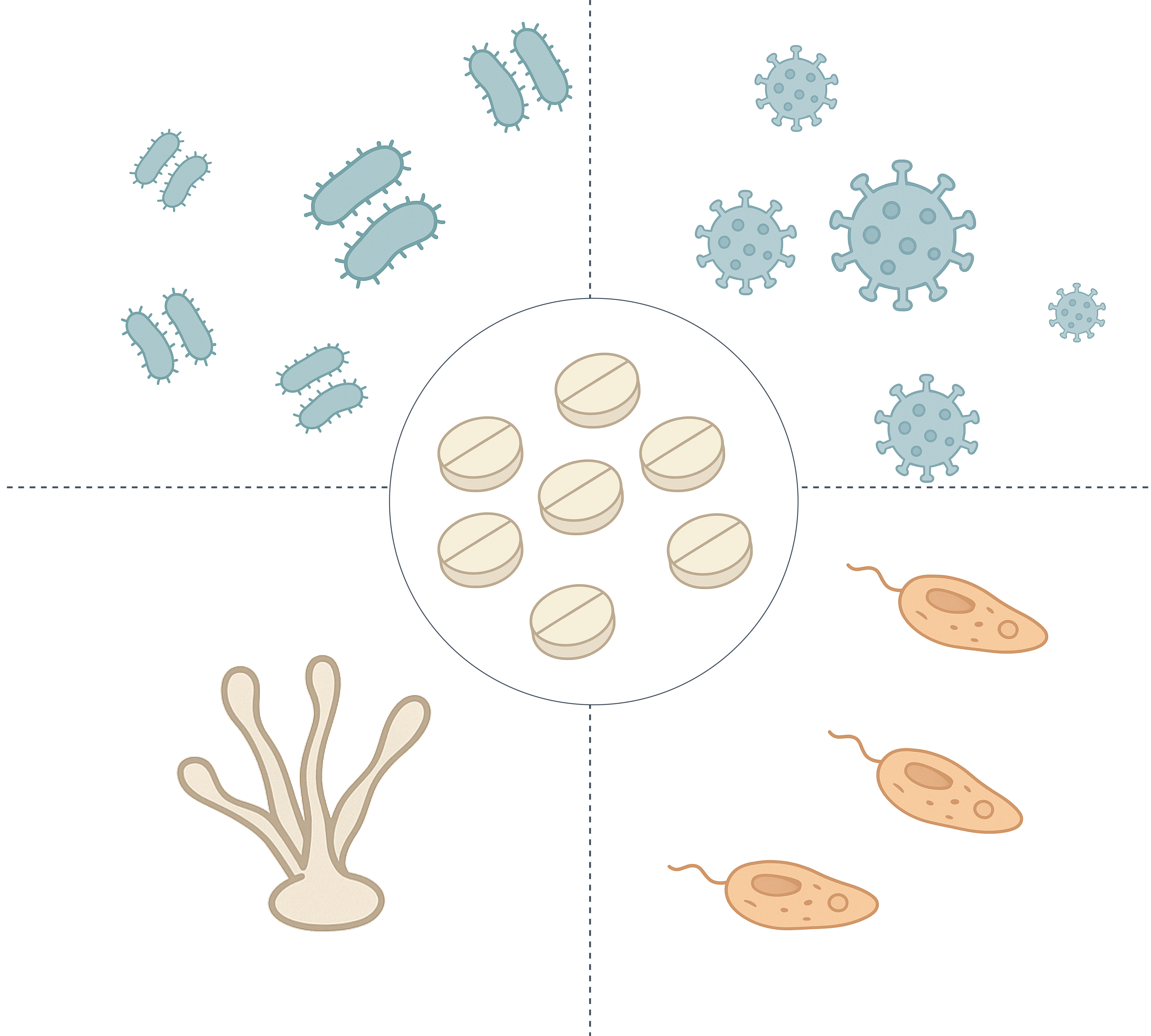
Anti-infectives are agents that eliminate or inhibit the spread of infectious organisms, encompassing antibiotics, antifungals, antivirals, and antiprotozoals.
Antibiotics are a class of antimicrobial agents specifically designed to target bacterial pathogens. They exert their effects by interfering with essential bacterial processes such as cell wall synthesis, protein synthesis, nucleic acid replication, and metabolic pathways, thereby either inhibiting bacterial growth or inducing bacterial death.
Antifungals are antimicrobial agents employed to combat fungal infections (mycoses) in humans and animals. Common antifungal classes include azoles, polyenes, echinocandins, and allylamines, which function by disrupting unique fungal structures or pathways, such as the synthesis or integrity of ergosterol-containing cell membranes and β-glucan-based cell walls, or by interfering with nucleic acid or protein synthesis.
Antivirals are compounds developed to inhibit the replication and spread of viruses within host organisms. Antivirals typically act by blocking viral entry, genome replication, protein processing, or virion assembly and release. Representative examples include nucleoside analogs, protease inhibitors, and neuraminidase inhibitors.
Antiprotozoals are drugs used to treat infections caused by protozoan parasites, including malaria, amebiasis, giardiasis, and trypanosomiasis. They act through a variety of mechanisms, including inhibition of nucleic acid synthesis, interference with mitochondrial function, and disruption of heme detoxification pathways in susceptible parasites.
-
 BA2302 KW-8232Summary: KW-8232 is an orally active anti-osteoporotic agent.
 -
BA2303 RdRP-IN-2Summary: RdRP-IN-2 is an RNA-dependent inhibitor of RNA polymerase.
-
BA2304 XP-59Summary: XP-59 is an effective inhibitor.
-
BA2305 CnicinSummary: Cnicin is a sesquiterpene lactone.
-
BA2306 SARS-CoV-2-IN-1Summary: SARS-CoV-2-IN-1 is a potent inhibitor.
-
BA2307 BurfiralimabSummary: Burfiralimab (hzVSF-v13) is a monoclonal antibody directed against waveform proteins expressed on the surface of virus-infected cells with broad-spectrum antiviral activity and anti-inflammatory effects against virus-induced inflammation.
-
BA2308 Z-Arg-Leu-Arg-Gly-Gly-AMCSummary: A peptide substrate for PL.
-
BA2309 PLpro-IN-1Summary: PLpro-IN-1 is an inhibitor (8.7 μM).
-
BA2310 NGI-1Summary: NGI-1 (ML414) is a potent inhibitor of oligosaccharyltransferases that directly targets and blocks the function of the OST catalytic subunits STT3A and STT3B.
-
BA2311 4E2RCatSummary: 4E2RCat is an inhibitor of the interaction.