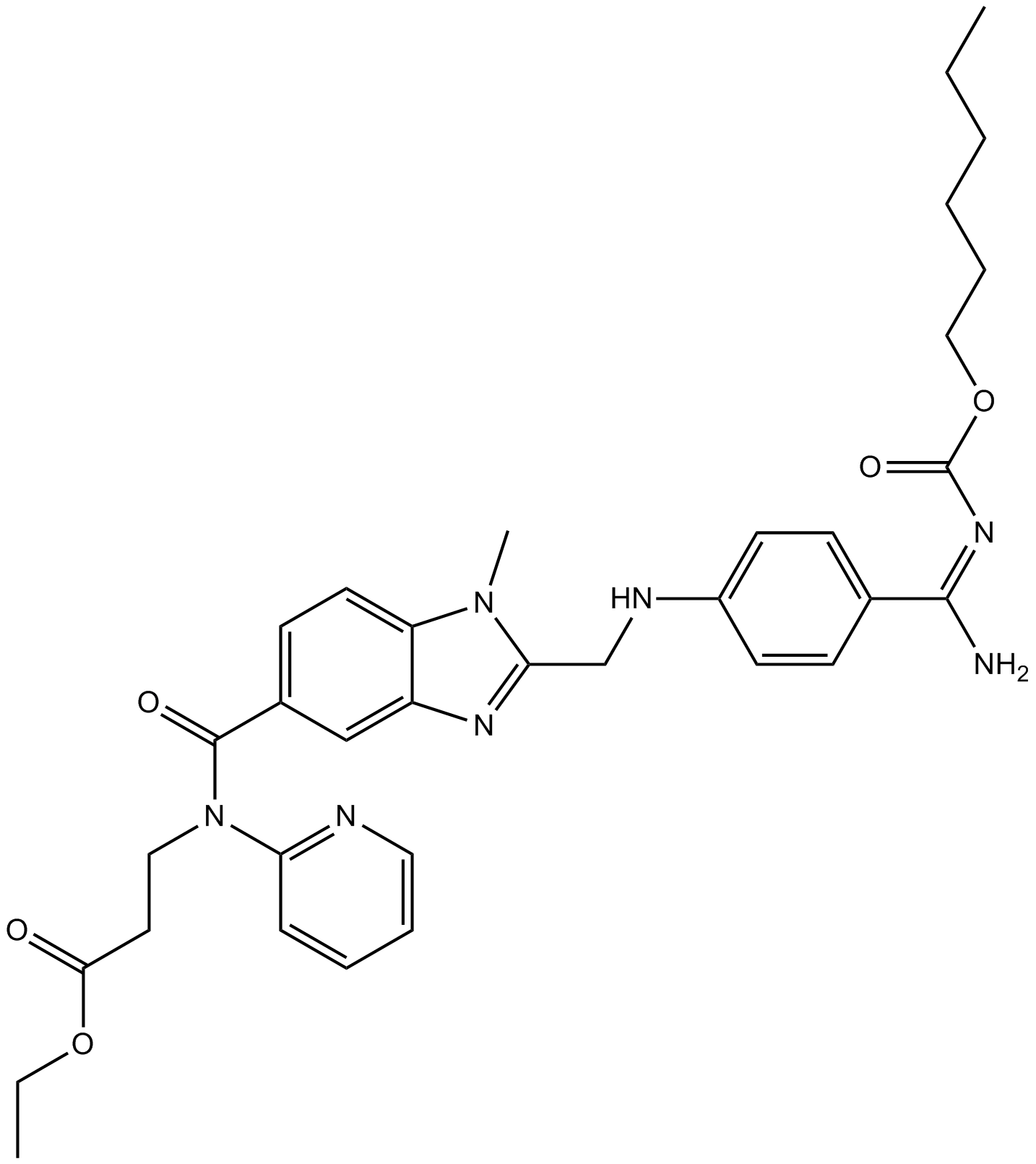
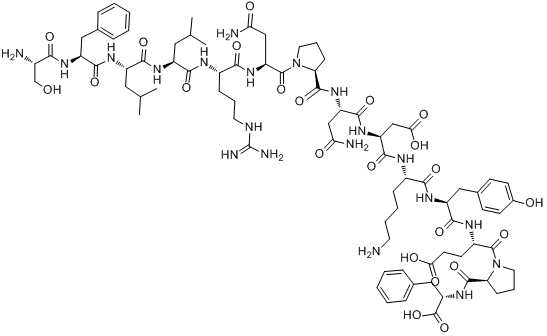
Dabigatran
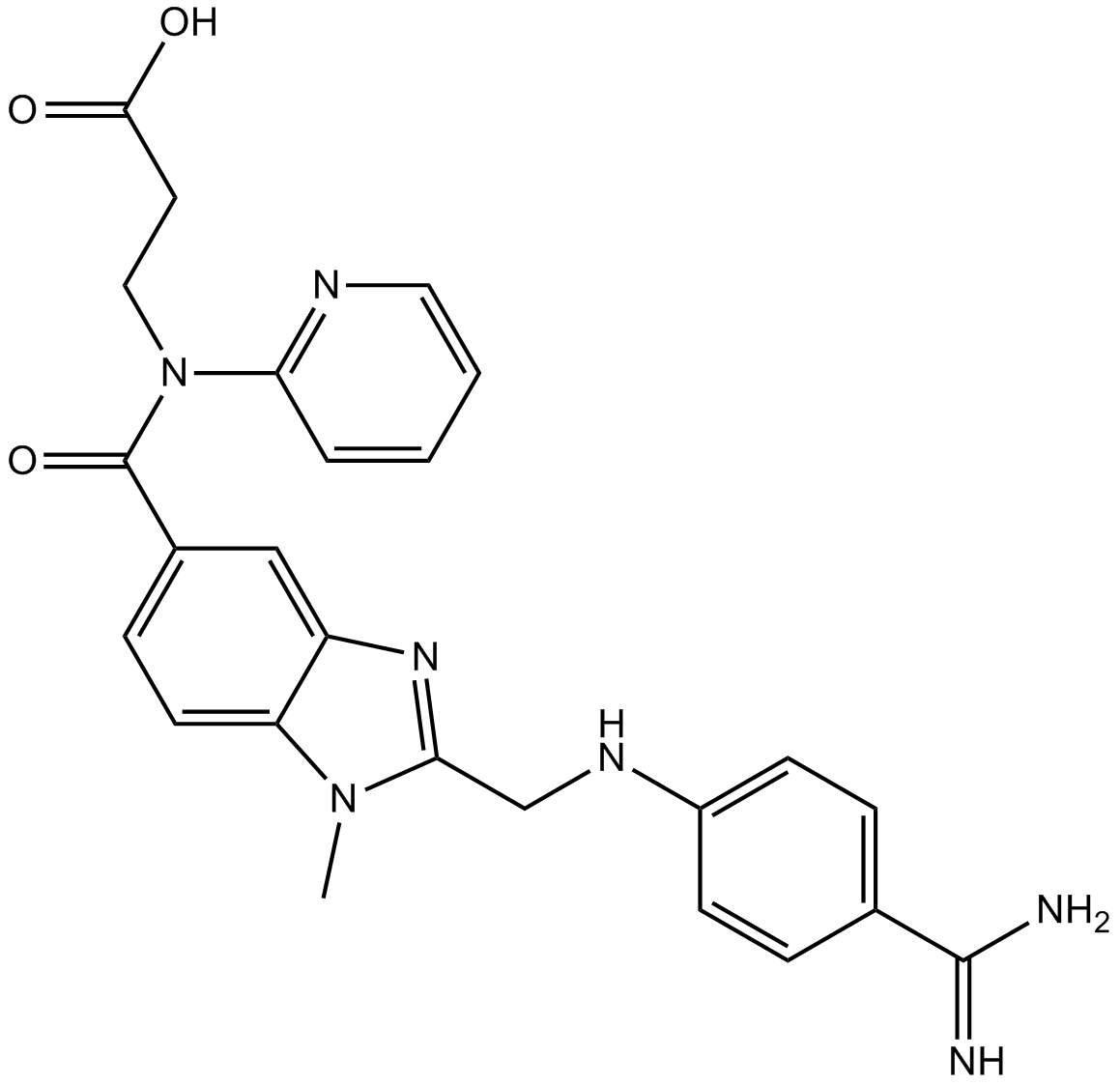
Dabigatran (CAS No. 211914-51-1) is a reversible direct thrombin inhibitor whose core bioactivity is inhibition of thrombus formation. Its targets include both free and fibrin-bound thrombin. It exerts anticoagulant effects by blocking thrombin-mediated fibrinogen conversion, platelet aggregation, and activation of coagulation factors. Its major metabolite, dabigatran acylglucuronide (DABG), also has anticoagulant activity but is weaker. IC?? data are well defined: the IC?? for in vitro thrombin generation AUC is 134.1 ng/mL (DAB) and 281.9 ng/mL (DABG), and the IC?? for thrombin generation peak (C???) is 185.9 ng/mL (DAB) and 470.3 ng/mL (DABG). Common application concentrations: in vitro experiments typically use a gradient of 0–1000 ng/mL (for coagulation function tests such as PT, aPTT, TT). In humans, commonly used clinical doses and effective therapeutic concentrations vary by indication: for prevention of stroke in non-valvular atrial fibrillation, 150 mg twice daily (steady-state peak plasma concentration approximately 75.8 ng/mL) or 110 mg twice daily; for treatment of acute venous thrombosis, 150 mg twice daily (after 5–10 days of parenteral anticoagulant bridging); in Europe, for prevention of postoperative thrombosis after orthopedic surgery, a loading dose of 110 mg is given 1–4 hours after surgery, followed by 220 mg once daily (for 10–35 days). Dose adjustment is required in patients with renal impairment: for creatinine clearance 15–30 mL/min, 75 mg twice daily is used. Its plasma concentration is affected by P-glycoprotein inhibitors/inducers. Routine coagulation monitoring is not required. In cases of emergency bleeding, its anticoagulant effect can be reversed with prothrombin complex concentrates or the specific reversal agent idarucizumab.
References:
[1] Blommel ML, Blommel AL. Dabigatran etexilate: A novel oral direct thrombin inhibitor. Am J Health Syst Pharm. 2011 Aug 15;68(16):1506-19. doi: 10.2146/ajhp100348. PMID: 21817082.
[2] Reddy P, Atay JK, Selbovitz LG, Connors JM, Piazza G, Block CC, Arpino PA, Berliner N, Hutter AM Jr, Fischer MA, Kuter D, Weitzman J, Sherwood GK, Almozlino A, Giugliano RP. Dabigatran: a review of clinical and pharmacoeconomic evidence. Crit Pathw Cardiol. 2011 Sep;10(3):117-27. doi: 10.1097/HPC.0b013e3182315c03. PMID: 21989032.
[3] Enriquez A, Baranchuk A, Redfearn D, Simpson C, Abdollah H, Michael K. Dabigatran for the prevention and treatment of thromboembolic disorders. Expert Rev Cardiovasc Ther. 2015 May;13(5):529-40. doi: 10.1586/14779072.2015.1034692. Epub 2015 Apr 5. PMID: 25843430.
[4] Lin S, Wang Y, Zhang L, Guan W. Dabigatran must be used carefully: literature review and recommendations for management of adverse events. Drug Des Devel Ther. 2019 May 6;13:1527-1533. doi: 10.2147/DDDT.S203112. PMID: 31190734; PMCID: PMC6511609.
[5] Kim JM, Noh J, Park JW, Chung H, Kim KA, Park SB, Lee JS, Park JY. Dabigatran Acylglucuronide, the Major Metabolite of Dabigatran, Shows a Weaker Anticoagulant Effect than Dabigatran. Pharmaceutics. 2022 Jan 22;14(2):257. doi: 10.3390/pharmaceutics14020257. PMID: 35213990; PMCID: PMC8875894.
| Storage | Store at -20°C |
| M.Wt | 471.5 |
| Cas No. | 211914-51-1 |
| Formula | C25H25N7O3 |
| Synonyms | Pradaxa; BIBR 953; BIBR 953ZW |
| Solubility | insoluble in DMSO; insoluble in EtOH; insoluble in H2O |
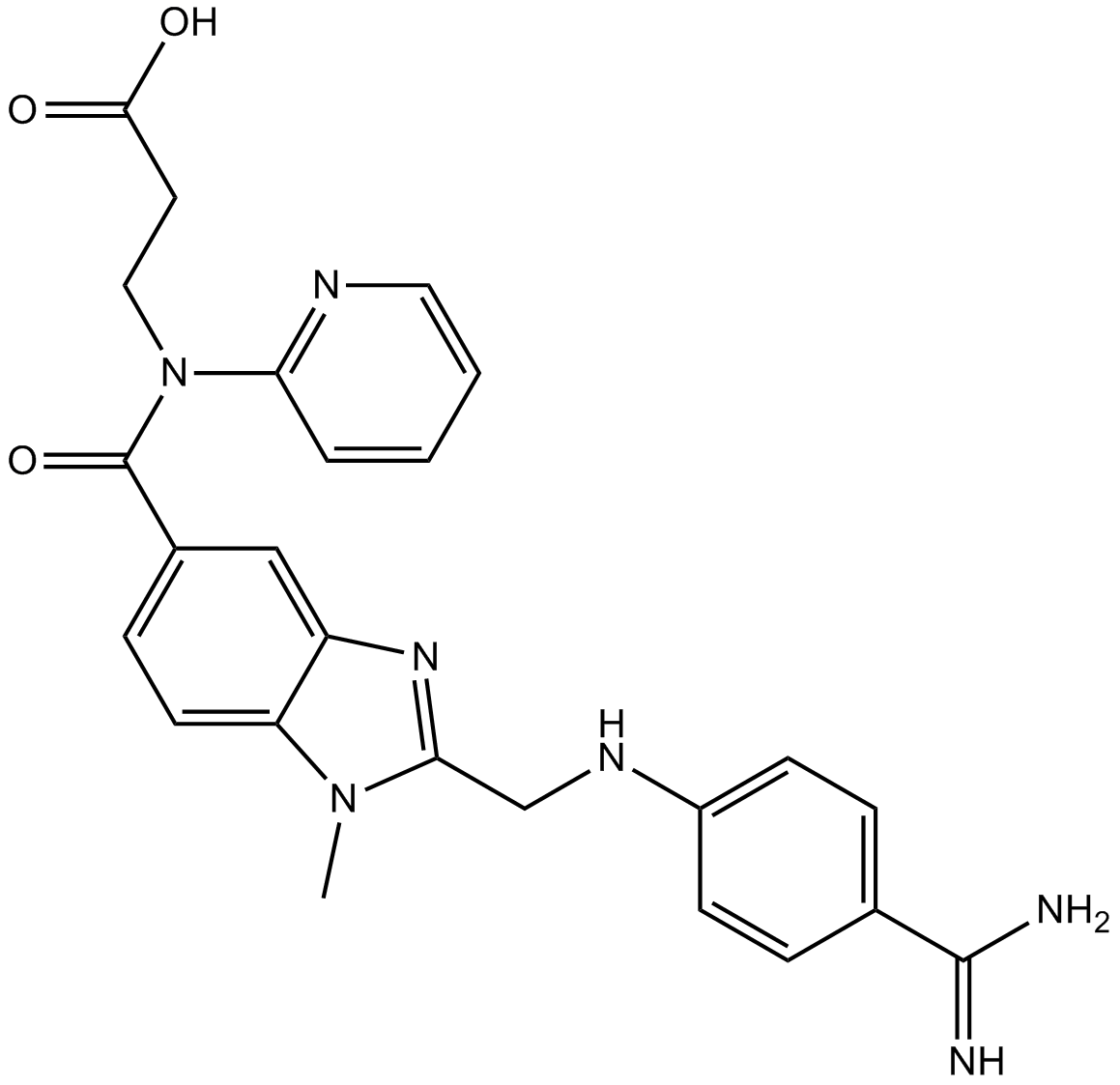
| Chemical Name | 3-[[2-[(4-carbamimidoylanilino)methyl]-1-methylbenzimidazole-5-carbonyl]-pyridin-2-ylamino]propanoic acid |
| Canonical SMILES | C[n]1c(ccc(C(N(CCC(O)=O)c2ncccc2)=O)c2)c2nc1CNc(cc1)ccc1C(N)=N |
| Shipping Condition | Small Molecules with Blue Ice, Modified Nucleotides with Dry Ice. |
| General tips | We do not recommend long-term storage for the solution, please use it up soon. |
| Thrombin inhibition assay [1]: | |
|
Chromogenic assay |
Human thrombin (0.042 U/mL) was pre-incubated for 10 mins at 37 °C with 10 different dilutions (concentration range of 0.003 ~ 100 μM) of BIBR 953 dissolved in DMSO or with DMSO as control. Upon addition of the pre-incubation mixture to the chromogenic substrate, tosyl-glycyl-prolyl-arginine-4-nitranilide acetate, nitraniline was cleaved by thrombin and the increase in absorbance at 405 nm, related to the free nitraniline, was measured in a spectrophotometer. By plotting the absorbance at 405 nm vs the concentration of the test compound, IC50 was calculated. |
| In intro experiment [2]: | |
|
Samples |
Adult and neonatal platelet-poor plasma |
|
Preparation method |
The solubility of this compound in DMSO is limited. General tips for obtaining a higher concentration: Please warm the tube at 37 °C for 10 minutes and/or shake it in the ultrasonic bath for a while. Stock solution can be stored below - 20 °C for several months. |
|
Reacting condition |
0, 40, 110, 180, 250 or 320 ng/mL |
|
Applications |
Without the presence of BIBR 953, neonatal and adult samples showed similar results on the time to clot initiation. In neonatal samples, BIBR 953 significantly delay clotting in a dose-dependent manner, with the difference increasing from 3 times for 40 ng/mL BIBR 953 to 9 times for 320 ng/mL BIBR 953. |
| Animal experiment [1]: | |
|
Animal models |
Rats |
|
Dosage form |
i.v. |
|
Applications |
Compared with all of the inhibitors tested, BIBR 953 exhibited the strongest activity and the longest duration of action. Besides, it was well-tolerated in rats up to the highest dose of 10 mg/kg. However, BIBR 953 was not orally active because it was a very polar, a permanently charged molecule with a logP of -2.4 (n-octanol/buffer, pH 7.4). |
|
Other notes |
Please test the solubility of all compounds indoor, and the actual solubility may slightly differ with the theoretical value. This is caused by an experimental system error and it is normal. |
|
References: [1]. Hauel NH, Nar H, Priepke H, Ries U, Stassen JM, Wienen W. Structure-based design of novel potent nonpeptide thrombin inhibitors. J Med Chem. 2002 Apr 25;45(9):1757-66. [2]. Nossair FF, Chan HHW, Gantioqui J, Atkinson HM, Berry LR, Chan AKC. In-vitro assessment of the effect of dabigatran on thrombosis of adult and neonatal plasma: comparisons using thromboelastography and microscopic visualization of fibrin clot structure. Blood Coagul Fibrinolysis. 2017 May 12. |
|
| Description | BIBR 953 is a potent nonpeptide inhibitor of thrombin with IC50 value of 9.3 nM. | |||||
| Targets | thrombin | |||||
| IC50 | 9.3 nM | |||||
Quality Control & MSDS
- View current batch:
Chemical structure
![coagulation factor II (thrombin) B chain fragment [Homo sapiens]](https://www.apexbt.com/media/prod_images/a/1/a1057.png)