BHT
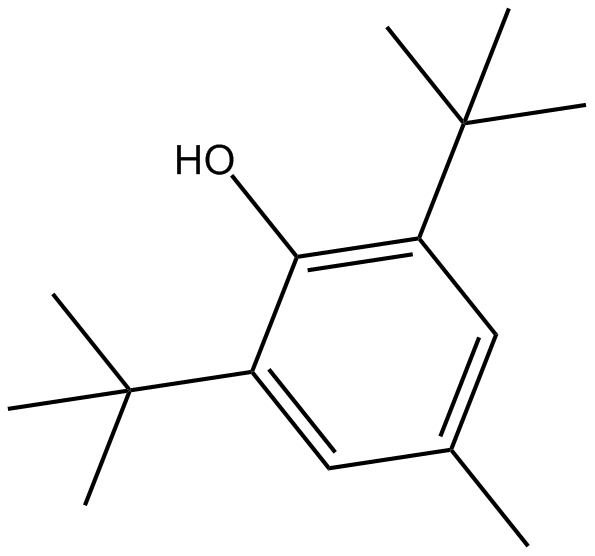
2,6-Di-tert-butyl-p-cresol (BHT, CAS: 128-37-0) is a small-molecule inhibitor of ferroptosis. It exerts its effects by acting as a synthetic phenolic antioxidant, inhibiting lipid peroxidation and thereby modulating cellular pathways associated with oxidative stress.
The biological activity of BHT involves inhibiting the proliferation of mouse testicular interstitial Leydig cells (TM3), inducing cell cycle arrest, and disrupting cytosolic and mitochondrial calcium homeostasis, leading to endoplasmic reticulum stress and DNA damage. In in vivo mouse models, BHT induces pulmonary fibrosis and alters pathways associated with pulmonary fibrosis.
BHT has potential applications in studies of oxidative stress regulation and pulmonary fibrosis.
References:
[1]. Ham J, Lim W, Whang K Y, Song G. Butylated hydroxytoluene induces dysregulation of calcium homeostasis and endoplasmic reticulum stress resulting in mouse Leydig cell death. Environ Pollut, 2020, 256: 113421
[2]. Teodoro W R. Butylated hydroxytoluene induces type-v collagen and overexpression of remodeling genes/proteins in experimental lung fibrosis. Histology & Histopathology, 2018, 33, 1111-1123.
| Physical Appearance | A solid |
| Storage | -20°C |
| M.Wt | 220.35 |
| Cas No. | 128-37-0 |
| Formula | C15H24O |
| Synonyms | Butylated Hydroxy Toluene; NSC 6347 |
| Solubility | ≥22 mg/mL in EtOH; insoluble in H2O; ≥81.6 mg/mL in DMSO |
| Chemical Name | 2,6-di-tert-butyl-4-methylphenol |
| Canonical SMILES | CC1=CC(C(C)(C)C)=C(O)C(C(C)(C)C)=C1 |
| Shipping Condition | Small Molecules with Blue Ice, Modified Nucleotides with Dry Ice. |
| General tips | We do not recommend long-term storage for the solution, please use it up soon. |