


beta-Alanine metabolism
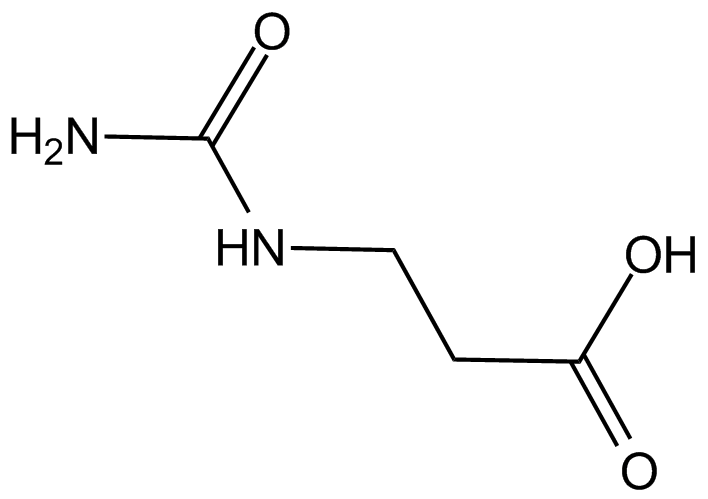
beta-Alanine metabolism (CAS No.: 462-88-4) encompasses intermediates such as ureidopropionic acid, a naturally occurring metabolite in the pyrimidine degradation pathway derived from uracil via dihydrouracil and subsequently converted to beta-alanine by beta-ureidopropionase, thereby linking nucleotide catabolism to amino acid metabolism. As a urea derivative of beta-alanine, ureidopropionic acid serves as a biochemical marker for investigating dysregulated pyrimidine metabolism and is frequently applied in studies of inherited metabolic deficiencies, including beta-ureidopropionase deficiency, as well as in research on cellular responses to antimetabolite stress. Functionally, it has been characterized as a selective inhibitor of mitochondrial respiratory chain complex V, with minimal impact on complexes I–IV or fatty acid β-oxidation, leading to impaired ATP synthesis, elevated reactive oxygen species generation, delayed intracellular calcium accumulation, and downstream activation of energy-dependent excitotoxic and neurodegenerative pathways. These properties position it as a useful tool for probing mitochondrial dysfunction, oxidative stress signaling, and metabolic crosstalk between nucleotide and energy pathways. In vitro studies typically employ concentrations in the low micromolar to higher ranges depending on cell type and assay conditions, while in vivo or ex vivo applications are tailored to specific experimental models to examine metabolic flux, enzyme deficiencies, or neurotoxicity mechanisms. This compound is broadly utilized in biochemical pathway elucidation, metabolic disorder modeling, and early-stage drug discovery efforts targeting mitochondrial function and pyrimidine metabolism.
| Physical Appearance | Solid |
| Storage | -20°C |
| M.Wt | 132.12 |
| Cas No. | 462-88-4 |
| Formula | C4H8N2O3 |
| Solubility | insoluble in EtOH; insoluble in H2O; ≥25.5 mg/mL in DMSO |
| Chemical Name | 3-ureidopropanoic acid |
| Canonical SMILES | NC(NCCC(O)=O)=O |
| Shipping Condition | Small Molecules with Blue Ice, Modified Nucleotides with Dry Ice. |
| General tips | We do not recommend long-term storage for the solution, please use it up soon. |