


Benzyl acetate
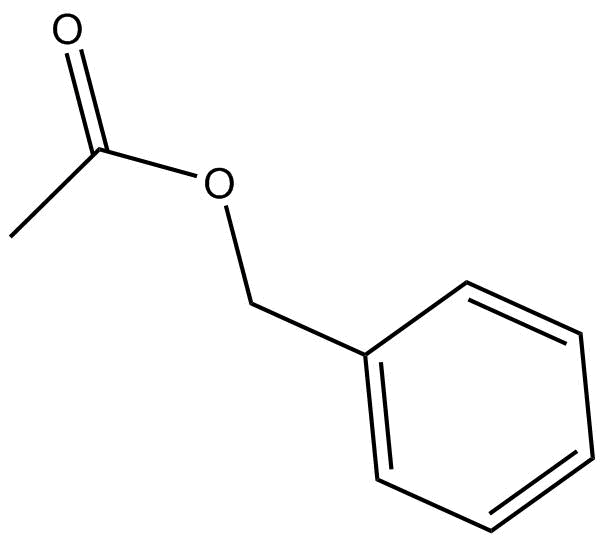
Benzyl acetate (CAS No.: 140-11-4) is a naturally occurring aromatic ester widely distributed in plant-derived matrices, including jasmine, ylang-ylang, neroli, and various fruits, and is classified as a small-molecule volatile organic compound of interest in chemical biology and natural product research. Beyond its established role as a major fragrance constituent, benzyl acetate has attracted attention in biomedical research for its potential to modulate cellular signaling processes, with experimental studies suggesting that it can influence enzyme activity and selected signaling pathways associated with metabolic regulation and cellular responsiveness. Although its precise molecular targets remain incompletely characterized, available evidence indicates that its biological effects are observable in vitro at concentrations typically spanning the low micromolar to higher micromolar range, consistent with other structurally related aromatic esters. Benzyl acetate is therefore utilized in studies investigating plant-derived bioactive compounds, signal transduction modulation, and the functional profiling of essential oil components, as well as in analytical workflows examining complex natural mixtures. In experimental systems, its application is generally tailored to the specific model and research objective, with dosing and exposure conditions optimized accordingly for cell-based assays, biochemical enzyme studies, or exploratory in vivo models aimed at elucidating its mechanistic roles.
| Physical Appearance | A liquid |
| Storage | -20°C |
| M.Wt | 150.17 |
| Cas No. | 140-11-4 |
| Formula | C9H10O2 |
| Solubility | insoluble in H2O; ≥35.7 mg/mL in EtOH; ≥49.4 mg/mL in DMSO |
| Chemical Name | benzyl acetate |
| Canonical SMILES | CC(OCC1=CC=CC=C1)=O |
| Shipping Condition | Small Molecules with Blue Ice, Modified Nucleotides with Dry Ice. |
| General tips | We do not recommend long-term storage for the solution, please use it up soon. |