ATS-9R
ATS-9R (CAS No. 2431960-42-6; peptide sequence: Cys-Lys-Gly-Gly-Arg-Ala-Lys-Asp-Arg-Arg-Arg-Arg-Arg-Arg-Arg-Arg-Arg-Cys) is a non-viral gene delivery fusion oligopeptide that specifically targets white adipose tissue. Its principal biological function is to mediate targeted delivery of therapeutic nucleic acids (e.g., shRNA, sgRNA/Cas9) to mature adipocytes and visceral adipose tissue macrophages (ATMs) with high Prohibitin expression, via specific binding to Prohibitin on the cell surface. This enables silencing of target genes (such as TACE, CCL2, FAM83A, and Fabp4), thereby attenuating obesity-associated inflammation, improving insulin resistance, ameliorating gestational diabetes mellitus (GDM) and obesity-induced type 2 diabetes, and reducing fat accumulation. Transfection is dependent on Prohibitin-mediated endocytosis. The nona-arginine (9R) motif enhances nucleic acid condensation and cellular penetration, and nucleic acids are released from the complexes after intracellular entry to exert their function.
For targeted delivery, complexes are prepared by incubating nucleic acids with ATS-9R at a weight ratio of 3:1 or 6:1 at room temperature for 30 min, yielding nanoparticles with a diameter of 150–354 nm and a zeta potential of 7–20 mV. The nucleic acid condensation efficiency can be verified by agarose gel retardation assays. In vivo, the complexes preferentially accumulate in visceral adipose tissue (epiWAT), followed by subcutaneous adipose tissue (subWAT), with minor distribution in the liver, which serves mainly as the clearance organ. The endocytosis rate in ATMs, RAW264.7 cells, and BMDMs reaches 70%–99%, and preincubation with free ATS competitively inhibits cellular binding.
Common working concentrations are as follows: in vitro, peptide concentrations of 10–25 μg/ml are typically used, with corresponding siRNA/plasmid concentrations of 5 μM–2 μg, incubated in serum-free medium. In animal experiments, mice are usually administered ATS-9R by intraperitoneal injection at 0.2–0.35 mg/kg, twice weekly or for four consecutive doses, with a gene (nucleic acid) dose of 0.35–0.7 mg/kg; this regimen can achieve 30%–70% knockdown of target gene mRNA.
Key considerations include the following: targeting efficiency depends on Prohibitin expression (which is higher in mature adipocytes and in adipose tissue of obese mice); complexes should be freshly prepared and protected from elevated temperatures; intraperitoneal injection is more favorable for visceral fat targeting. No obvious cytotoxicity (cell viability >80%) or abnormalities in hepatic and renal function in animals have been observed, and the complexes are cleared predominantly via the liver within 12–24 h.
References:
[1] Won YW, Adhikary PP, Lim KS, Kim HJ, Kim JK, Kim YH. Oligopeptide complex for targeted non-viral gene delivery to adipocytes. Nat Mater. 2014 Dec;13(12):1157-64. doi: 10.1038/nmat4092. Epub 2014 Oct 5. PMID: 25282508.
[2] Yong SB, Song Y, Kim YH. Visceral adipose tissue macrophage-targeted TACE silencing to treat obesity-induced type 2 diabetes. Biomaterials. 2017 Dec;148:81-89. doi: 10.1016/j.biomaterials.2017.09.023. Epub 2017 Sep 23. PMID: 28985514.
[3] Chung JY, Ain QU, Song Y, Yong SB, Kim YH. Targeted delivery of CRISPR interference system against Fabp4 to white adipocytes ameliorates obesity, inflammation, hepatic steatosis, and insulin resistance. Genome Res. 2019 Sep;29(9):1442-1452. doi: 10.1101/gr.246900.118. PMID: 31467027; PMCID: PMC6724665.
[4] Huang K, Jia Z, Li H, Peng Y, Chen X, Luo N, Song T, Wang Y, Shi X, Kuang S, Yang G. Proto-oncogene FAM83A contributes to casein kinase 1-mediated mitochondrial maintenance and white adipocyte differentiation. J Biol Chem. 2022 Oct;298(10):102339. doi: 10.1016/j.jbc.2022.102339. Epub 2022 Aug 2. PMID: 35931121; PMCID: PMC9493395.
[5] Wang M, Chen X, Shang Y, Chen B, Chen H, Zhou L, Li H, Zhang D, Tao B, Zhou X, Zhang H. Oligopeptide-strategy of targeting at adipose tissue macrophages using ATS-9R/siCcl2 complex for ameliorating insulin resistance in GDM. Biomed Pharmacother. 2024 Jun;175:116775. doi: 10.1016/j.biopha.2024.116775. Epub 2024 May 21. PMID: 38776680.
| Storage | Store at -20°C for 12 months |
| M.Wt | 2342.77 |
| Cas No. | 2431960-42-6 |
| Formula | C89H172N50O21S2 |
| Synonyms | Adipocyte-targeting sequence-9-arginine |
| Solubility | ≥49.8 mg/mL in DMSO; insoluble in EtOH; ≥48.1 mg/mL in H2O |
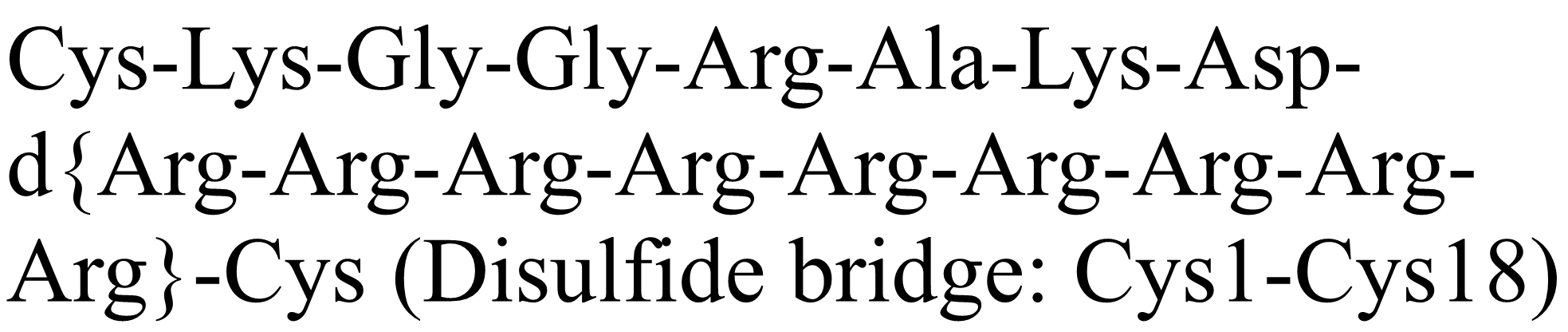
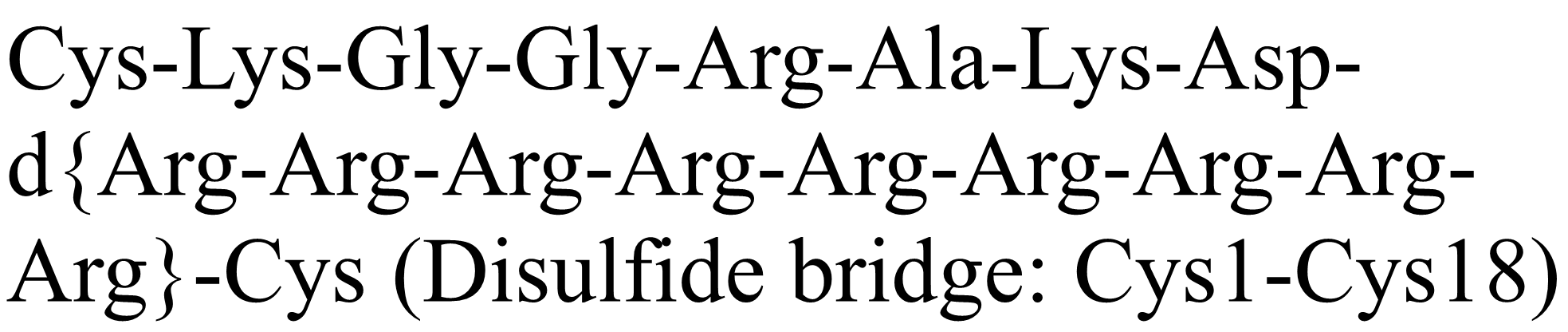
| Canonical SMILES | Cys-Lys-Gly-Gly-Arg-Ala-Lys-Asp-d{Arg-Arg-Arg-Arg-Arg-Arg-Arg-Arg-Arg}-Cys (Disulfide bridge: Cys1-Cys18) |
| Shipping Condition | Small Molecules with Blue Ice, Modified Nucleotides with Dry Ice. |
| General tips | We do not recommend long-term storage for the solution, please use it up soon. |
Quality Control & MSDS
- View current batch:
Chemical structure