


Amodiaquine
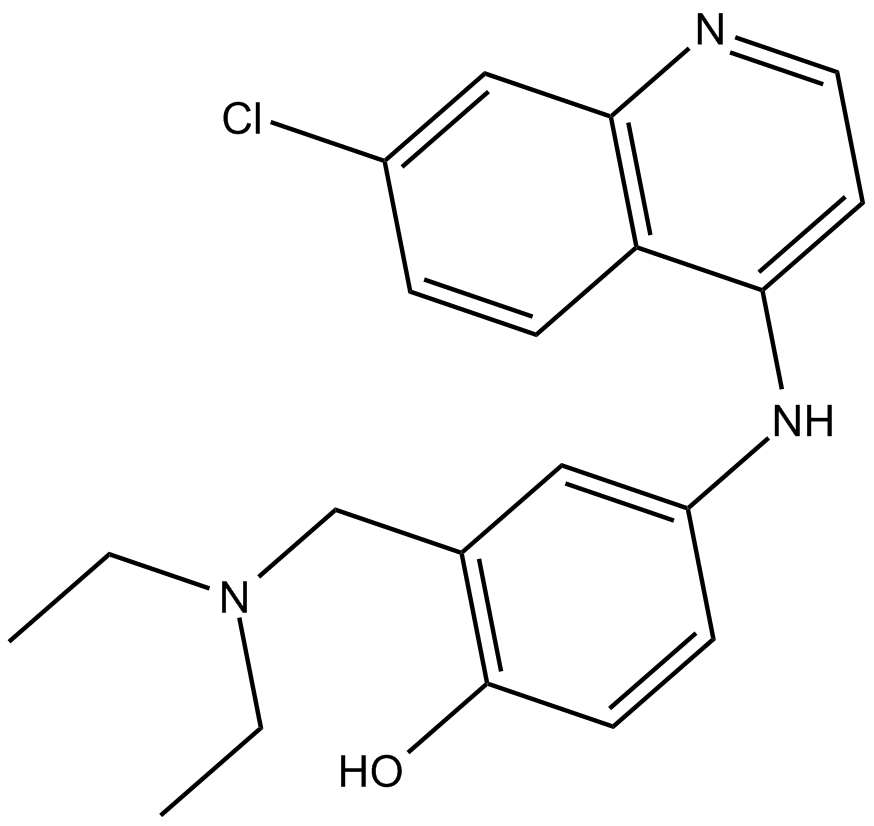
Amodiaquine (CAS No.: 86-42-0) is a synthetic 4-aminoquinoline derivative widely studied as an antimalarial and anti-inflammatory agent within biomedical research and drug discovery contexts. Functioning as a prodrug, it is metabolized to the active compound N-desethyl amodiaquine, which exhibits potent activity against multiple strains of Plasmodium falciparum in vitro, with efficacy observed in the nanomolar range, and demonstrates dose-dependent suppression of parasitemia in murine malaria models. Mechanistically, amodiaquine is recognized as an orally active inhibitor of histamine N-methyltransferase and as an agonist of the nuclear receptor Nurr1, binding to its ligand-binding domain at low micromolar levels, thereby implicating it in pathways related to inflammation modulation and neuroregulation. Its dual pharmacological profile supports its classification as both an antiparasitic and immunomodulatory agent, making it a valuable tool for investigating host–pathogen interactions, inflammatory signaling pathways, and nuclear receptor biology. In experimental settings, amodiaquine is commonly utilized in cell-based assays and animal models to evaluate antimalarial efficacy, synergistic drug interactions, and anti-inflammatory responses, with concentrations or dosing regimens adapted to specific study designs and therapeutic hypotheses.
| Physical Appearance | A solid |
| Storage | -20°C |
| M.Wt | 355.86 |
| Cas No. | 86-42-0 |
| Formula | C20H22ClN3O |
| Synonyms | Camoquine; Flavoquine; NSC 13453; SN 10751 |
| Solubility | insoluble in H2O; ≥25.85 mg/mL in EtOH with ultrasonic; ≥26.95 mg/mL in DMSO with ultrasonic |
| Chemical Name | 4-((7-chloroquinolin-4-yl)amino)-2-((diethylamino)methyl)phenol |
| Canonical SMILES | OC(C=CC(NC1=CC=NC2=C1C=CC(Cl)=C2)=C3)=C3CN(CC)CC |
| Shipping Condition | Small Molecules with Blue Ice, Modified Nucleotides with Dry Ice. |
| General tips | We do not recommend long-term storage for the solution, please use it up soon. |