AK-1690
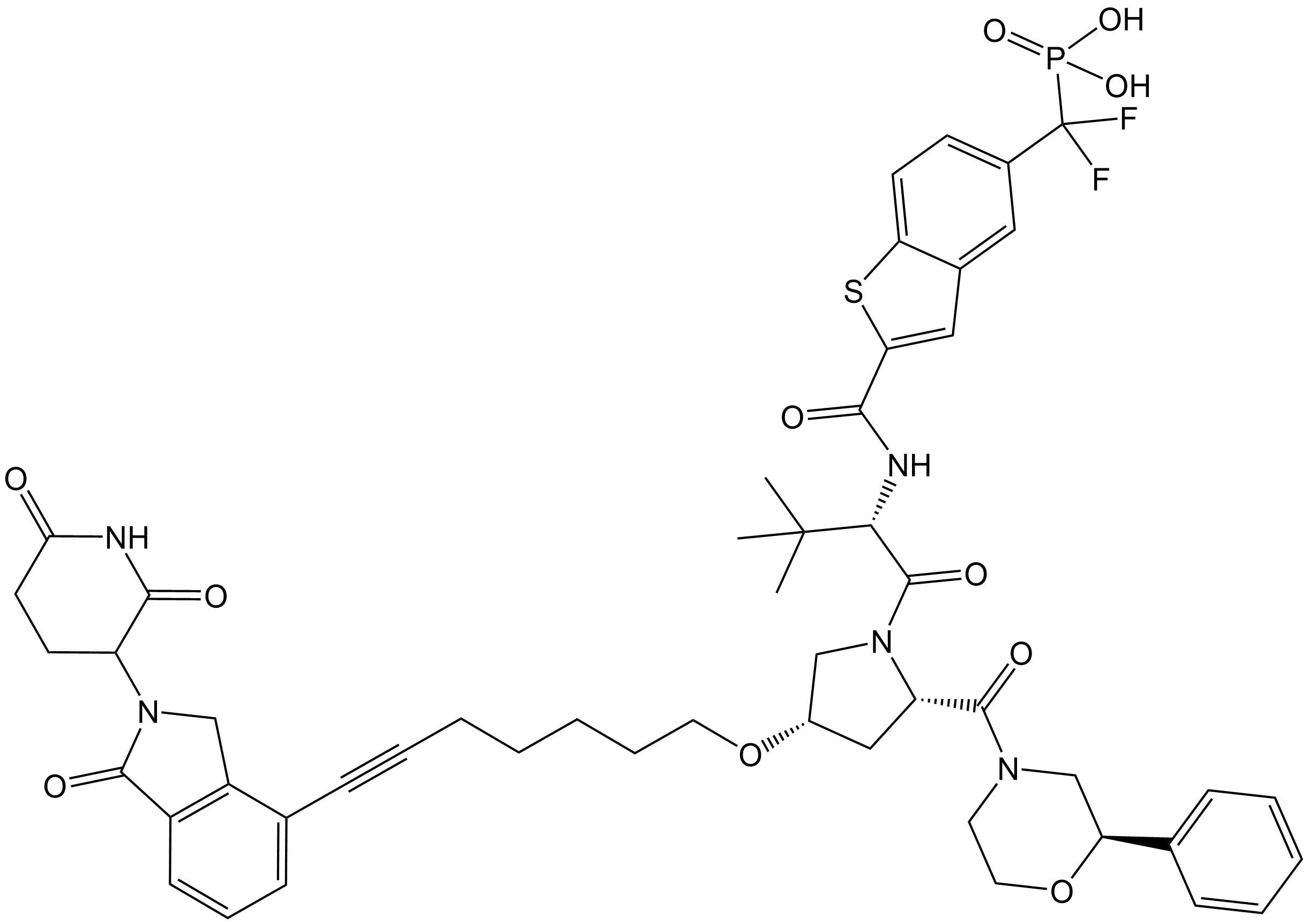
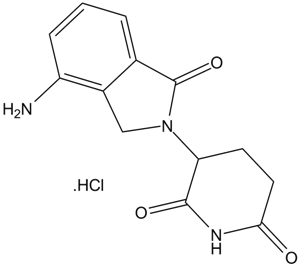
AK‑1690 (CAS No.: 2984505-88-4) is the first reported potent and highly selective STAT6 PROTAC degrader, designed based on STAT6 as a potential target in various tumors and immune-related diseases. Its structure is formed by coupling AK‑068 (CAS No.: 2982851-09-0, STAT6 binding Ki≈6 nM, at least >85-fold selective over STAT5), a small-molecule ligand with high affinity for the STAT6 SH2 domain, with a CRBN E3 ligase ligand (a lenalidomide analog, Lenalidomide-I, CAS No.: 2207541-30-6) through an alkyne-containing ether linker, 7-Bromohept-1-yne (CAS No.: 81216-14-0). By simultaneously binding STAT6 and CRBN, AK‑1690 recruits the ubiquitination system and specifically labels STAT6 as a proteasomal degradation substrate, thereby enabling an epigenetic regulatory mode of “degradation rather than mere inhibition”; its design ensures essentially no effect on canonical CRBN substrates such as IKZF1/3, demonstrating excellent target and substrate selectivity. The resolved STAT6–AK‑1690 co-crystal structure further provides a structural basis for this binding mode and degradation mechanism.
At the cellular level, AK‑1690 exhibits extremely strong degradation potency and high selectivity toward the STAT6 protein. Commonly used models include MV4;11 leukemia cells, human peripheral blood mononuclear cells (PBMCs), and the Hodgkin lymphoma L1236 cell line, with treatment times typically of 12–24 hours. In MV4;11 cells, the half-maximal degradation concentration (DC₅₀) of AK‑1690 is as low as 1 nM, and the maximum degradation efficiency (Dmax) can exceed 95%; in human PBMCs, the DC₅₀ is approximately 80 nM, and the Dmax can also reach >90%. Proteomics results show that under treatment with 5 μM for 18 hours, AK‑1690 significantly affects almost only STAT6 at the whole-proteome level, while under 10 μM conditions it produces almost no detectable changes in other STAT family members, fully demonstrating its advantages as a STAT6-specific PROTAC tool molecule.
In in vivo animal models, AK‑1690 also demonstrates rapid and sustained STAT6 depletion effects and good pharmacokinetic stability. After a single intraperitoneal injection of 200 mg/kg in Balb/c mice, liver and lung tissues were collected at 2, 6, and 24 hours for analysis: in the liver, STAT6 was depleted by more than 90% as early as 2 hours after dosing and this depletion could be maintained through 24 hours; in lung tissue, the STAT6 degradation rate exceeded 90% at 6 hours, and the depletion levels at both 2 hours and 24 hours were also above 70%. Multi-species microsomal and plasma stability assays confirmed that AK‑1690 has excellent in vitro metabolic stability.
Overall, AK‑1690 is not only a powerful chemical tool for studying the function of STAT6 in tumors and other human diseases, but also a highly promising lead compound for the further optimization of STAT6-targeted degradation therapeutics.
References:
[1] Kaneshige A, Yang Y, Bai L, Wang M, Xu R, Mallik L, Chinnaswamy K, Metwally H, Wang Y, McEachern D, Tošović J, Yang CY, Kirchhoff PD, Meagher JL, Stuckey JA, Wang S. Discovery of AK-1690: A Potent and Highly Selective STAT6 PROTAC Degrader. J Med Chem. 2025 Mar 13;68(5):5125-5151. doi: 10.1021/acs.jmedchem.4c01009. Epub 2024 Sep 23. PMID: 39311434.
| Storage | 4°C, protect from light, stored under nitrogen |
| M.Wt | 1016.05 |
| Cas No. | 2984505-88-4 |
| Formula | C51H56F2N5O11PS |
| Solubility | ≥51 mg/mL in DMSO; ≥2.87 mg/mL in EtOH with ultrasonic; insoluble in H2O |
| Chemical Name | ((2-(((2S)-1-((2S,4S)-4-((7-(2-(2,6-dioxopiperidin-3-yl)-1-oxoisoindolin-4-yl)hept-6-yn-1-yl)oxy)-2-((R)-2-phenylmorpholine-4-carbonyl)pyrrolidin-1-yl)-3,3-dimethyl-1-oxobutan-2-yl)carbamoyl)benzo[b]thiophen-5-yl)difluoromethyl)phosphonic acid |
| Canonical SMILES | FC(C1=CC=C2C(C=C(C(N[C@@H](C(C)(C)C)C(N3[C@H](C(N4C[C@@H](C5=CC=CC=C5)OCC4)=O)C[C@H](OCCCCCC#CC6=CC=CC7=C6CN(C(CC8)C(NC8=O)=O)C7=O)C3)=O)=O)S2)=C1)(P(O)(O)=O)F |
| Shipping Condition | Small Molecules with Blue Ice, Modified Nucleotides with Dry Ice. |
| General tips | We do not recommend long-term storage for the solution, please use it up soon. |
Quality Control & MSDS
- View current batch: