


AFMK
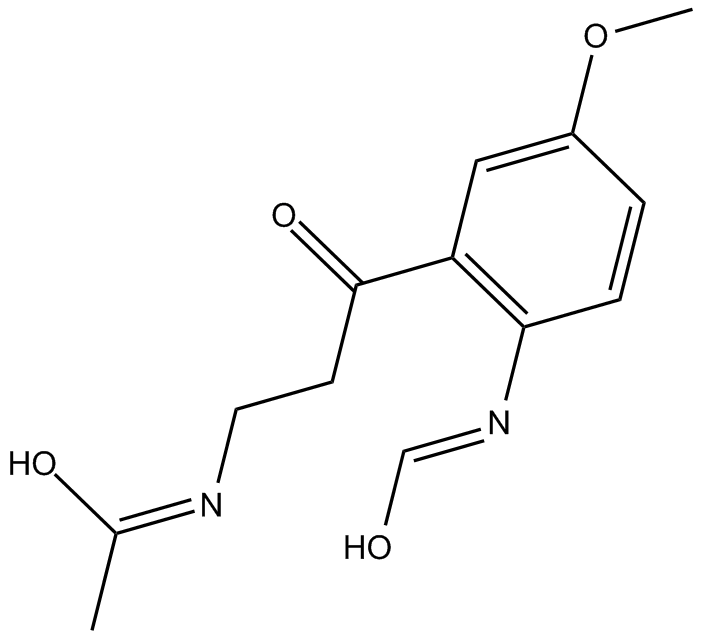





AFMK (CAS No.: 52450-38-1) is an endogenous oxidative metabolite of melatonin, originally identified in brain tissue, and is widely studied in the context of redox biology, circadian-associated metabolism, and cancer research. As a downstream product of melatonin catabolism, AFMK exhibits antioxidant and free radical scavenging properties, attenuating oxidative damage to DNA, proteins, and lipids in experimental models, including protection against X-ray–induced cellular injury in vivo. Although considered a relatively weaker direct radical scavenger compared to its parent compound, AFMK contributes to cellular defense mechanisms through modulation of oxidative stress responses and regulation of apoptosis-related signaling pathways. It has been shown to enhance the antitumor efficacy of chemotherapeutic agents such as gemcitabine in pancreatic cancer cell models, including PANC-1 cells, likely through effects on apoptotic pathway modulation. With a reported pKa of approximately 8.7 under physiological conditions, AFMK is relevant for studies examining pH-dependent biochemical behavior and intracellular activity. In vitro studies typically evaluate its biological effects across low micromolar to higher concentration ranges depending on assay design, while in vivo investigations explore its role as both a biomarker of melatonin metabolism and a functional mediator of antioxidant defense. Consequently, AFMK is broadly applied in studies of oxidative stress, apoptosis regulation, neurobiology, and combination anticancer strategies in both cellular and animal models.
| Physical Appearance | A crystalline solid |
| Storage | -20°C |
| M.Wt | 264.28 |
| Cas No. | 52450-38-1 |
| Formula | C13H16N2O4 |
| Synonyms | N-acetyl-N-formyl-5-Methoxykynuramine; NSC 688263 |
| Solubility | ≤5mg/ml in ethanol;30mg/ml in DMSO;30mg/ml in dimethyl formamide |
| Chemical Name | (Z)-N-(3-(2-((E)-(hydroxymethylene)amino)-5-methoxyphenyl)-3-oxopropyl)acetimidic acid |
| Canonical SMILES | C/C(O)=N/CCC(C1=C(/N=C/O)C=CC(OC)=C1)=O |
| Shipping Condition | Small Molecules with Blue Ice, Modified Nucleotides with Dry Ice. |
| General tips | We do not recommend long-term storage for the solution, please use it up soon. |