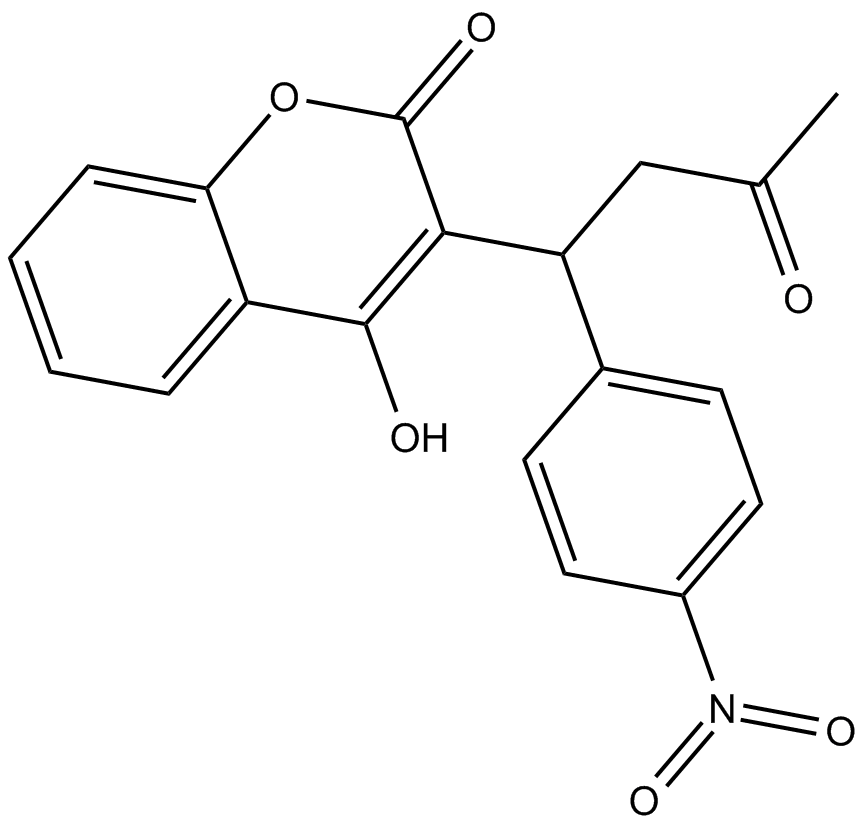
Acenocoumarol
Acenocoumarol (CAS No.: 152-72-7) is a potent anticoagulant that plays an important role in biomedical research and drug development as a vitamin K antagonist. It prevents the conversion of vitamin K epoxide to its active form by inhibiting vitamin K epoxide reductase (VKOR), with inhibitory concentrations (IC50) against VKORC1 and VKORC1L1 in the nanomolar range. The mechanism of action of this compound also includes inhibition of multiple VKOR mutants, showing IC50 values ranging from low nanomolar to low micromolar levels in cell reporter systems. The effects of Acenocoumarol on cellular mechanisms are reflected in the regulation of signaling pathways, particularly inhibition of the MAPK/ERK/JNK pathway and reduction of nuclear translocation of NF-κB p65, while activating the Akt/GSK3β pathway. Studies indicate that it can induce apoptosis in the A549 cell line and arrest the cell cycle in the S phase, highlighting its importance in studying cell growth regulation and signaling dynamics. In experiments, Acenocoumarol is commonly used in vitro and in animal models to evaluate its biological effects and molecular mechanisms, with the doses and concentrations used depending on the specific research objectives and experimental design.
| Physical Appearance | A crystalline solid |
| Storage | -20°C |
| M.Wt | 353.33 |
| Cas No. | 152-72-7 |
| Formula | C19H15NO6 |
| Synonyms | (±)-Acenocoumarin; (±)-Nicoumalone; G-23350 |
| Solubility | ≥48.4 mg/mL in DMSO; insoluble in EtOH; insoluble in H2O |
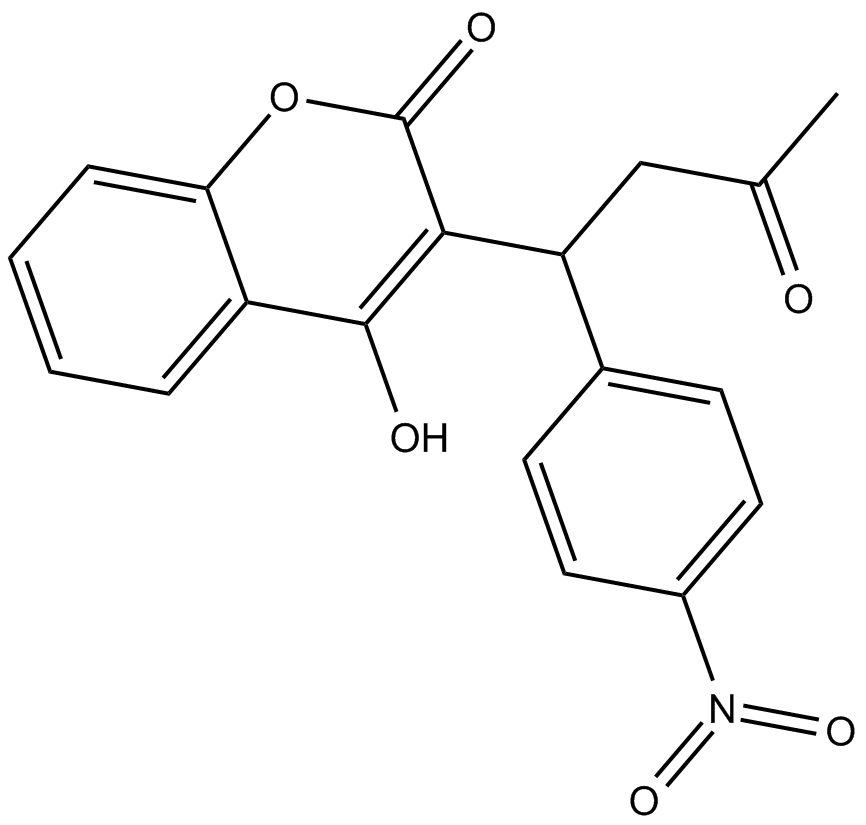
| Chemical Name | 4-hydroxy-3-(1-(4-nitrophenyl)-3-oxobutyl)-2H-chromen-2-one |
| Canonical SMILES | CC(CC(C1=C(O)C2=CC=CC=C2OC1=O)C3=CC=C(N(=O)=O)C=C3)=O |
| Shipping Condition | Small Molecules with Blue Ice, Modified Nucleotides with Dry Ice. |
| General tips | We do not recommend long-term storage for the solution, please use it up soon. |
Quality Control & MSDS
- View current batch:
Chemical structure