


α-CGRP, human TFA
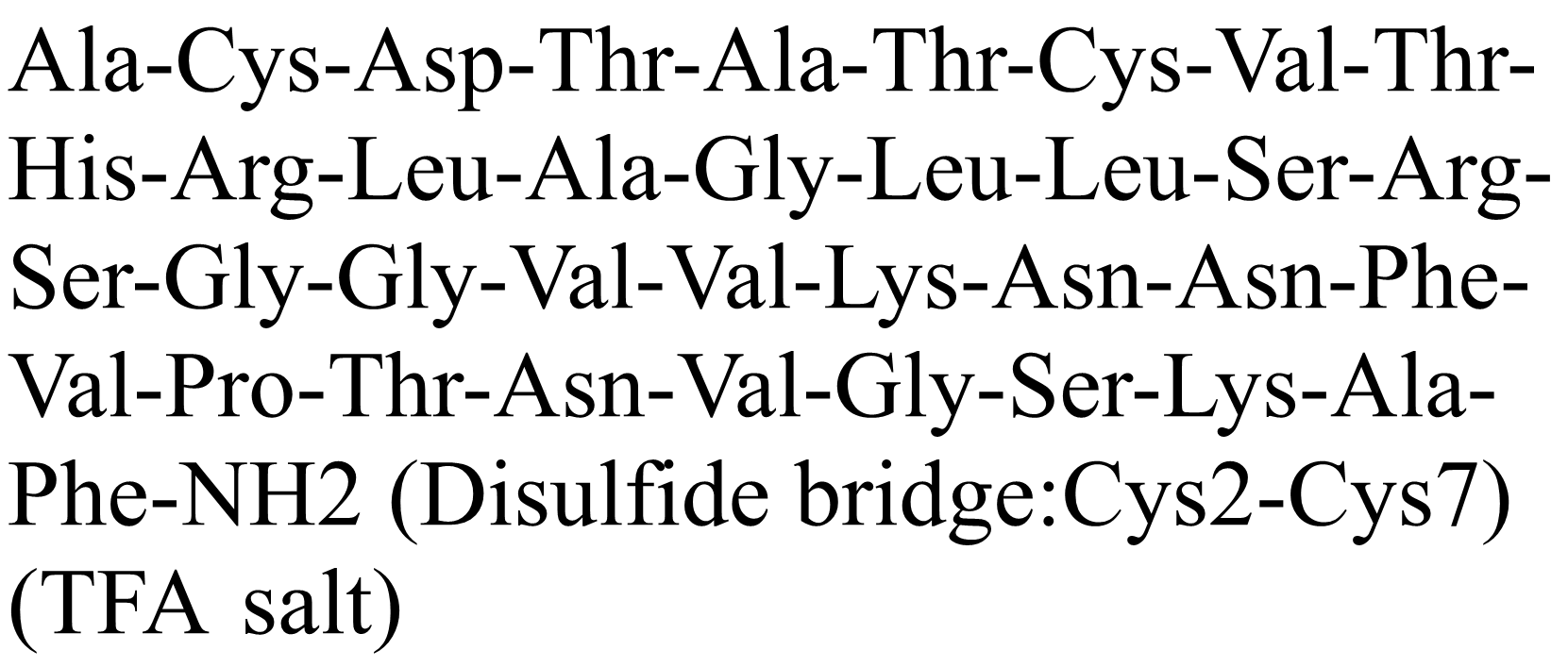
α-CGRP, human TFA is the trifluoroacetate salt form of human α-CGRP. Human α-calcitonin gene-related peptide (human α-CGRP, CAS No.: 90954-53-3) is a 37-amino-acid C-terminally amidated neuropeptide produced from the calcitonin gene through tissue-specific alternative splicing. Its peptide sequence is Ala-Cys-Asp-Thr-Ala-Thr-Cys-Val-Thr-His-Arg-Leu-Ala-Gly-Leu-Leu-Ser-Arg-Ser-Gly-Gly-Val-Val-Lys-Asn-Asn-Phe-Val-Pro-Thr-Asn-Val-Gly-Ser-Lys-Ala-Phe-NH₂. The disulfide bond formed between cysteines at positions 2 and 7 is an essential structure for receptor activation. Two isoforms, α and β, exist in humans, with sequence homology >90% and similar biological activity. Its core target is the heterodimeric CGRP receptor (class B GPCR) composed of calcitonin receptor-like receptor (CLR) and receptor activity-modifying protein 1 (RAMP1), and optimal signal transduction requires cooperation with the receptor component protein RCP. As a full agonist, it mainly mediates effects through the Gαs–adenylyl cyclase–cAMP–PKA pathway, while also coupling to multiple pathways such as Gαq/11, β-arrestin, and MAPK/ERK. In human subcutaneous resistance arteries, it mediates potent, long-lasting, and artery-selective vasodilation (pIC₅₀≈8.62, corresponding to IC₅₀≈2.4 nM). Its potency for arteriolar relaxation is approximately 10-fold that of sodium nitroprusside, while it has almost no relaxing effect on veins.
At the cellular level, cell lines such as HEK293 and COS-7 stably co-expressing CLR/RAMP1 are commonly used in receptor binding and cAMP production assays, with administration ranges mostly at the pM–nM level, to evaluate the relationship between receptor occupancy and signal amplification of CGRP as a full agonist. Primary vascular smooth muscle cells and endothelial cells are used to elucidate its vasodilatory mechanisms through cAMP-PKA activation of smooth muscle ATP-sensitive potassium channels and the endothelial eNOS–NO–cGMP pathway. Trigeminal ganglion neuronal models are used to study pain transmission and regulation of neurogenic inflammation. Fluorescently labeled CGRP analogs modified at Lys³⁵ or Lys²⁴, whose receptor agonist potencies are approximately 1/3–1/5 and 1/5–1/10 of the native peptide, respectively, are used to visualize processes such as receptor internalization, uptake by nerve terminals, and intracellular trafficking.
At the animal level, CGRP and its signaling axis are widely used for functional validation and therapeutic evaluation in various disease models, including trigeminal nerve-related migraine models, hypertension and heart failure models, myocardial ischemia/infarction models, hindlimb ischemia and wound healing models, as well as metabolism- and inflammation-related models such as osteoarthritis and diabetic obesity, to assess its integrated effects in analgesia, blood pressure reduction, myocardial protection, angiogenesis promotion, anti-inflammation, and metabolic regulation. CGRP or its receptor gene knockout mice are used to elucidate its fundamental physiological and pathological functions in cardiovascular homeostasis, vascular reactivity, and inflammatory responses.
At the clinical level, CGRP has become a core target in migraine treatment. Oral small-molecule antagonists and monoclonal antibodies targeting the CGRP ligand or its receptor have been approved for termination of acute migraine attacks and preventive treatment. Compared with traditional triptans, they almost do not cause coronary artery contraction and have better cardiovascular safety. Meanwhile, CGRP itself is being explored for vascular reconstruction and perfusion improvement therapy in diseases such as Raynaud’s disease and peripheral arterial ischemia. Its peripheral blood level can serve as an auxiliary biomarker for diseases such as carcinoid tumors, medullary thyroid carcinoma, migraine, and sepsis, for assessment of disease activity and prognosis.
References:
[1] Marshall I, Al-Kazwini SJ, Holman JJ, Craig RK. Human alpha-calcitonin gene-related peptide (CGRP) is a potent vasodilator in human mesenteric vasculature. Br J Clin Pharmacol. 1988 Dec;26(6):691-5. doi: 10.1111/j.1365-2125.1988.tb05306.x. PMID: 3266556; PMCID: PMC1386582.
[2] Russell FA, King R, Smillie SJ, Kodji X, Brain SD. Calcitonin gene-related peptide: physiology and pathophysiology. Physiol Rev. 2014 Oct;94(4):1099-142. doi: 10.1152/physrev.00034.2013. PMID: 25287861; PMCID: PMC4187032.
[3] Zhu J, Pedersen MD, Ahmed LS, Abdolalizadeh B, Grell AS, Berg JO, Thulstrup PW, Franzyk H, Edvinsson L, Sams A, Sheykhzade M, Hansen PR. Fluorescent Analogues of Human α-Calcitonin Gene-Related Peptide with Potent Vasodilator Activity. Int J Mol Sci. 2020 Feb 17;21(4):1343. doi: 10.3390/ijms21041343. PMID: 32079247; PMCID: PMC7072916.
| Storage | -20℃, sealed storage, away from moisture |
| M.Wt | 3789.31 (free base) |
| Cas No. | 90954-53-3 (free base) |
| Formula | C163H267N51O49S2·xCF3COOH |
| Synonyms | Human alpha-calcitonin gene-related peptide (trifluoroacetate salt); Human α-CGRP (trifluoroacetate salt) |
| Canonical SMILES | Ala-Cys-Asp-Thr-Ala-Thr-Cys-Val-Thr-His-Arg-Leu-Ala-Gly-Leu-Leu-Ser-Arg-Ser-Gly-Gly-Val-Val-Lys-Asn-Asn-Phe-Val-Pro-Thr-Asn-Val-Gly-Ser-Lys-Ala-Phe-NH2 (Disulfide bridge:Cys2-Cys7) |
| Shipping Condition | Small Molecules with Blue Ice, Modified Nucleotides with Dry Ice. |
| General tips | We do not recommend long-term storage for the solution, please use it up soon. |