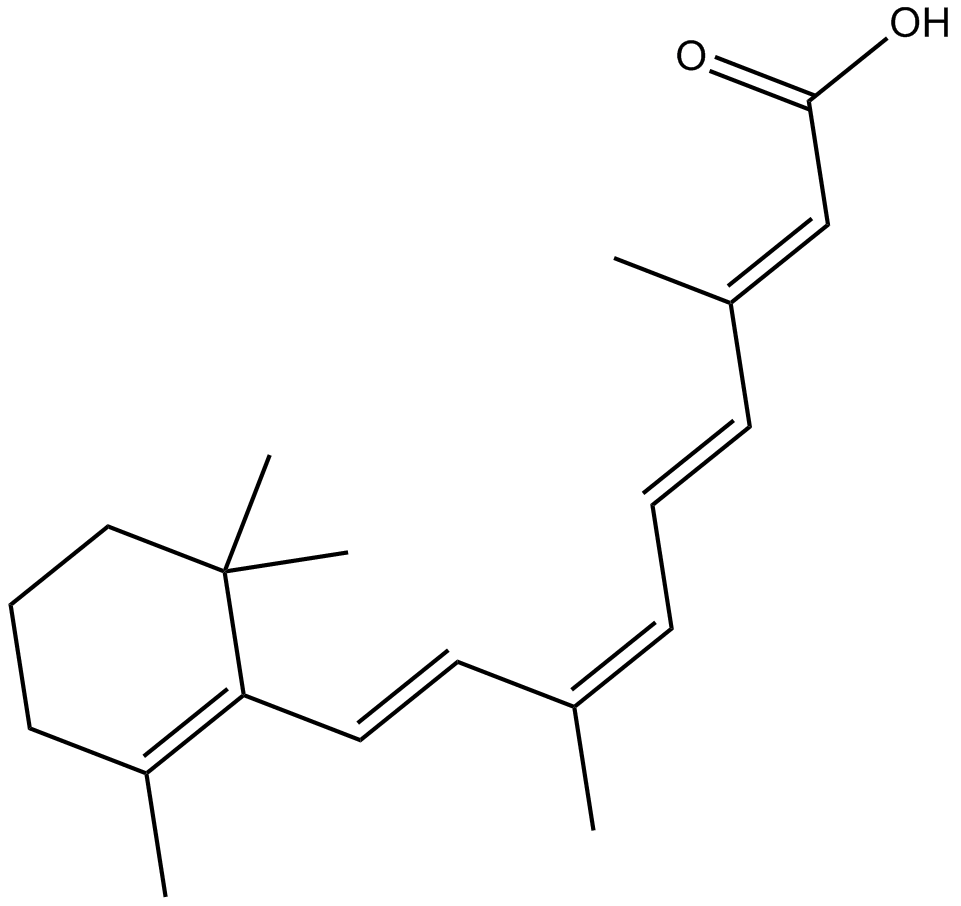


9-cis-Retinoic Acid
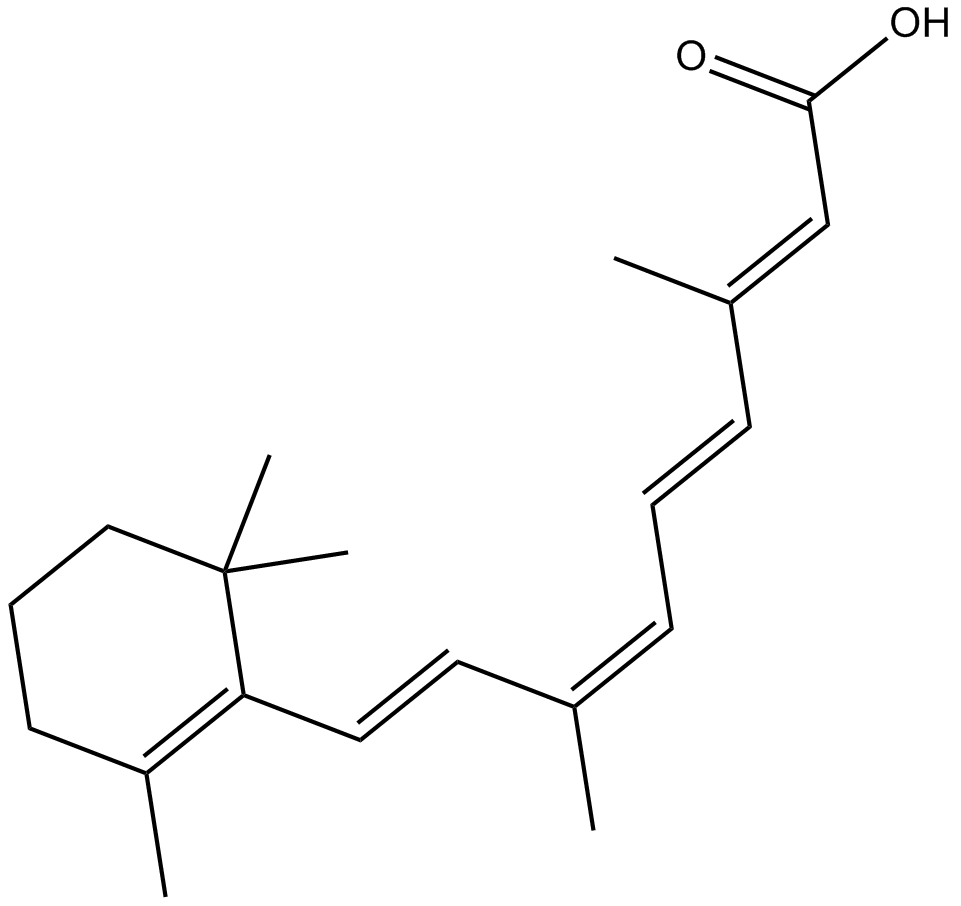
9-cis-Retinoic Acid (CAS 5300-03-8) is an active metabolite of vitamin A and a high-affinity agonist of retinoic acid receptors (RAR) and retinoid X receptors (RXR). It regulates gene expression to influence biological processes including cell proliferation, differentiation, and apoptosis, with IC50 values of approximately 14 nmol/L for RARalpha, RARbeta, and RARgamma. It is commonly used to establish retinoic acid-induced embryonic teratogenesis models and to study its inhibitory effect on cancer cell growth.
9-cis-Retinoic Acid has Ki values of 0.5-27 nM for RAR and 3.8-12 nM for RXR.
Vitamin A is metabolically activated to retinoic acid (RA), which regulates physiological processes such as nervous system function, immune responses, cell proliferation and differentiation, and reproduction. Most activities of retinoic acid are mediated by two nuclear receptor subfamilies, RAR and RXR.
In vitro, 9-cis-Retinoic Acid reduces Mptn expression with a concurrent increase in miR-375 in the pancreatic beta-cell line INS-1 832/13; in breast cancer models, 9-cis-Retinoic Acid shows distinct effects on the expression of Mtpn and miR-375. In INS-1 832/13, 3T3-L1 preadipocytes, and MCF-7 cells (with the exception of MDA-MB-231), 9-cis-Retinoic Acid regulates Mptn gene expression and its microRNA through RAR and RXR receptors[1].
In chemoprevention studies in male Wistar-Unilever rats, continuous oral gavage of 9-cis-Retinoic Acid reduces the incidence of carcinogenesis in the dorsolateral and anterior prostate; the same dose of 9-cis-Retinoic Acid also reduces the incidence of carcinogenesis in all accessory sex glands. Long-term feeding causes no obvious general or organ-specific toxicity and does not suppress average group body weight gain[2].
In patients with severe chronic hand eczema, the impact of 9-cis-Retinoic Acid on quality of life in alitretinoin-treated patients has been evaluated: at baseline, 83% of patients were rated as severe by Physician Global Assessment (PGA), and 48% achieved clear/almost clear PGA response at the last visit; at week 24, mean DLQI score improvements were 58% and 70%, respectively, with a low overall incidence of adverse events that was similar between the two groups[3].
[1] Perri M, Caroleo MC, Liu N, Gallelli L, De Sarro G, Kagechika H, Cione E. 9-cis Retinoic acid modulates myotrophin expression and its miR in physiological and pathophysiological cell models. Exp Cell Res. 2017 Mar 12. pii: S0014-4827(17)30126-X.
[2] McCormick DL, Rao KV, Steele VE, Lubet RA, Kelloff GJ, Bosland MC. Chemoprevention of rat prostate carcinogenesis by 9-cis-retinoic acid. Cancer Res. 1999 Feb 1;59(3):521-4.
[3] Augustin M, Thai D, Kamps A. Impact on quality of life of alitretinoin in severe chronic hand eczema: FUGETTA real-world study. J Dtsch Dermatol Ges. 2016 Dec;14(12):1261-1270.
| Physical Appearance | A crystalline solid |
| Storage | Store at -20°C |
| M.Wt | 300.44 |
| Cas No. | 5300-03-8 |
| Formula | C20H28O2 |
| Synonyms | 9-cis-Retinoic acid |
| Solubility | ≥21 mg/mL in DMSO; ≥4.12 mg/mL in EtOH with ultrasonic; insoluble in H2O |
| Chemical Name | (2E,4E,6Z,8E)-3,7-dimethyl-9-(2,6,6-trimethylcyclohex-1-en-1-yl)nona-2,4,6,8-tetraenoic acid |
| Canonical SMILES | CC1(C)C(/C=C/C(\C)=C\C=C\C(/C)=C\C(O)=O)=C(C)CCC1 |
| Shipping Condition | Small Molecules with Blue Ice, Modified Nucleotides with Dry Ice. |
| General tips | We do not recommend long-term storage for the solution, please use it up soon. |
| Cell experiment:[1] | |
|
Cell lines |
Human oral squamous cell lines CA 9-22 and NA |
|
Reaction Conditions |
1 and 10 μM 9-cis-retinoic acid for 0, 1, 3 and 5 d incubation |
|
Applications |
9-cis-Retinoic acid (1 ~ 10 μM; 0 ~ 5 d) treatment significantly decreased proliferation in a dose-dependent manner in CA 9-22 and NA cells. 9-cis-Retinoic acid (1 μM; 24 h) treatment also significantly increased PPARγ functional activity by > 200% in CA 9-22 and NA aerodigestive cells. In addition, 9-cis-retinoic acid treatment (10 μM) resulted in the formation of a nuclear PPARγ-RXRα heterodimer supershift complex in CA 9-22 cells. |
| Animal experiment:[2] | |
|
Animal models |
Male Wistar-Unilever (HsdCpb:Wu) rats, 7 ~ 8 weeks of age |
|
Dosage form |
50 or 100 mg/kg Diet |
|
Applications |
Continuous dietary administration of 9-cis-retinoic acid at 100 mg/kg diet or 50 mg/kg diet beginning 1 week before N-methyl-N-nitrosourea (MNU) administration reduced cancer incidence in the dorsolateral + anterior prostate from 65% in dietary controls to 18 and 20%, respectively. Similarly, these dose levels of 9-cis-retinoic acid reduced the incidence of cancer in all accessory sex glands from 79% in dietary controls to 48 and 33%, respectively. Chronic dietary administration of 9-cis-retinoic acid induced no gross or organ-specific toxicity in any animal and did not suppress group mean body weight gain. Therefore, 9-cis-retinoic acid may serve as an inhibitor of prostate carcinogenesis. |
|
Note |
The technical data provided above is for reference only. |
|
References: 1. Rosas R, Buryska S, Silver R, et al. Retinoids Augment Thiazolidinedione PPARγ Activation in Oral Cancer Cells. Anticancer Research, 2020, 40(6): 3071-3080. 2. McCormick DL, Rao KV, Steele VE, et al. Chemoprevention of rat prostate carcinogenesis by 9-cis-retinoic acid. Cancer Research, 1999, 59(3): 521-524. |
|
Quality Control & MSDS
- View current batch:
Chemical structure