


5-hydroxy Indole-3-acetic Acid
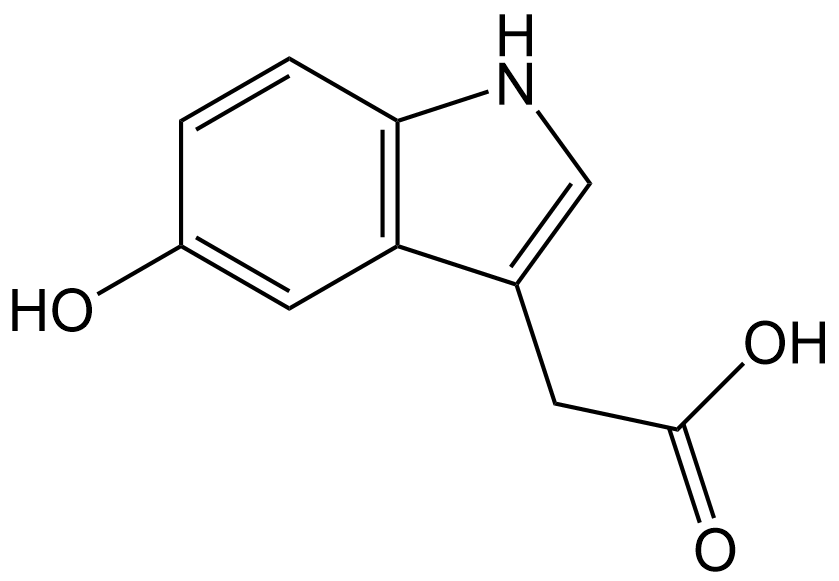
5 - Hydroxyindoleacetic acid (5-hydroxyindoleacetic acid, 5-HIAA, CAS No.: 54-16-0) is the major terminal metabolic end product of serotonin (5 - hydroxytryptamine, CAS No.: 50-67-9, Cat. No.: BA4989) in vivo, and is a core surrogate biomarker for assessing systemic serotonin levels, while also possessing biological activities related to metabolic regulation and immunomodulation; it can act on post-receptor steps in the skeletal muscle insulin signaling pathway, and by regulating calcium homeostasis-related processes in the insulin signaling cascade, it inhibits basal glucose uptake as well as insulin- and tolbutamide-stimulated glucose uptake. In isolated rat soleus muscle, the half-effect concentration A₅₀ for inhibition of basal glucose uptake is 1.25 μmol/L, and the maximum inhibition rate Eₘₐₓ reaches 88.6%. This inhibitory effect shows partial additivity under calcium- and magnesium-depleted conditions, and non-additivity under conditions of potassium excess; at the same time, as an indole product generated from tryptophan metabolism by the gut microbiota, it can activate the aryl hydrocarbon receptor (AhR)/ interleukin - 22 (IL-22) signaling pathway, participate in intestinal immune regulation and maintenance of metabolic homeostasis, and in a high-fat diet mouse model can be accompanied by reductions in fasting blood glucose and total triglyceride levels, improving metabolic disorders associated with gut microbiota dysbiosis.
In clinical applications, 5-HIAA is mainly measured using 24-hour urine samples, with a normal reference range of 3~15 mg/24 hours. It is the preferred biomarker for diagnosis and therapeutic efficacy monitoring of midgut carcinoids (carcinoids originating from the jejunum-ileum, ascending colon, and appendix). A decrease in levels after treatment indicates a therapeutic response, while an increase indicates no response to treatment. However, because foregut and hindgut carcinoids lack dopa decarboxylase and cannot generate sufficient serotonin, the diagnostic value of this marker is limited; in addition, abnormal urinary 5-HIAA levels can also assist in characterizing a variety of disease states: elevated levels are seen in intestinal neuroendocrine tumors, celiac disease, cystic fibrosis, and autism spectrum disorder, while decreased levels are seen in obsessive-compulsive disorder, aromatic L - amino acid decarboxylase deficiency, sepiapterin reductase deficiency, and multiple sclerosis.
References:
[1] Sebeková K, Spustová V, Dzúrik R. Inhibition of glucose uptake by 5-hydroxyindoleacetic acid in the isolated rat soleus muscle. Int Urol Nephrol. 1996;28(1):123-31. doi: 10.1007/BF02550149. PMID: 8738631.
[2] Yan T, Shi L, Liu T, Zhang X, Yang M, Peng W, Sun X, Yan L, Dai X, Yang X. Diet-rich in wheat bran modulates tryptophan metabolism and AhR/IL-22 signalling mediated metabolic health and gut dysbacteriosis: A novel prebiotic-like activity of wheat bran. Food Res Int. 2023 Jan;163:112179. doi: 10.1016/j.foodres.2022.112179. Epub 2022 Nov 19. PMID: 36596122.
[3] Lenchner JR, Santos C. Biochemistry, 5 Hydroxyindoleacetic Acid. 2023 May 1. In: StatPearls [Internet]. Treasure Island (FL): StatPearls Publishing; 2026 Jan–. PMID: 31869148.
| Storage | -20℃ stored under nitrogen, sealed and away from moisture and light |
| M.Wt | 191.19 |
| Cas No. | 54-16-0 |
| Formula | C10H9NO3 |
| Synonyms | 5-HIAA; 5-Hydroxyindoleacetic Acid; 5-hydroxy IAA; NSC 90432 |
| Chemical Name | 2-(5-hydroxy-1H-indol-3-yl)acetic acid |
| Canonical SMILES | O=C(O)CC1=CNC2=C1C=C(O)C=C2 |
| Shipping Condition | Small Molecules with Blue Ice, Modified Nucleotides with Dry Ice. |
| General tips | We do not recommend long-term storage for the solution, please use it up soon. |