


3-Phenoxybenzaldehyde
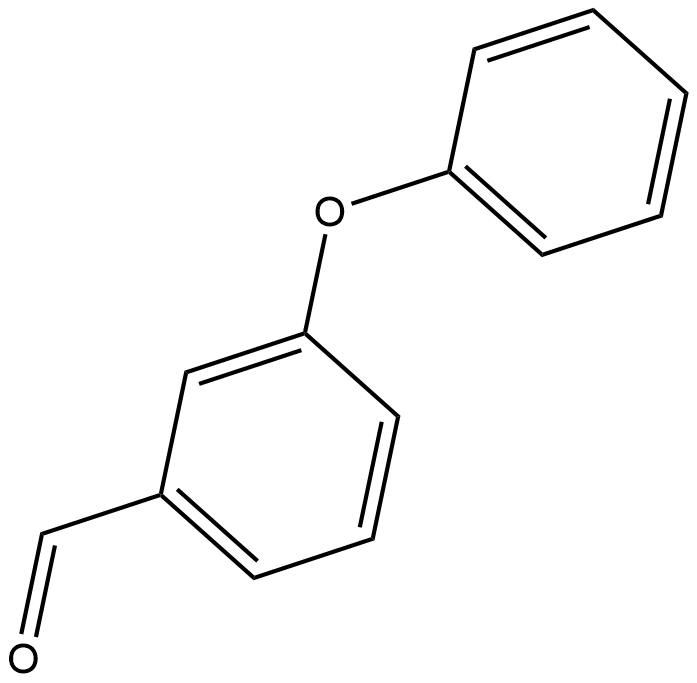
3-Phenoxybenzaldehyde (CAS No.: 39515-51-0) is an aromatic aldehyde compound primarily utilized as a biochemical tool in immunology and inflammation research, characterized by its ability to modulate the complement system, particularly through weak inhibition of the classical complement pathway. Mechanistic studies indicate that this compound interferes with complement-mediated immune complex activation, thereby affecting downstream signaling events associated with complement cascade initiation and propagation. In vitro evaluations demonstrate that 3-Phenoxybenzaldehyde exhibits inhibitory activity in the high micromolar range, with reported IC50 values around the low millimolar to high micromolar level, and it can induce measurable hemolytic effects under certain experimental conditions, reflecting its interaction with complement-dependent lytic processes. These properties make it a useful probe for investigating complement regulation, immune complex-driven inflammation, and related pathways in cellular assays. It is commonly applied in studies exploring complement-mediated cytotoxicity, erythrocyte lysis models, and screening platforms aimed at identifying modulators of innate immune signaling, where experimental concentrations are selected based on specific assay requirements and study design to elucidate pathway-specific effects.
| Physical Appearance | <13°C solid,>13°C liquid |
| Storage | 4°C |
| M.Wt | 198.22 |
| Cas No. | 39515-51-0 |
| Formula | C13H10O2 |
| Solubility | ≥24.5 mg/mL in DMSO; ≥10.35 mg/mL in EtOH; insoluble in H2O |
| Chemical Name | 3-phenoxybenzaldehyde |
| Canonical SMILES | O=CC1=CC=CC(OC2=CC=CC=C2)=C1 |
| Shipping Condition | Small Molecules with Blue Ice, Modified Nucleotides with Dry Ice. |
| General tips | We do not recommend long-term storage for the solution, please use it up soon. |