


2-hydroxyoctanoate
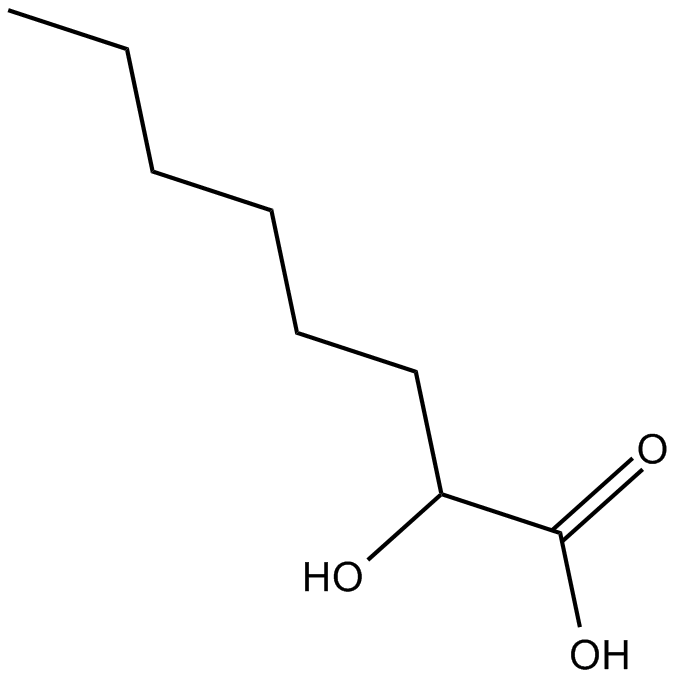
2-hydroxyoctanoate (CAS No.: 617-73-2) is a medium-chain hydroxy fatty acid derivative commonly utilized as a biochemical tool in lipid metabolism research, particularly for its activity as an inhibitor of medium-chain acyl-CoA synthetase. By interfering with the enzymatic conversion of fatty acids into their corresponding acyl-CoA derivatives, it modulates key steps in lipid activation and downstream metabolic pathways, thereby influencing cellular energy homeostasis and signaling processes. This compound exhibits inhibitory activity in the low millimolar to high micromolar range, with reported inhibition constants around 500 μM, making it suitable for mechanistic studies of enzyme function and metabolic flux. In vitro and cell-based models employ this molecule to investigate the role of fatty acyl-CoA formation in processes such as lipid signaling, mitochondrial function, and metabolic regulation under physiological and pathophysiological conditions. Its application extends to probing dysregulated lipid metabolism and identifying enzyme-specific contributions within complex biochemical networks, with experimental concentrations varying depending on assay design and biological context.
| Physical Appearance | Solid |
| Storage | -20°C |
| M.Wt | 160.21 |
| Cas No. | 617-73-2 |
| Formula | C8H16O3 |
| Solubility | insoluble in H2O; ≥26.1 mg/mL in EtOH; ≥45.2 mg/mL in DMSO |
| Chemical Name | 2-hydroxyoctanoic acid |
| Canonical SMILES | CCCCCCC(O)C(O)=O |
| Shipping Condition | Small Molecules with Blue Ice, Modified Nucleotides with Dry Ice. |
| General tips | We do not recommend long-term storage for the solution, please use it up soon. |