


2,6-Pyridinedicarboxylic acid
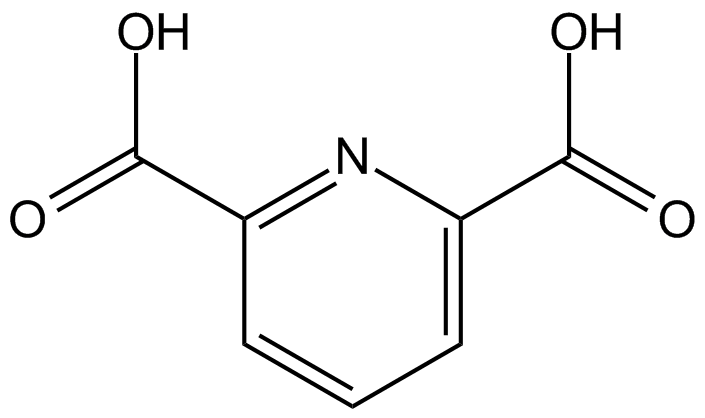
2,6-Pyridinedicarboxylic acid (CAS No.: 499-83-2) is a heteroaromatic dicarboxylic acid belonging to the class of pyridinecarboxylic acids, widely utilized in chemical biology and medicinal chemistry as a versatile coordination ligand and synthetic intermediate. Its ability to chelate a range of metal ions underlies its frequent application in studies of metalloenzyme mimetics, metal-dependent signaling processes, and coordination-driven supramolecular assemblies. In biochemical research, this compound is commonly employed to probe metal ion homeostasis and to modulate metal-catalyzed redox reactions, which are relevant to oxidative stress pathways and enzymatic catalysis. Although it does not function as a direct pharmacological agent, derivatives and complexes based on this scaffold have demonstrated bioactivity in vitro, often exhibiting effects in the micromolar concentration range depending on the specific metal complex and experimental system. It is also used as a building block in the synthesis of small molecules and functional materials for screening libraries, enabling structure–activity relationship studies in drug discovery workflows. In cellular and biochemical assays, experimental concentrations and conditions are tailored to the specific objectives, such as investigating metal-binding affinity, enzyme inhibition, or coordination-driven molecular interactions, while in vivo applications are generally limited to exploratory research models focused on metal-mediated biological processes.
| Physical Appearance | Solid |
| Storage | -20°C |
| M.Wt | 167.12 |
| Cas No. | 499-83-2 |
| Formula | C7H5NO4 |
| Solubility | insoluble in H2O; ≥15.55 mg/mL in EtOH; ≥39.1 mg/mL in DMSO |
| Chemical Name | pyridine-2,6-dicarboxylic acid |
| Canonical SMILES | O=C(O)C1=CC=CC(C(O)=O)=N1 |
| Shipping Condition | Small Molecules with Blue Ice, Modified Nucleotides with Dry Ice. |
| General tips | We do not recommend long-term storage for the solution, please use it up soon. |