


2,5-Furandicarboxylic acid
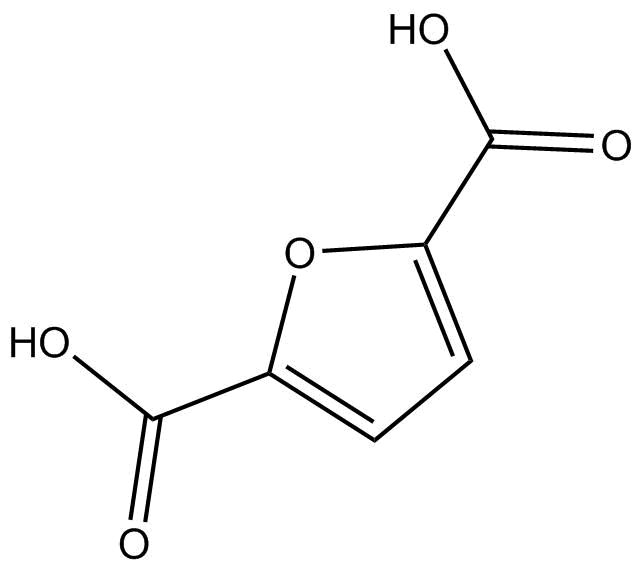





2,5-Furandicarboxylic acid (CAS No.: 3238-40-2) is a small-molecule dicarboxylic compound recognized as both an endogenous urinary metabolite and a microbial oxidation product derived from hydroxymethylfurfural via enzymatic activity in species such as Cupriavidus basilensis, positioning it at the interface of metabolic biochemistry and renewable chemical biology. This compound is widely studied as a sustainable biotechnological building block due to its role as an environmentally favorable alternative to terephthalic acid in polyester synthesis, while also serving as a versatile precursor for the preparation of diverse chemical intermediates including polymers, polyurethanes, thermosetting resins, and macrocyclic ligands. In biomedical research contexts, its detection in human urine has prompted its use as a metabolomic marker for investigating metabolic flux and oxidative pathways associated with furan-based compounds, although it is not associated with a single defined molecular target or canonical signaling pathway. Mechanistic studies instead focus on its formation through enzymatic oxidation processes and its integration into broader metabolic networks. In vitro investigations typically employ concentrations in the micromolar range, depending on assay design, to explore its biochemical transformation, cellular compatibility, or role as a substrate or intermediate in enzymatic systems. 2,5-Furandicarboxylic acid is therefore primarily utilized in studies spanning metabolic profiling, enzyme characterization, microbial biotransformation, and the development of bio-based materials, with experimental conditions tailored to specific model systems and research objectives.
| Physical Appearance | Solid |
| Storage | -20°C |
| M.Wt | 156.09 |
| Cas No. | 3238-40-2 |
| Formula | C6H4O5 |
| Solubility | insoluble in H2O; ≥3.15 mg/mL in EtOH with ultrasonic; ≥53.5 mg/mL in DMSO |
| Chemical Name | furan-2,5-dicarboxylic acid |
| Canonical SMILES | O=C(O)C1=CC=C(C(O)=O)O1 |
| Shipping Condition | Small Molecules with Blue Ice, Modified Nucleotides with Dry Ice. |
| General tips | We do not recommend long-term storage for the solution, please use it up soon. |