MK 0893
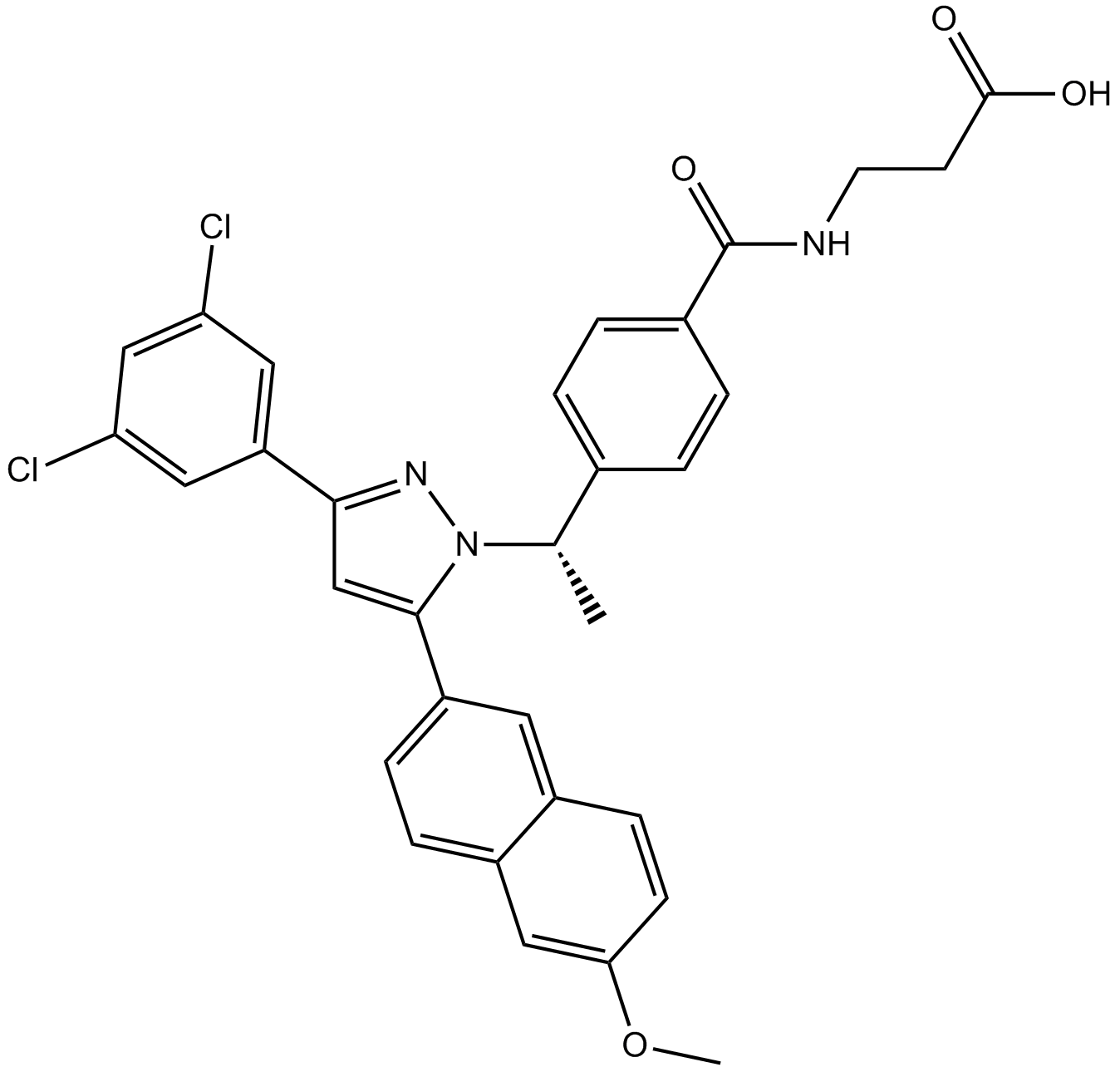





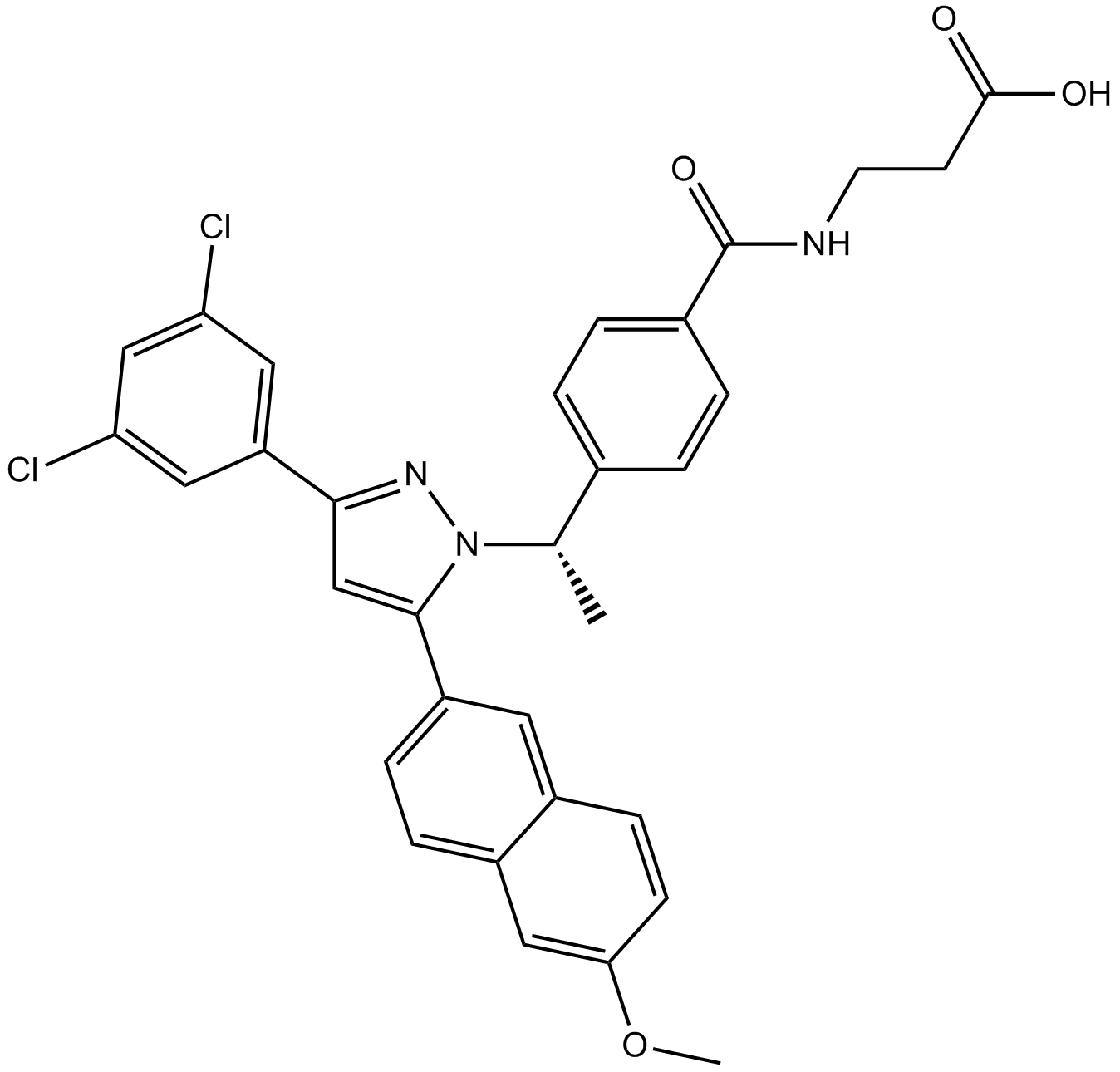
MK 0893 (CAS No. 870823-12-4) is a competitive, reversible glucagon receptor (GCGR) antagonist [1][3]. Its core biological function is to bind an extra-helical allosteric site (non-orthosteric site) between TM6 and TM7 of GCGR, forming polar interactions with residues such as Arg346, Lys349, Ser350, and Asn404, thereby restricting the outward helical movement of TM6 and inhibiting receptor activation and G protein coupling [3][4]. It also shows some inhibitory activity against GIPR (IC₅₀ 1020 nM) and PAC1 (IC₅₀ 9200 nM) among class B GPCRs, with no significant inhibitory effect on GLP-1R or VPAC1/2 [1][3]. IC₅₀ data show: human GCGR binding IC₅₀ 6.6±3.5 nM and functional cAMP IC₅₀ 15.7±5.4 nM; rhesus monkey GCGR IC₅₀ 55.5 nM; mouse 122 nM; rat 727±350 nM; CYP2C8 inhibition IC₅₀ 2.7±0.2 μM and CYP2C9 14±1.8 μM [1][3][4]. Animal experiments are used for model treatment. Common models include the hGCGR mouse acute glucagon challenge model, the hGCGR ob/ob mouse obesity-diabetes model, the high-fat diet–induced hGCGR mouse chronic diabetes model, and the rhesus monkey glucagon challenge model [1][2][3].
Common working concentrations: in cell culture, CHO-hGCGR cells are used for receptor binding and functional assays (nM-range concentrations) [1][4]; in animal studies, mice oral 3-30 mpk, rats oral 3-10 mg/kg/d, and rhesus monkeys intragastric gavage 0.3-3 mpk [1][3]; clinically, type 2 diabetes patients received a single dose of 200-1000 mg and a 12-week maintenance dose of 60-80 mg qd [1][5].
Effective therapeutic concentrations: in animal studies, 3 mpk reduced blood glucose AUC by 32% in hGCGR ob/ob mice and 10 mpk reduced it by 39%; in high-fat diet mice, 3-10 mpk/d within 10 days reduced blood glucose by 89%-94%; in rhesus monkeys, 1-3 mpk reduced blood glucose by 55%-59% [1][3].
Clinically, 60-80 mg qd reduced fasting blood glucose by 53-63 mg/dL and glycated hemoglobin (HbA₁c) by 1.1%-1.5%; a single 200 mg dose blocked 59% of glucagon-induced blood glucose elevation [1][5]. In a 5-week repeated-dose safety study in rats, tolerability was good at daily doses ≤100 mg/kg [1].
References:
[1] Xiong Y, Guo J, Candelore M R, et al. Discovery of a Novel Glucagon Receptor Antagonist N-[(4-{(1S)-1-[3(3,5-Dichlorophenyl)-5-(6-methoxynaphthalen-2-yl)-1H-pyrazol-1-yl]ethyl}phenyl)carbonyl]-β-alanine (MK-0893) for the Treatment of Type II Diabetes[J]. Journal of Medicinal Chemistry, 2012, 55(14): 6137-6148.
[2] Lin S, Zhang F, Jiang G, et al. A novel series of indazole-/indole-based glucagon receptor antagonists[J]. Bioorganic & Medicinal Chemistry Letters, 2015, 25(18): 4143-4147.
[3] Jazayeri A, Doré A S, Lamb D, et al. Extra-helical binding site of a glucagon receptor antagonist[J]. Nature, 2016, 533(7604): 274-277.
[4] Wang M, Fu X, Du L, et al. The Inferential Binding Sites of GCGR for Small Molecules Using Protein Dynamic Conformations and Crystal Structures[J]. International Journal of Molecular Sciences, 2024, 25(15): 8389.
[5] Chepurny O G, Matsoukas X M T, Liapakis G, et al. Nonconventional glucagon and GLP-1 receptor agonist and antagonist interplay at the GLP-1 receptor revealed in high-throughput FRET assays for cAMP[J]. Journal of Biological Chemistry, 2019, 294(10): 3514-3531.
- 1. Ting Liu, Susmita Khanal, et al. "Single-molecule analysis reveals that a glucagon-bound extracellular domain of the glucagon receptor is dynamic." J Biol Chem. 2023 Aug 14;105160. PMID: 37586587
- 2. Jonathan M O Rawson, Alice Duchon, et al. "Development of a Cell-Based Luciferase Complementation Assay for Identification of SARS-CoV-2 3CLpro Inhibitors." Viruses. 2021 Jan 24;13(2):173. PMID: 33498923
| Physical Appearance | A solid |
| Storage | Store at -20°C |
| M.Wt | 588.48 |
| Cas No. | 870823-12-4 |
| Formula | C32H27Cl2N3O4 |
| Synonyms | MK0893; MK-0893 |
| Solubility | ≥24.05 mg/mL in DMSO; insoluble in H2O; ≥4.8 mg/mL in EtOH with gentle warming and ultrasonic |
| Chemical Name | (S)-3-(4-(1-(3-(3,5-dichlorophenyl)-5-(6-methoxynaphthalen-2-yl)-1H-pyrazol-1-yl)ethyl)benzamido)propanoic acid |
| Canonical SMILES | OC(CCNC(C1=CC=C([C@H](C)N2N=C(C3=CC(Cl)=CC(Cl)=C3)C=C2C4=CC=C(C=C(OC)C=C5)C5=C4)C=C1)=O)=O |
| Shipping Condition | Small Molecules with Blue Ice, Modified Nucleotides with Dry Ice. |
| General tips | We do not recommend long-term storage for the solution, please use it up soon. |
| Kinase experiment [1]: | |
|
Binding assays |
A CHO cell line expressing the human glucagon receptor (CHO hGCGR) was maintained and membranesprepared as described in Chicchi et al. Membranes (2-5 μg) were incubated in buffer containing 50 mM Tris, pH 7.5, 5 mM MgCl2, 2 mM EDTA, 1% bovine serum albumin, 12% glycerol, 0.2 mg of wheat germ agglutinin-coated polyvinyltoluene scintillation proximity assay beads, increasing concentration of MK 0893 (diluted in 100% DMSO and added to the assay at a final concentration of 2.5%), and 50 pM 125I-glucagon. The assay was incubated for 3 h at room temperature, and the total bound radioactivity was measured with a Wallac-Microbeta counter. Nonspecific counts were determined using 1 μM unlabeled glucagon. Data were analyzed using the nonlinear regression analysis software GraphPad Prism, v4. |
| Cell experiment [1]: | |
|
Cell lines |
CHO cells expressing the hGCGR. |
|
Preparation method |
Dissolved in DMSO. General tips for obtaining a higher concentration: Please warm the tube at 37℃ for 10 minutes and/or shake it in the ultrasonic bath for a while. Stock solution can be stored below -20℃ for several months. |
|
Reaction Conditions |
56-1000 nM; 30 min. |
|
Applications |
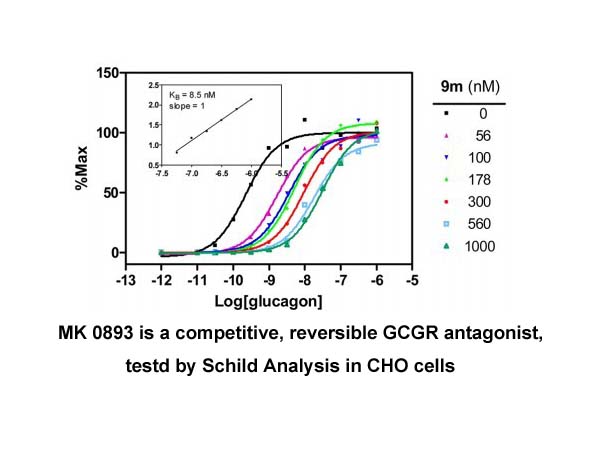
In CHO cells expressing the hGCGR, MK 0893 dose dependently rightshifts the EC50 of glucagon without changing the maximum effect of glucagon. MK 0893 inhibits cAMP production. |
| Animal experiment [1]: | |
|
Animal models |
hGCGR ob/ob mice. |
|
Dosage form |
3, 10, and 30 mpk;1 h; administrated orally. |
|
Applications |
MK 0893 reduces glucose elevation stimulated by glucagon (15 μg/kg) by 30%, 56%, and 81% at 3, 10, and 30 mpk, respectively. |
|
Other notes |
Please test the solubility of all compounds indoor, and the actual solubility may slightly differ with the theoretical value. This is caused by an experimental system error and it is normal. |
|
References: [1]. Xiong Y, Guo J, Candelore MR, et al. Discovery of a novel glucagon receptor antagonist N-[(4-{(1S)-1-[3-(3, 5-dichlorophenyl)-5-(6-methoxynaphthalen-2-yl)-1H-pyrazol-1-yl]ethyl}phenyl)carbonyl]-β-alanine (MK-0893) for the treatment of type II diabetes. J Med Chem, 2012, 55(13): 6137-6148. |
|
Quality Control & MSDS
- View current batch:
Chemical structure
Related Biological Data